Every business owner eventually hits the same wall. You know your customers are scrolling Instagram at 7 a.m., watching Reels over chai, and asking AI assistants which brand to trust — but turning that attention into actual sales feels like guesswork. That gap is exactly what social media marketing services are built to close.
This guide is written for Indian founders, marketers, and small-business owners who are tired of vague “starting at ₹5,000” promises and want to understand what they’re really paying for in 2026. We’ll cover what these services actually include, how the platforms have changed this year, honest pricing, the compliance rules that can land you in trouble, and a practical framework for choosing a partner who delivers results instead of screenshots of follower counts.
No fluff, no jargon for its own sake — just a clear-eyed look at how social media marketing works today, and how to make it work for you.
What Exactly Are Social Media Marketing Services?
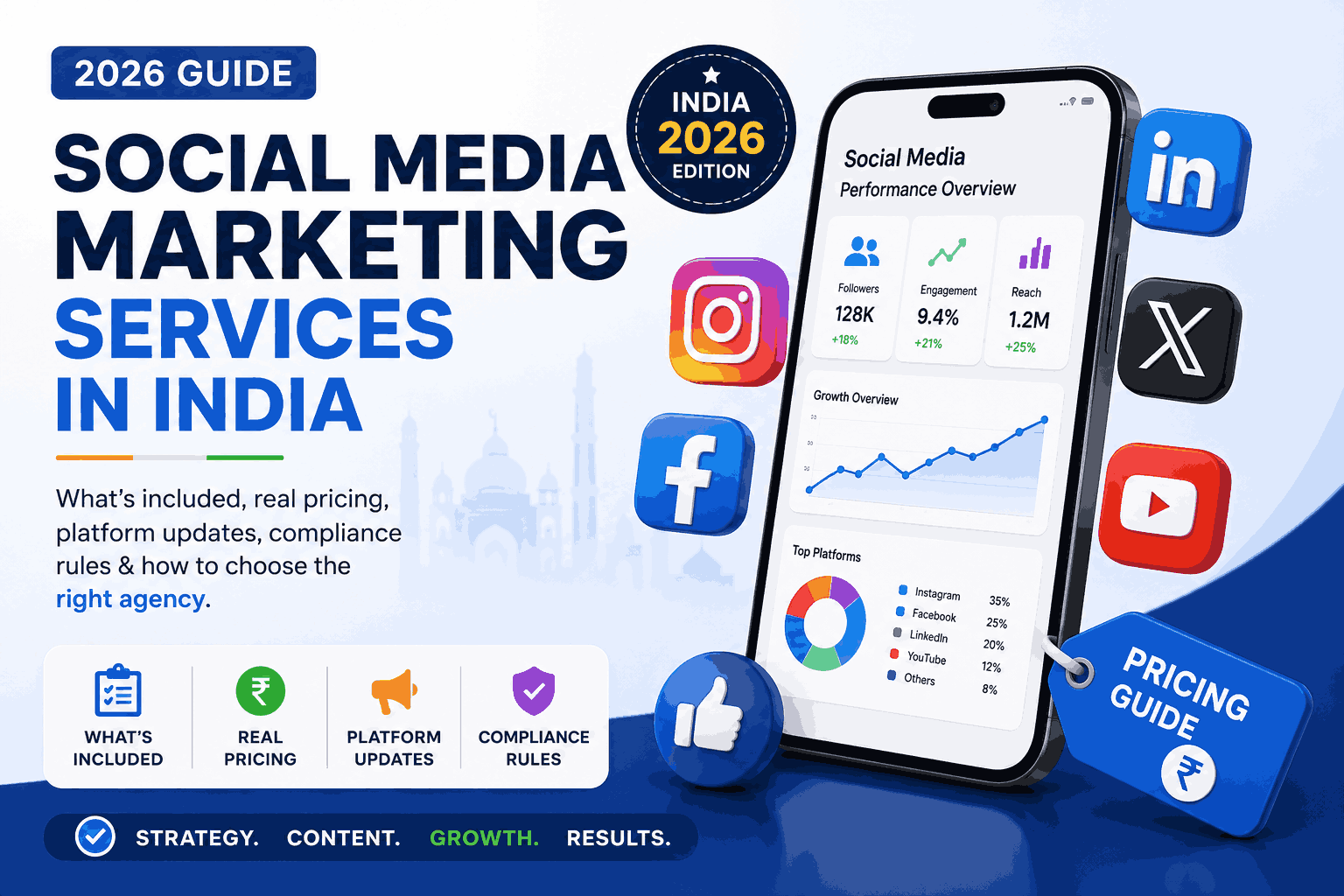
Social media marketing services are the strategy, content, advertising, and community work that a specialist or agency handles to grow a brand on platforms like Instagram, YouTube, Facebook, LinkedIn, and X. At a basic level, someone is creating posts and replying to comments on your behalf. At a serious level, a team is researching your audience, building a content system, running paid campaigns, tracking what converts, and steadily turning followers into customers.
The phrase covers a huge range, and that’s precisely why pricing feels so confusing. A ₹8,000 plan and a ₹80,000 plan are not the same service at different prices — they’re different jobs entirely. One keeps your page from looking abandoned. The other is engineered to drive measurable business growth.
The core building blocks of a modern SMM service
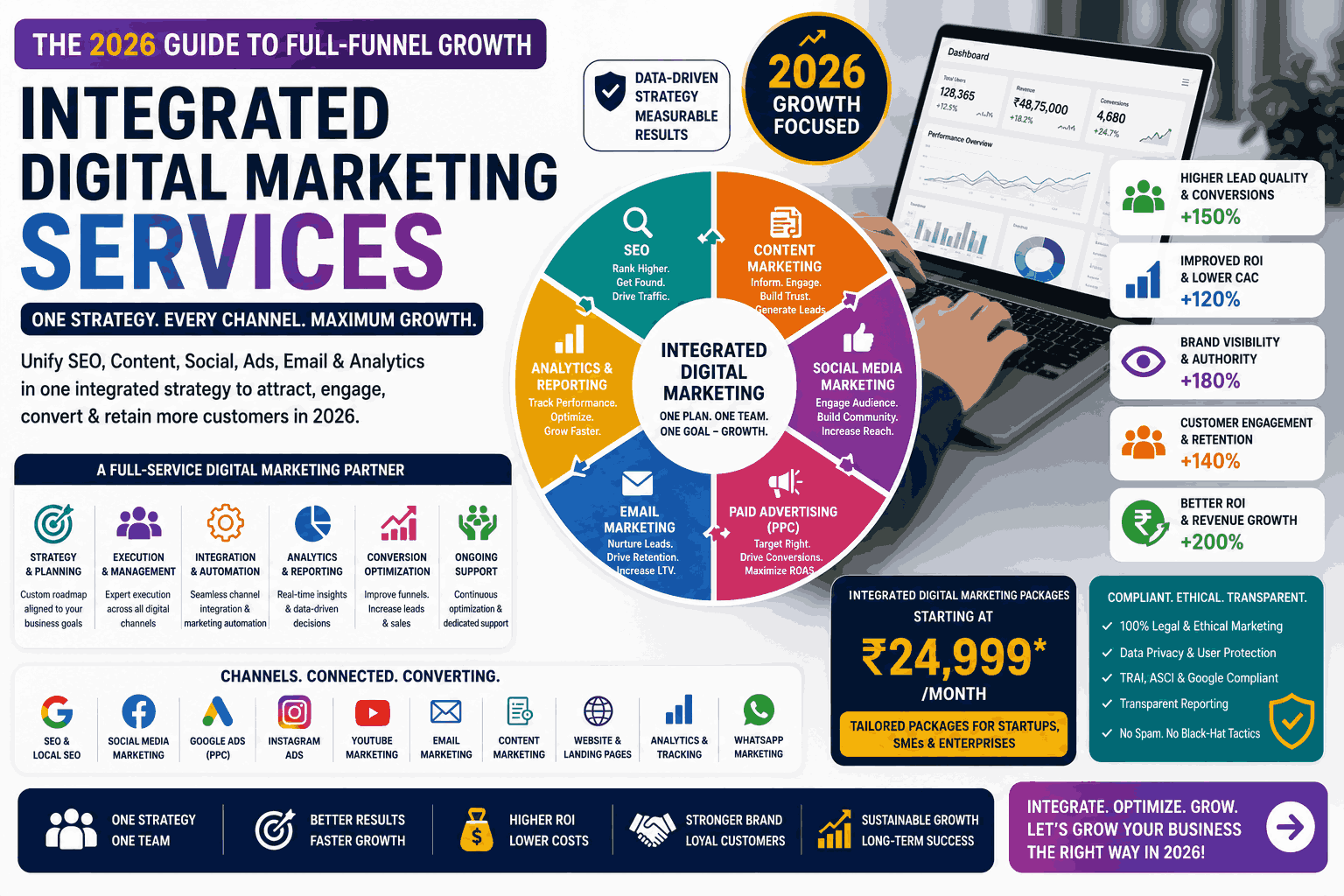
Most professional social media marketing services are assembled from these components:
- Strategy and audience research — defining who you’re talking to, what they care about, and where they actually spend time.
- Content creation — graphics, captions, short-form video (Reels, Shorts), carousels, and increasingly long-form video.
- Publishing and scheduling — consistent posting across platforms at the times that work.
- Community management — replying to comments, DMs, and reviews; this is where trust is genuinely built.
- Paid social advertising — running and optimising campaigns on Meta, YouTube, LinkedIn, and beyond.
- Analytics and reporting — tracking reach, engagement, leads, and return on ad spend (ROAS), then adjusting.
- Influencer and creator collaborations — partnering with voices your audience already trusts.
A genuinely good service connects these so they reinforce one another. Content feeds ads, ads generate data, data sharpens strategy, and community management keeps the whole thing human.
Why Social Media Marketing Services Matter More in 2026
Two shifts have made professional help close to essential this year.
First, social platforms have become search engines. Younger Indian audiences increasingly open Instagram, YouTube, or TikTok before they open Google when researching a product or brand. Discovery now happens inside the scroll, which means your content has to be findable there — a discipline marketers now call social SEO and answer engine optimisation (AEO). Getting found is no longer only about your website ranking; it’s about whether your Reels, captions, and on-screen text answer the questions people are typing into the search bars inside apps.
Second, there’s the AI-and-authenticity paradox. Marketers have adopted AI tools at a staggering pace — usage is up well over 100% year on year for ideation, copy, and optimisation. At the same time, audiences have grown allergic to content that feels synthetic or over-produced, and a meaningful share of consumers now say they’re *less* likely to buy from a brand whose ads obviously look AI-generated. The winning move in 2026 isn’t choosing between automation and authenticity. It’s using AI to move faster behind the scenes while keeping the visible output genuinely human — real faces, real stories, lo-fi video, honest captions.
This is exactly the balance that good social media marketing services are built to strike, and it’s hard to pull off solo while also running a business.
The Platforms That Matter for Indian Businesses (and What Changed in 2026)
You don’t need to be everywhere. You need to be where your buyers are, in the formats those platforms currently reward. Here’s how the major platforms stack up for Indian brands right now.
| Platform | Best For | Strongest Format in 2026 | Typical Audience |
|---|---|---|---|
| B2C, D2C, local services, lifestyle | Reels, carousels, Stories | Broad; strong 18–40 | |
| YouTube | Education, high-consideration buys, trust | Shorts + long-form video | Massive reach across ages |
| Local business, 30–55, click-to-WhatsApp | Reels, Groups, lead ads | Older, family, Tier 2/3 | |
| B2B, SaaS, services, recruiting | Native video, thought leadership | Professionals; younger skew rising | |
| X / Threads | Real-time, news, sports, tech | Text + short video | Tech-savvy, urban |
| Direct sales, support, retention | Broadcast, click-to-WhatsApp ads | Near-universal in India |
Platform changes worth knowing this year
A few 2026 updates have genuinely changed how content should be made:
- Instagram Reels can now run up to 20 minutes, blurring the old line between short and long form. Brands can tell deeper stories without leaving the format the algorithm favours.
- YouTube Shorts now allow up to three minutes, and YouTube has cemented itself as one of the highest-impact channels for marketers — many marketing leaders say it drives the most business impact of any platform.
- LinkedIn is having a creative moment. Its audience is getting younger, and new video features make it far more than a résumé site. For B2B brands, it’s arguably the best organic opportunity of the year.
- Substack and Bluesky have matured into real social platforms, not just newsletter or microblog tools, giving brands new ways to build owned, direct audience relationships.
- Threads is on track to overtake X in monthly active users and has become a key real-time platform, especially around sports and live events.
- Native-first tools are winning. Platforms increasingly reward content created and published inside their own apps — native editing, scheduling, analytics, and shopping — and roll new features out to native tools first.
- AI-only feeds have arrived. Platforms such as Meta’s Vibes and OpenAI’s Sora are gaining traction, but consumer trust in fully AI-generated content remains shaky — which is exactly why human-led storytelling still wins.
A capable social media marketing service keeps up with these shifts so you don’t have to track every algorithm tweak yourself.
What’s Actually Included in Professional Social Media Marketing Services
Here’s a clearer breakdown of what each component should deliver, so you can read any agency proposal with confidence.
| Service Component | What It Should Deliver | Why It Matters |
|---|---|---|
| Strategy & research | Buyer personas, platform plan, content pillars, competitor analysis | Stops you posting into the void |
| Content creation | Monthly calendar, graphics, Reels/Shorts, carousels, copywriting | The actual fuel for growth |
| Community management | Comment/DM responses, review handling, defined response times | Where trust and sales conversations happen |
| Paid advertising | Campaign setup, targeting, A/B testing, budget management | Organic reach alone is limited in 2026 |
| Analytics & reporting | Monthly reports on reach, engagement, leads, CPL, ROAS | Separates real progress from vanity |
| Influencer / UGC | Creator sourcing, briefs, ASCI-compliant disclosures | Borrowed trust converts better than ads |
Organic vs paid — you need both
Organic social builds trust, community, and long-term brand equity. Paid social buys reach, speed, and predictable lead flow. In 2026, relying on organic alone leaves most brands close to invisible to new audiences, because unpaid reach on the major platforms keeps shrinking. The smart approach is a blend: organic content earns credibility, and paid campaigns put your best-performing content in front of the right people quickly.
How Much Do Social Media Marketing Services Cost in India in 2026?
This is where most business owners get burned, so let’s be direct. Across the Indian market in 2026, professionally managed social media marketing services typically range from around ₹15,000 to ₹4,00,000+ per month, depending on platforms, content volume, whether paid ads are involved, and how much strategy sits behind the work. Here’s a realistic tier breakdown.
| Tier | Monthly Fee | What You Get | Best For |
|---|---|---|---|
| Basic | ₹15,000–40,000 | Regular posting, basic graphics, light engagement, 1–2 platforms | Startups, personal brands, local businesses |
| Growth | ₹40,000–90,000 | Strategy, original content, Reels, community management, tracking | SMEs with real growth targets |
| Advanced | ₹90,000–1,80,000 | Organic + paid campaigns, A/B testing, deeper analytics, multi-platform | Established brands scaling acquisition |
| Enterprise | ₹4,00,000+ | Full-funnel campaigns, influencer programmes, event coverage, senior strategist | Large brands, competitive categories |
The biggest source of confusion — management fees vs ad spend
If you remember one thing from this guide, make it this: your agency fee and your ad budget are two completely different things.
Your management fee pays the humans who plan, create, post, engage, and report — that’s labour. Your ad spend goes directly to Meta, Google, or LinkedIn to actually show your ads — that’s media buying. Any quote that bundles both into a single “all-inclusive” number without separating them is hiding something. Insist on seeing both lines clearly. This is the number-one cause of disappointment in Indian SMM engagements: a business owner assumes their ₹20,000 package includes ad spend, then discovers the ads need a separate budget on top.
Don’t forget GST and the real out-of-pocket cost
Indian agencies charge 18% GST on their service fees, and ad spend billed through an Indian account also attracts 18% GST. So a plan that looks like ₹30,000 of management plus ₹15,000 of ads actually costs roughly ₹35,400 (fee + GST) plus ₹17,700 (ad spend + GST) — about ₹53,100 out of pocket per month. Budget for the tax, not just the sticker price.
Platform-wise ad benchmarks for 2026
To set expectations for the ad-spend side, here are rough Indian benchmarks reported across the market this year:
| Platform | Typical CPC | Typical CPM | Notes |
|---|---|---|---|
| Instagram / Facebook | ₹3–₹30 | ₹40–₹450 | Most cost-effective reach; best for B2C/D2C |
| ₹25–₹80 | Premium | Higher cost, but far better B2B lead quality | |
| YouTube | Low per view | Low CPM | Strong for awareness + consideration at scale |
A practical rule on Meta: start at a minimum of around ₹300 per day per campaign so the algorithm has enough data to exit its learning phase. Spend below that and you’re often paying for almost nothing.
In-House vs Freelancer vs Agency — Which Model Fits You?
There’s no universally right answer; there’s a right answer for your stage and budget.
| Model | Typical Monthly Cost | Strengths | Trade-offs |
|---|---|---|---|
| Freelancer | ₹8,000–30,000 | Affordable, flexible, personal attention | No team backup, limited design/video, capacity caps |
| Agency | ₹25,000–2,00,000+ | Full skill set, strategy + execution + ads, consistency | Higher cost; you’re one of several clients |
| In-house team | ₹93,000–1,95,000+ | Full control, deep brand knowledge | Salaries, tools, hiring, attrition, management load |
A useful insight many founders miss: a mid-tier agency at, say, ₹75,000/month often works out cheaper than building an in-house team once you add salaries, software, training, and the opportunity cost of managing people. For most small and mid-sized Indian businesses, an agency or a strong freelancer is the practical starting point; an in-house team usually only makes sense once monthly marketing spend is already well into six figures.
The Honest Advantages and Disadvantages
Every guide lists the upsides. Fewer are honest about the trade-offs. Here’s both.
Advantages
- Expertise on tap — strategists, designers, video editors, and ad specialists without hiring each one.
- Consistency — content keeps shipping even when you’re buried in running the business.
- Speed and reach — paid campaigns can put you in front of thousands of qualified people quickly.
- Measurable outcomes — done right, you track leads, cost per lead, and ROAS, not just likes.
- Cost efficiency vs in-house — often cheaper than a full salaried team once you do the maths.
- Trend awareness — a good partner tracks algorithm and platform changes so you don’t have to.
Disadvantages
- It’s a long game — meaningful results usually take three to six months, sometimes longer. Anyone promising overnight ROI is selling a fantasy.
- Ad spend is extra — the management fee is rarely the whole bill.
- Quality varies wildly — the gap between a ₹10,000 “post mill” and a strategic partner is enormous.
- Less direct control — an external team won’t know your business as intimately as you do, at least at first.
- No legitimate guarantees — credible providers won’t promise specific follower or sales numbers.
- Dependency risk — if everything lives with one agency, transitions hurt without proper documentation and account ownership.
Security, Compliance, and Trust — The Rules Indian Brands Can’t Ignore
This is the part most “social media marketing services” pages skip entirely, and it’s exactly where real-world risk and trust live. If you’re spending money on social in India in 2026, you and your agency are operating inside a genuine regulatory framework.
ASCI influencer disclosure rules — now with real teeth
The Advertising Standards Council of India (ASCI) requires that any “material connection” between a brand and an influencer be disclosed clearly and upfront. A material connection isn’t just cash — it includes free products, gifts, discounts, trips, or any employment or family relationship. Disclosures must be prominent and hard to miss, using labels like #Ad, #Sponsored, or #PaidPartnership, not buried in a cluster of hashtags or hidden behind a “more” button.
What’s changed: these guidelines now carry serious weight because the Central Consumer Protection Authority (CCPA) can treat non-disclosure as an unfair trade practice, meaning government penalties on top of ASCI action. The 2026 update also adds rules for AI and virtual influencers — brands must disclose both that the character isn’t a real person and that the content is paid, with the brand bearing primary responsibility. And for finance or health content, finfluencers are expected to display relevant credentials such as a SEBI registration number or recognised certification. The takeaway for your business is simple: every paid or gifted collaboration needs a clear disclosure, and your agency should build that into every brief.
Data protection under the DPDP Act, 2023
If your social campaigns collect personal data — lead-form details, email lists, click-to-WhatsApp contacts, or analytics tied to individuals — you’re handling personal data under India’s Digital Personal Data Protection Act, 2023 (DPDPA). That brings obligations around consent, purpose limitation, secure storage, and responsible processing. A trustworthy agency treats lead data carefully, documents how it’s collected and used, and avoids sloppy practices that could expose you to liability. Ask any prospective partner exactly how they handle and store the data your campaigns generate.
Account security and access management
Trust isn’t only about regulators; it’s about who holds the keys to your accounts. Insist on a few non-negotiables:
- You own the accounts. Business pages, ad accounts, and analytics should sit under your business, with the agency given access — never the reverse.
- Two-factor authentication on every account, with access managed through Meta Business Suite or equivalent rather than shared passwords.
- Clear off-boarding. If you ever part ways, you should keep full ownership and access without a fight.
These small protections prevent the all-too-common nightmare of a brand losing its own audience because an agency held the logins.
How to Choose a Social Media Marketing Agency Without Getting Burned
Use this as a filter when evaluating providers.
Green flags
- They ask about your business goals and margins before quoting.
- They separate management fees from ad spend transparently.
- They show case studies with business metrics (leads, CPL, ROAS), not just follower screenshots.
- They mention ASCI disclosures and data handling without being prompted.
- They set realistic timelines and don’t promise viral guarantees.
Red flags
- “All-inclusive” pricing that quietly hides the ad budget.
- Guarantees of specific follower counts or overnight sales.
- No clear reporting cadence, or a refusal to share metrics.
- They want to own your accounts.
- Pricing so low (₹3,000–5,000/month) that real strategy is impossible.
Questions worth asking before you sign
- Exactly how many posts, Reels, and stories per platform per month?
- What’s your response time for comments and DMs?
- Is ad spend separate, and what minimum do you recommend?
- Who owns the accounts and the content?
- How, and how often, do you report results?
- How do you keep us ASCI- and DPDPA-compliant?
Measuring ROI — The Metrics That Actually Matter
Followers and likes feel good but rarely pay the bills. Focus your attention here instead:
- Reach and impressions — how many people you’re actually getting in front of.
- Engagement rate — whether your content resonates, not just how many saw it.
- Click-through rate (CTR) — how many people act on it.
- Leads and enquiries — DMs, form fills, click-to-WhatsApp conversations.
- Cost per lead (CPL) — the number that tells you whether paid is working.
- Return on ad spend (ROAS) — revenue generated for every rupee of ad spend.
And set realistic expectations on timing. Social media marketing compounds; it doesn’t switch on.
| Timeframe | What to Expect |
|---|---|
| Month 1–3 | Foundations: audience growth, engagement improvement, brand awareness. Don’t expect direct sales yet. |
| Month 4–6 | Content starts clicking; enquiries arrive via DMs and comments; paid ads begin showing positive ROAS. |
| Month 7–12+ | Compounding kicks in; consistent lead flow and stronger brand equity for those who stayed the course. |
The brands winning on social in 2026 are usually the ones that stayed consistent for twelve months while competitors quit after three.
Expert Insights — What Actually Works in 2026
A few hard-won principles, distilled from how the best teams are operating this year:
- Authenticity outperforms polish. Mobile-shot, lightly edited, human content consistently beats glossy ad-style creative — and Indian audiences in particular now trust real over perfect. User-generated and creator-led content can outperform traditional brand creative by a wide margin.
- Community management is back. The fastest-growing brands treat comments, DMs, and micro-communities as a priority, not an afterthought. Engagement now influences reach as much as the content itself.
- Short-form and long-form both matter. Short video drives discovery; longer video drives conversion when buyers want depth. With Reels at 20 minutes and Shorts at three, you can do both inside the formats algorithms favour.
- Speed is a strategy. With creative cycles compressing, teams that ship and learn quickly beat teams stuck in month-long approval loops.
- Optimise for social search and AI answers. Write captions, hooks, and on-screen text the way people actually search — because increasingly, they’re searching inside the apps, and AI assistants summarise brands from that same content.
- Use AI as an accelerator, not the face. Let it speed up ideation and drafts; keep humans in charge of voice, taste, and judgement.
FAQs about Social Media Marketing Services
Social media marketing services are the strategy, content creation, paid advertising, community management, and reporting that a specialist or agency handles to grow your brand on platforms like Instagram, YouTube, Facebook, and LinkedIn. Basic plans focus on regular posting, while advanced services combine organic content with paid campaigns built to generate leads and sales.
In 2026, professionally managed social media marketing services in India typically cost between roughly ₹15,000 and ₹4,00,000+ per month. Basic posting plans start around ₹15,000–40,000, growth plans run ₹40,000–90,000, and advanced organic-plus-paid packages range from ₹90,000 to ₹1,80,000 or more, depending on platforms, content volume, and strategy.
Usually not. Your management fee pays the team that plans, creates, and manages content, while ad spend goes directly to platforms like Meta or Google to run your ads. These are two separate costs. Always ask an agency to show management fees and recommended ad budget as separate line items, and remember that 18% GST applies to both in India.
It depends on your audience. Instagram leads for B2C, D2C, and local brands through Reels and Stories. YouTube is powerful for education and high-consideration products. LinkedIn is best for B2B and SaaS. Facebook still works well for the 30–55 audience and click-to-WhatsApp campaigns. Most brands benefit from focusing on two or three platforms rather than being everywhere.
Legitimate providers do not guarantee specific follower counts or sales. Genuine agencies focus on business outcomes like leads, cost per lead, and return on ad spend. Be cautious of anyone promising viral growth or fixed results overnight, as that is usually a red flag for low-quality or fake-engagement tactics.
Social media marketing compounds over time. The first three months are usually about building audience, trust, and brand awareness. Enquiries and positive ad performance often start appearing around months four to six, and consistent lead flow typically builds from month seven onward. Brands that stay consistent for a year usually outperform those that quit after three months.
Two frameworks matter most. ASCI guidelines require clear disclosure of any paid or material brand connection using labels like #Ad or #Sponsored, and the CCPA can treat non-disclosure as an unfair trade practice. The Digital Personal Data Protection Act, 2023 governs how you collect and store personal data such as leads and email lists. A trustworthy agency builds both into its process.
Freelancers (around ₹8,000–30,000/month) suit early-stage brands that need affordable, flexible help on one or two platforms. Agencies (₹25,000–2,00,000+/month) offer a full team, strategy, paid ads, and consistency, and often cost less than building an in-house team. Choose based on your stage, budget, and how central social media is to your growth.
AI can accelerate ideation, drafting, and optimisation, but it cannot replace human strategy, taste, and authentic storytelling. In fact, many consumers are now less likely to trust content that obviously looks AI-generated. The most effective approach in 2026 uses AI behind the scenes for speed while keeping the visible content genuinely human.
Final Verdict
Social media marketing services in 2026 are less about posting pretty pictures and more about building a system: the right platforms, genuinely human content, disciplined paid campaigns, honest measurement, and full compliance with India’s advertising and data rules. The market spans roughly ₹15,000 to ₹4,00,000+ a month, and the gap between a cheap “post mill” and a strategic partner is the difference between simply existing on social media and actually growing from it.
If social is a real growth channel for your business, don’t cheap out — but do go in with clear eyes. Demand transparent pricing that separates fees from ad spend, insist on account ownership and compliance, judge proposals on business metrics rather than vanity numbers, and give the work the six-to-twelve months it genuinely needs to compound. Do that, and social media marketing stops being a cost you tolerate and becomes one of the most efficient growth engines available to an Indian business today.