Picture a shopper standing in your category. A few years ago they’d have walked to the nearest store. Today they pull out a phone — searching “[your product] shop near me,” reading your Google reviews, comparing on Instagram, or simply asking a quick-commerce app to deliver it in ten minutes. For a physical retail store, that single shift is both the threat and the opportunity, and it’s exactly why digital marketing services for retail stores have become essential rather than optional.
Here’s the honest reality of 2026: you can’t out-speed a dark store doing 10-minute delivery, and you don’t need to. Physical retail still drives the vast majority of sales, and stores hold advantages an app never will — touch and feel, instant takeaway, expert help, experience, and trust. The winning move is to use digital marketing to amplify those strengths: get found locally, bring shoppers in, sell online where it makes sense, and own the customer relationship so they keep coming back.
This guide is written for Indian retailers — from a single-store boutique or kirana to a growing multi-outlet brand — who want a clear, practical picture of what works now, how to respond to quick commerce, honest pricing, the rules that matter, and how to choose a partner who grows footfall and sales rather than just posting nice photos.
What Are Digital Marketing Services for Retail Stores?
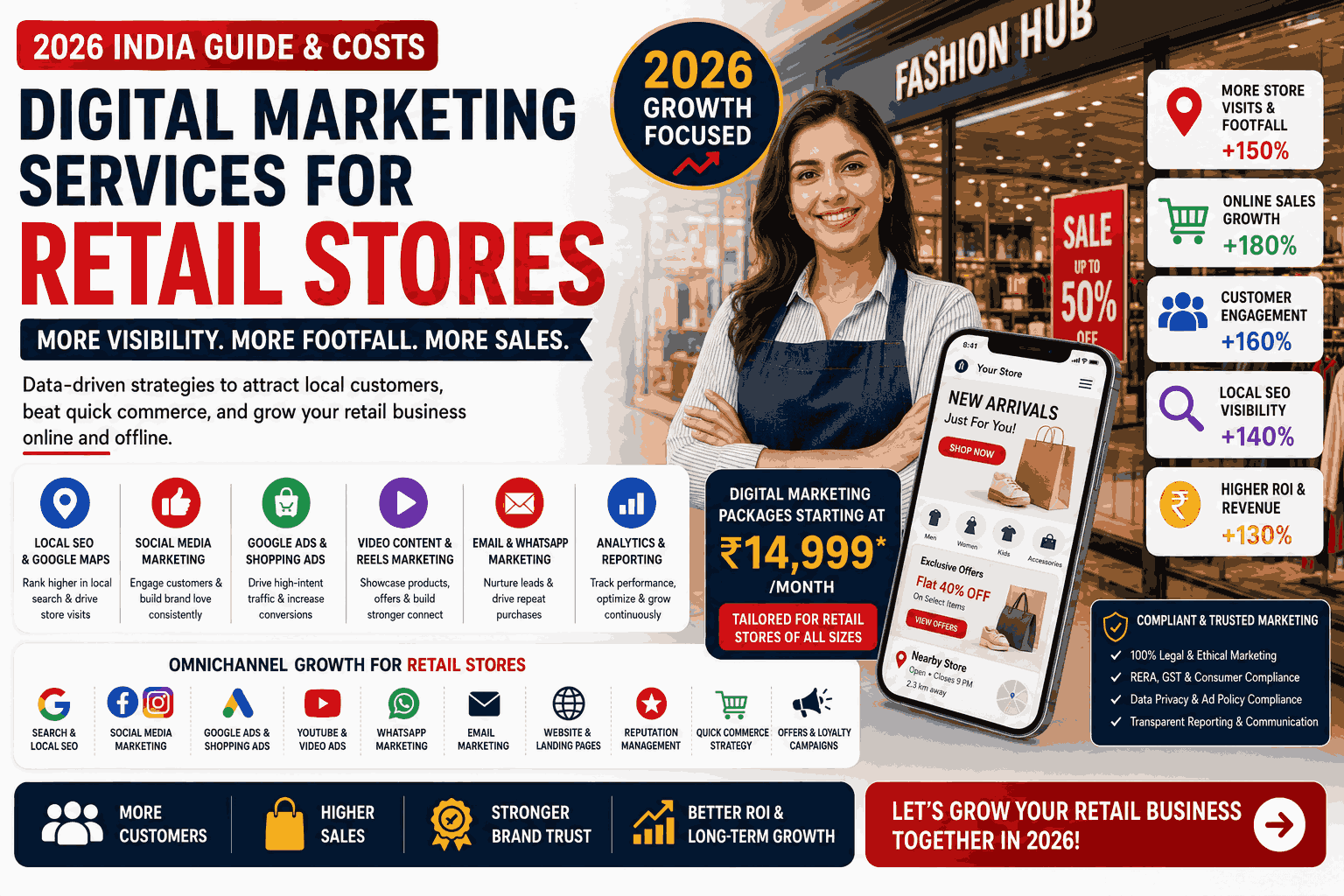
Digital marketing services for retail stores cover everything that helps a physical or omnichannel store get discovered online, convert that attention into footfall and orders, and turn one-time buyers into loyal regulars. It’s a broad umbrella, and the pieces work best as a connected system rather than scattered, one-off efforts.
The core components
A serious retail marketing programme usually combines:
- Local SEO and Google Business Profile — showing up for “[product] shop near me” and on Google Maps.
- Social media and short-form video — Reels and shoppable content that drive discovery and desire.
- Reviews and reputation management — earning and responding to reviews that build trust.
- WhatsApp and conversational commerce — catalogues, enquiries, and commission-free repeat orders.
- Paid advertising — Meta and Google campaigns to reach nearby shoppers quickly.
- Marketplace and ONDC presence — lower-commission online reach beyond your four walls.
- Omnichannel and BOPIS — buy-online-pickup-in-store and unified inventory across channels.
- Loyalty and CRM — bringing past customers back with offers and personalisation.
Why Retail Stores Can’t Ignore Digital Marketing in 2026
Shopper behaviour has changed for good. Most people research online before walking into a store, and roughly three in four move across several channels — phone, social, and shop — before they buy. Physical stores still generate the large majority of retail sales worldwide, but increasingly only the stores that are easy to find and trust online capture that demand.
The payoff for getting it right is real. Omnichannel retailers retain far more customers than single-channel ones and earn meaningfully higher lifetime value, and shoppers who engage across several channels tend to spend more in store, not less. Meanwhile discovery keeps moving — a majority of younger shoppers now buy directly inside apps like Instagram, and many start product research by asking an AI assistant rather than typing a keyword.
And then there’s the elephant in the aisle: quick commerce. Apps that deliver in minutes have steadily eaten into traditional retail, with the kirana share of grocery sliding from around 95% in 2018 toward an estimated 89% by 2028. That pressure is exactly why a smart digital strategy — one that plays to a store’s strengths — has shifted from nice-to-have to survival skill.
What’s Included in Professional Digital Marketing Services for Retail Stores
Here’s a clear breakdown of what a strong provider should deliver, so you can read any proposal with confidence.
| Service | What It Covers | Why It Matters |
|---|---|---|
| Local SEO & Google Profile | Profile optimisation, accurate details, photos, local keywords | Wins “near me” discovery — highest ROI |
| Social media & video | Content calendar, Reels, shoppable posts, community | Where shoppers discover and judge you |
| Reviews & reputation | Review generation, monitoring, professional responses | Builds trust and lifts local ranking |
| WhatsApp commerce | Catalogues, broadcasts, enquiries, repeat orders | Commission-free repeat business |
| Paid advertising | Meta and Google campaigns targeting nearby shoppers | Fast footfall and online orders |
| Marketplace & ONDC | Listings, content, and low-commission online reach | Sales beyond your physical location |
| Omnichannel & BOPIS | Unified inventory, buy-online-pickup-in-store | Convenience that drives extra purchases |
| Loyalty & CRM | Offers, win-backs, segmentation, festive campaigns | Higher repeat rate and lifetime value |
The Big 2026 Shifts Every Retailer Should Know
If you skim one section, make it this one. These shifts are reshaping how Indian retail stores market themselves this year.
1. The quick-commerce squeeze
Quick commerce — Blinkit, Zepto, Swiggy Instamart, and now Amazon Now, which is targeting a large dark-store network by the end of 2026 — has turned minutes-fast delivery into an everyday habit, mostly in metros for now. Stores can’t beat that on speed, but they can win on what apps lack: the ability to see and touch products, instant takeaway, knowledgeable staff, and a real experience. Digital marketing’s job is to make those advantages visible and easy to act on.
2. ONDC — the lower-cost path online
The Open Network for Digital Commerce has matured into a genuine alternative, with over a lakh sellers live across 600-plus cities and hundreds of millions of cumulative orders. It typically charges far lower commissions than the big platforms, gives retailers access to their own customer data, and lets stms list across multiple buyer apps. For a store that wants online reach without surrendering margin and data, ONDC is one of the most important developments of the year.
3. WhatsApp and conversational commerce
With more than 200 million WhatsApp Business users in India, the app has become a powerful retail channel — product catalogues, broadcast offers, order-taking, and quick replies that turn a chat into a sale. It’s especially effective for repeat business and for reaching tier-2 and tier-3 shoppers, and because orders taken on WhatsApp carry no marketplace commission, it directly protects margin.
4. Social and live commerce
Social platforms have become storefronts. Shoppable Instagram posts, YouTube product tagging, and live shopping let customers discover and buy without leaving the app, and live, local formats with real-time deals are lifting conversion noticeably. Short, authentic video — a product demo, a new arrival, a behind-the-counter clip — consistently outperforms polished ads for driving both online orders and store visits.
5. AI-led discovery and local search
More shoppers now begin with an instruction rather than a keyword — “find me a gift under ₹2,000” — and delegate the search to AI. To be recommended, a store needs accurate product information, transparent pricing, genuine reviews, and a complete Google Business Profile, plus geo-targeted ads and local inventory visibility so nearby shoppers see what’s in stock. Being the trustworthy, well-described option is what gets you surfaced, by both Google and AI assistants.
6. Omnichannel and BOPIS
Buy-online-pickup-in-store has become a genuine advantage for physical retailers: it blends online convenience with the immediacy of a shop, and a large share of pickup customers make an additional purchase while they’re there. Done well — with unified inventory so online stock matches the shelf — omnichannel turns your store into a fulfilment and loyalty hub, not just a point of sale.
The Economics: Footfall, Quick Commerce, and Owning Your Customer
Most retail marketing advice skips the money. Let’s not. The most important strategic decision you’ll make online is how much of your customer relationship you hand to platforms versus how much you own. Here’s how the main channels compare on cost and control.
| Channel | Cost to the Store | Customer Data & Control |
|---|---|---|
| Big marketplaces / q-commerce | High commissions + fees + funded discounts | Limited |
| ONDC | Low commission (often around 3–5%) | Full |
| Paid ads (Meta / Google) | Ad spend + management fee | You keep the customer you win |
| Owned channels (GBP, WhatsApp, CRM) | Low — mostly time and tools | Full — you own it |
Put it in plain terms. Every sale you push through a high-commission platform is margin you give away, and the customer effectively belongs to the platform, not you. The same shopper acquired through local search or a one-time ad — and then retained on WhatsApp, a loyalty programme, or ONDC — costs far less on the second, third, and tenth purchase, and stays your customer. In thin-margin retail, that difference compounds into the gap between surviving and thriving.
So the verdict isn’t to avoid platforms — they’re excellent for discovery and reaching new shoppers. It’s to treat platform commissions as a customer-acquisition cost you actively try to recover. Win the shopper wherever they are, then move repeat business to channels you control. Track the numbers that prove it’s working: cost to acquire a customer, average basket size, repeat-purchase rate, and customer lifetime value. When repeat customers come back through your own channels, your marketing pays for itself.
How Much Do Digital Marketing Services for Retail Stores Cost in India in 2026?
Let’s be direct. Pricing depends on how many channels you run, how much content you need, and whether paid ads are involved. Here are realistic 2026 ranges for the Indian market.
| Tier | Monthly Fee | What You Get | Best For |
|---|---|---|---|
| DIY + tools | ₹2,000–8,000 | Scheduling and design tools; you create content | Owner-run stores testing the waters |
| Starter | ₹15,000–30,000 | Google Profile, 1–2 social platforms, light content, reporting | Single-location stores |
| Growth | ₹30,000–70,000 | Local SEO, regular content, reviews, ads, WhatsApp | Stores chasing real growth |
| Full omnichannel | ₹70,000–2,00,000+ | All channels, paid media, ONDC, pro content, analytics | Multi-outlet and scaling brands |
Two costs are almost always separate from the management fee: paid ad spend, and professional content production (photography and video). Both are worth planning for deliberately, because good visuals and well-targeted ads do much of the heavy lifting in retail.
Management fee vs ad spend — and GST
Your management fee and your ad spend are two different things. The fee pays the people who plan, create, post, and report; the ad spend goes directly to Meta or Google to actually show your ads. A quote that bundles both into one “all-inclusive” number is hiding something. As a rule of thumb on Meta, budget at least ₹300 per day per campaign so the algorithm has enough data to optimise, and remember that 18% GST applies to Indian agency fees — a ₹30,000 retainer really costs ₹35,400.
A simple budgeting rule
Don’t guess. Many growing retailers allocate roughly 5–12% of revenue to marketing, weighted toward customer acquisition, retention, and a few experiments. Crucially, plan around the festive calendar: Diwali and the big sale events are when Indian shoppers spend most and competition peaks, so concentrate budget there rather than spreading it thinly all year. Spending too little to sustain consistent content and a managed profile tends to produce little — at the bottom end, doing authentic content yourself often beats half-hearted paid execution.
Where Should a Retail Store Invest? SEO vs Paid vs Social & WhatsApp
These channels are complementary, not competing. Here’s how they compare for a retail store.
| Factor | Local SEO + GBP | Paid Ads | Social / Live + WhatsApp |
|---|---|---|---|
| Speed to results | 2–3 months | Days | Days to weeks |
| Cost model | Monthly retainer | Ad spend + management | Content + light spend |
| Longevity | Compounds; durable | Stops when budget stops | Builds audience & loyalty |
| Best for | “Near me” discovery, footfall | Fast reach, festive pushes | Desire, engagement, repeat orders |
| Owns the customer? | Yes (your profile/site) | Yes (once acquired) | Yes (followers, WhatsApp list) |
The verdict: build the foundation first — a complete Google Business Profile and local SEO — because that’s where most nearby shoppers discover you and it’s durable. Add social and short video to create desire, use WhatsApp to capture and retain customers commission-free, and switch on paid ads to accelerate during festive peaks or new launches. For online reach beyond your store, layer in ONDC. No single channel wins alone; the mix is what fills the store and keeps people coming back.
Advantages and Disadvantages of Digital Marketing Services for Retail Stores
Every agency lists the upsides. Here’s an honest look at both sides.
Advantages
- Local, high-intent reach — you meet shoppers exactly when they’re looking to buy nearby.
- Measurable results — footfall, orders, basket size, and repeat rate, not just likes.
- Margin protection — owned channels and ONDC win back commission lost to big platforms.
- A real edge over apps — digital amplifies touch, experience, and expert help that delivery can’t offer.
- Compounding loyalty — reviews, content, and CRM build a base that keeps paying off.
- Affordable to start — a strong profile and authentic content cost very little.
Disadvantages
- It rewards consistency — sporadic posting does little; results come from showing up regularly.
- Ad spend and content are extra — the management fee is rarely the whole bill.
- Quality varies enormously — a cheap “post mill” and a strategic partner are worlds apart.
- Platform dependence is a trap — relying only on marketplaces erodes margin and customer ownership.
- Omnichannel adds complexity — BOPIS and unified inventory need accurate stock and coordination.
- No legitimate guarantees — credible providers don’t promise viral sales or fixed numbers.
Security, Compliance, and Trust in Retail Marketing
Trust is what turns a browser into a buyer, and a few real rules sit behind it. Getting these right protects your customers and your brand.
Honest advertising and influencer disclosure
Marketing must be truthful under the Advertising Standards Council of India (ASCI) code, and any paid or gifted influencer collaboration must be disclosed clearly with labels like #Ad. Misleading claims — exaggerated discounts, “lowest price” assertions without basis, or fake scarcity — can be challenged and damage trust. Keep offers genuine and verifiable.
Dark patterns are now regulated
India’s 2023 guidelines for the prevention of dark patterns specifically prohibit manipulative online tactics — false urgency, basket sneaking (adding items the shopper didn’t choose), drip pricing (hiding charges until checkout), bait-and-switch, forced action, and similar tricks. For retailers running promotions and online checkouts, this matters: design honest, transparent journeys, show the full price upfront, and never manufacture fake countdowns or stock scares.
Fake reviews are barred
Under India’s standard for online consumer reviews, fake or paid reviews are prohibited, and platforms actively police them. Don’t buy reviews or post them yourself. Earn genuine ones by asking happy customers at the right moment, and respond professionally to criticism — a calm, helpful public reply often wins a customer back and reassures everyone else reading.
Customer data and the DPDP Act
Loyalty programmes, WhatsApp lists, and CRM data are personal data under India’s Digital Personal Data Protection Act, 2023. Collect it with clear consent, use it only for what customers agreed to, store it securely, and make opting out easy. Handled responsibly, your customer database becomes your most valuable, commission-free marketing asset.
Product claims, pricing, and selling online
Product and price claims must follow Legal Metrology rules on MRP and mandatory declarations, so listings and ads should show accurate prices, quantities, and details. If you sell online, India’s e-commerce rules require clear seller information, accurate descriptions, and a working grievance-redress process. And as always, your website, Google Business Profile, social accounts, and customer data should belong to your business — with any agency given access, never the reverse.
How to Choose a Retail Marketing Agency
Use this as a filter when evaluating providers.
Green flags
- They ask about your footfall, basket size, and margins before quoting.
- They focus on owning the customer and reducing platform dependence, not just posting.
- They separate management fees, ad spend, and content costs transparently.
- They report in retail terms — footfall, orders, repeat rate — with real tracking.
- They mention ASCI, dark-pattern rules, and data handling without being asked.
Red flags
- “Guaranteed viral” or fixed sales/follower promises.
- “All-inclusive” pricing that hides ad spend and production costs.
- Buying reviews or followers, or using fake urgency and hidden charges.
- They want to own your Google Profile, accounts, or customer data.
- Pricing so low that real strategy and decent content are impossible.
Questions worth asking before you sign
- How will you help us capture and market to repeat customers directly?
- How many posts, Reels, and shoots per month, and is content extra?
- Is ad spend separate, and what do you recommend for our area and festive season?
- Who owns our Google Profile, website, and customer list?
- How do you generate reviews ethically and handle negative ones?
- Can you help us list and sell on ONDC and set up WhatsApp commerce?
Measuring ROI — Metrics That Actually Drive Retail Sales
Followers and impressions feel good but don’t ring the till. Track what ties to revenue, and judge each effort on its own timeline.
- Footfall and store visits — including visits traced from online (research-online, purchase-offline).
- Average basket / order value — are promotions lifting or eroding the bill?
- Repeat-purchase rate and customer lifetime value — loyalty is where retail margin lives.
- Direct & ONDC order share — sales that bypass high marketplace commissions.
- Google Business Profile actions — calls, direction requests, and website clicks.
- Review rating and volume — your most public, sales-moving trust metric.
| Timeframe | What to Expect |
|---|---|
| Week 1–4 | Paid ads, WhatsApp, and promos can drive footfall and orders; profile and listings cleaned up. |
| Month 2–3 | Local SEO and reviews lift discovery; repeat orders start shifting to your own channels. |
| Month 4–6+ | Social, loyalty, and omnichannel compound; steadier footfall and a healthier margin mix. |
Expert Insights — What Works for Retail Stores in 2026
A few hard-won principles from retailers winning this year:
- Win local discovery first. A complete, active Google Business Profile is the highest-ROI move most stores can make.
- Lean into what apps can’t do. Showcase touch-and-feel, expertise, and experience in your content and in store.
- Own the customer. Move repeat orders to WhatsApp, loyalty, and ONDC; your customer list beats any single campaign.
- Use authentic video. Real product demos and new arrivals outperform glossy ads across every channel.
- Plan around festivals. Concentrate budget on Diwali and big sale events, when Indian shoppers spend the most.
- Keep it honest. Skip fake urgency and hidden charges — clean, transparent journeys convert better and stay compliant.
- Be the trusted, well-described option. Good product data, transparent pricing, and genuine reviews get you recommended by Google and AI alike.
Frequently Asked Questions
Digital marketing services for retail stores are the strategy and execution that help a physical or omnichannel store get discovered online, drive footfall and online orders, and build customer loyalty. They include local SEO and Google Business Profile, social media and short-form video, reviews and reputation management, WhatsApp and conversational commerce, paid advertising, listing on networks like ONDC, omnichannel tools such as BOPIS, and loyalty or CRM — all working together to connect nearby shoppers with the store.
In 2026, basic retail marketing packages in India start around ₹15,000–30,000 per month for a Google Business Profile, one or two social platforms, and light content. Growth packages with local SEO, ads, and regular content run ₹30,000–70,000, while full omnichannel management ranges from ₹70,000 to ₹2,00,000+ per month. Paid ad spend and content production are usually separate, and 18% GST applies to Indian agency fees.
Physical stores can’t out-speed 10-minute delivery, so they compete on their real strengths: touch-and-feel products, expert help, instant takeaway, experience, and trust. Digitally, that means winning local ‘near me’ search with a strong Google Business Profile, taking repeat orders directly over WhatsApp, listing on ONDC for low-commission online reach, and building loyalty so customers come back. The goal is to use digital to amplify what a store does that an app cannot.
For most Indian retail stores, the priority is Google Business Profile and local SEO first, since shoppers search ‘[product] shop near me.’ Instagram and short video drive discovery, WhatsApp is powerful for orders and repeat business, and reviews build trust. Paid ads on Meta and Google help reach nearby shoppers quickly, and ONDC offers lower-commission online sales. The best mix depends on what you sell and who your customers are.
Yes. Most shoppers now research online before visiting a store, and omnichannel retailers retain far more customers than single-channel ones. Even a modest, well-run setup — an optimised Google Business Profile, genuine reviews, a WhatsApp ordering option, and a little local advertising — can lift footfall and repeat sales. Because the basics are affordable, the return for a small store is often high.
It is critical. Google Business Profile powers the map results that appear for almost every ‘near me’ search and shows your hours, photos, products, and reviews. For a physical store it is usually the single highest-ROI digital asset — a complete, active profile with fresh photos, correct details, and prompt review responses directly influences how many nearby shoppers find and choose you, and it increasingly feeds AI-generated recommendations.
ONDC (Open Network for Digital Commerce) is a government-backed network that lets retailers sell online across multiple apps without depending on a single marketplace. It typically charges far lower commissions than big platforms, gives retailers access to customer data, and has grown to over a lakh sellers across 600+ cities. For a store, ONDC is a lower-cost way to reach online shoppers while keeping more control and margin.
It varies by channel. Paid ads, festive promotions, and WhatsApp campaigns can drive footfall and orders within days. Local SEO, Google Business Profile improvements, and reviews usually show meaningful results in two to three months, while social media and loyalty compound over three to six months. Anyone promising overnight viral sales is overselling — steady, consistent effort is what reliably grows a store.
Yes. Advertising must be honest under ASCI norms, influencer collaborations must be disclosed, and India’s 2023 dark-patterns guidelines prohibit tactics like false urgency, drip pricing, and sneaking items into carts. Fake reviews are barred under the BIS standard for online reviews, customer data is governed by the Digital Personal Data Protection Act, 2023, and product claims must follow Legal Metrology rules on MRP and declarations. Compliant marketing protects both customers and your brand.
Final Verdict
Digital marketing services for retail stores in 2026 are no longer about the occasional post — they’re about building a connected system that gets you found locally, drives footfall and online orders, and keeps customers coming back, while protecting the margins that quick commerce and big marketplaces keep pressuring. The stores that thrive don’t try to out-run 10-minute delivery; they amplify what only a real store can offer, and they own their customers, their data, and their reputation.
If you’re investing in this, go in with clear eyes. Build a strong Google Business Profile and local SEO, capture customers on channels you control, demand transparent pricing that separates fees, ads, and content, market honestly within India’s advertising and dark-pattern rules, and concentrate spend where it counts — your local catchment and the festive season. Do that, and digital marketing stops being a cost you tolerate and becomes the most dependable way to keep your store busy and genuinely profitable.