Think about the last thing you bought that cost real money. You probably started with a search — typing a question into Google, or increasingly, asking ChatGPT, Gemini, or Perplexity to recommend an option. That single habit is why search engine digital marketing services have become one of the most important investments a business can make.
But the rules changed in 2026, and they changed fast. Google now answers a huge share of questions itself with AI Overviews, a new conversational AI Mode is rolling out as the default search experience, and paid campaigns have shifted to AI-driven automation almost overnight. Ranking number one no longer guarantees clicks. Running ads the old way quietly wastes budget.
This guide is written for Indian founders, marketers, and business owners who want a clear, honest picture of how search marketing actually works today — across SEO, paid ads, and the new world of AI answers — plus real pricing, the compliance rules that matter, and a framework for choosing a partner who delivers leads instead of jargon.
What Are Search Engine Digital Marketing Services?
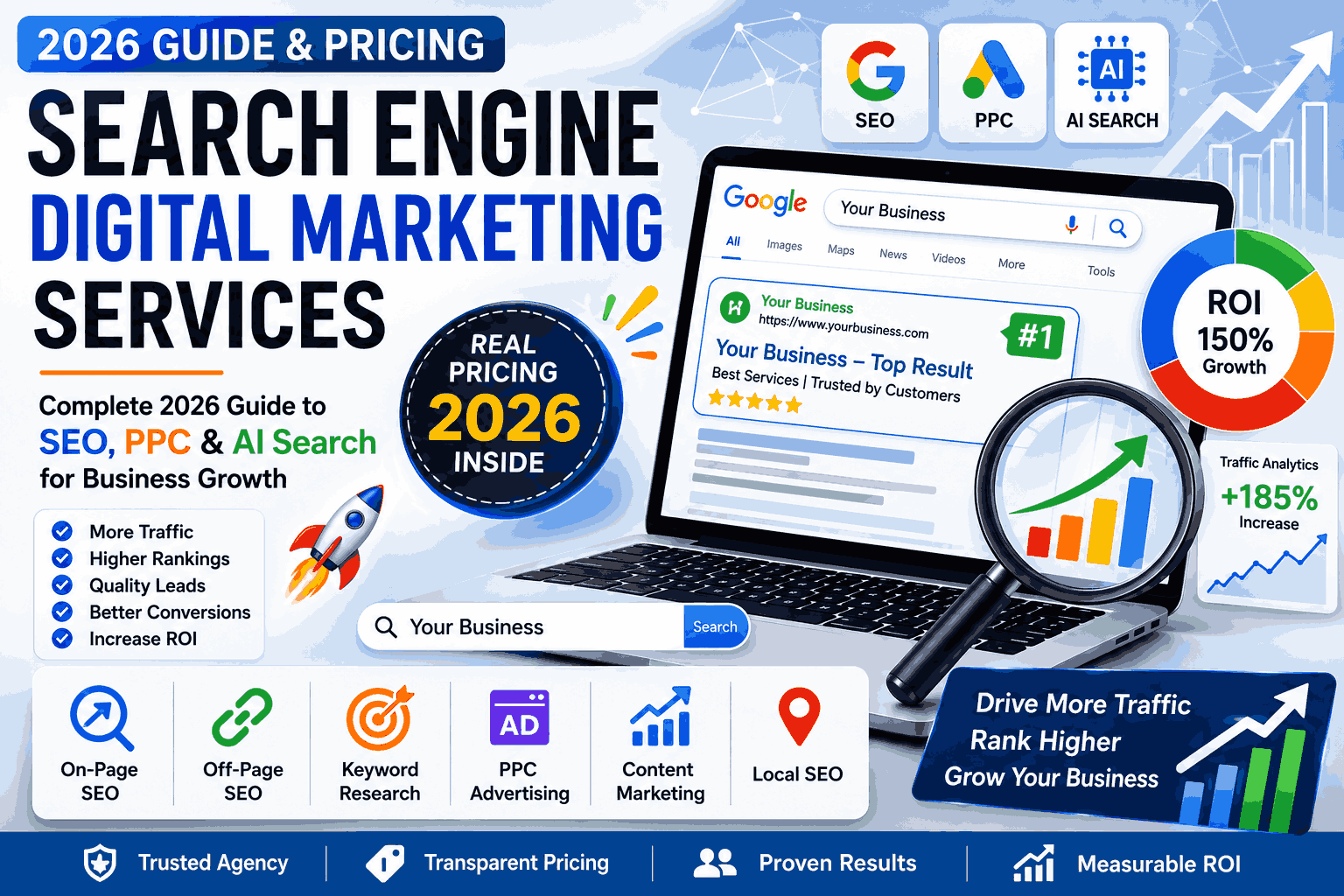
Search engine digital marketing services are everything a specialist or agency does to make your business visible when people search — and to turn that visibility into enquiries and sales. The phrase is an umbrella. Underneath it sit several disciplines that work best together rather than alone.
SEM vs SEO — the difference that trips people up
People use these terms loosely, so let’s be precise. SEO (search engine optimisation) is the work of earning unpaid, organic rankings — through content, technical health, and authority — that build up over time. SEM (search engine marketing) is the broader umbrella, but in everyday use it usually means paid search advertising, like Google Ads, where you pay for each click.
The simplest way to hold it in your head: SEO is the long game that compounds and keeps working after you stop paying. Paid search is the fast lane — instant visibility that stops the moment your budget does. Neither is “better.” They do different jobs, and the smartest businesses run both.
The three layers of search visibility in 2026
What’s genuinely new is that there are now three places to be found on a search engine, not two. A modern search marketing strategy has to cover all of them.
| Layer | What It Is | How You Win |
|---|---|---|
| Organic results | The classic ranked links earned through SEO | Technical health, helpful content, authority |
| Paid ads | Google Ads shown above and around results | Smart bidding, relevance, Quality Score, clean data |
| AI answers | AI Overviews, AI Mode, and ChatGPT/Gemini/Perplexity/Claude | Citation-worthy, structured, trusted content (GEO/AEO) |
Why Search Engine Marketing Matters More in 2026
Search is where buying intent lives. When someone types “best demat account” or “bail lawyer near me,” they’re not browsing — they’re deciding. Capturing that moment is far more valuable than interrupting someone scrolling a feed.
Here’s what makes 2026 a turning point. AI Overviews — the AI-generated summaries at the top of Google — now appear on an estimated 30–40% of all searches and reach close to a billion people. At Google I/O in May 2026, the company called AI Mode the biggest change to its search box in over 25 years and began rolling it out as a default, conversational experience.
The effect on clicks is real. Independent research suggests organic click-through rates fall sharply when an AI Overview appears — by roughly half on many informational queries — and around 60% of Google searches now end without any click at all. Inside AI Mode, that zero-click rate climbs to about 93%, because the answer replaces the list of links entirely.
That sounds bleak, but it’s only half the story. The traffic didn’t vanish — it concentrated. Being cited as a source inside an AI answer can lift click-through rates dramatically, and visitors who arrive from AI answers tend to convert several times better than ordinary organic traffic, because they show up already informed and closer to a decision. In other words, search marketing in 2026 isn’t dying. It’s rewarding the brands that adapt and punishing the ones that don’t.
What’s Included in Professional Search Engine Digital Marketing Services
Here’s a clear breakdown of what a serious provider should deliver, mapped to the layer each component serves. Use it to read any proposal with confidence.
| Service | What It Covers | Primary Layer |
|---|---|---|
| Keyword & intent research | Mapping what buyers search for and why | All |
| On-page SEO | Titles, headings, content, internal links | Organic |
| Technical SEO | Crawlability, speed, Core Web Vitals, schema | Organic + AI |
| Content creation | Answer-first pages, blogs, comparison guides | Organic + AI |
| Digital PR & link building | Earned mentions and authority signals | Organic + AI |
| Google Ads (Search / Shopping / PMax) | Paid campaigns across Google’s surfaces | Paid |
| Local SEO | Google Business Profile, Map Pack, citations | Organic |
| GEO / AEO | Getting cited inside AI-generated answers | AI |
| Analytics & tracking (GA4) | Conversion tracking, dashboards, attribution | All |
| Conversion rate optimisation | Turning traffic into leads and sales | All |
The Big 2026 Shifts Every Search Marketer Should Know
If you only skim one section, make it this one. These four shifts are reshaping how search marketing is done this year.
1. Google AI Overviews and AI Mode
AI Overviews summarise answers from multiple sites at the top of the page; AI Mode goes further, replacing the results list with a back-and-forth conversation. Google has confirmed these features run on its existing ranking and quality systems, so strong SEO fundamentals still matter — but they’re no longer enough on their own. A telling data point: the overlap between the top ten organic results and the sources AI Overviews actually cite has collapsed from around 75% in mid-2025 to somewhere between 17% and 38% by early 2026. High rankings and AI visibility have become two different games.
2. Generative Engine Optimisation (GEO) and Answer Engine Optimisation (AEO)
GEO is the discipline of getting your brand cited inside AI answers — across Google’s AI features and standalone engines like ChatGPT, Gemini, Perplexity, and Claude. The tactics are practical: lead each page with a direct, quotable answer; back claims with original data and named statistics; add schema markup so machines parse your content; and build genuine brand authority. A widely cited Princeton study found that adding statistics and citations to content lifted AI-citation rates by up to 40%. The window is open precisely because most businesses haven’t started yet.
3. Google Ads goes AI-first
On the paid side, Google has moved aggressively to automation. AI Max for Search exited beta in April 2026, and from September 2026 legacy formats like Dynamic Search Ads, automatically created assets, and campaign-level broad match are being auto-upgraded to AI Max. Google reports the full AI Max feature suite delivers around 7% more conversions at a similar cost, rising further when paired with Smart Bidding Exploration. All four million Performance Max accounts are now eligible to appear inside AI Overview and AI Mode placements, and new tools like journey-aware bidding (announced at Google Marketing Live in May 2026) push further toward signal-driven, hands-off campaigns. The catch: less manual control means your strategy, creative, and conversion data have to be excellent.
4. The data-quality moat
As automation widens which searches your ads can match, the integrity of your conversion data becomes the real competitive advantage. Industry reporting puts the average invalid-click (bot and fraud) rate across Google Ads accounts above 11%, and enabling broader AI matching can nudge invalid traffic higher still. Add Google’s 2026 GA4 reporting changes and the ongoing shift to privacy-first, cookieless tracking, and the lesson is clear: clean tracking, accurate conversion definitions, and first-party data now separate good results from wasted budget. Google has also introduced disclosure requirements for AI-generated ad content this year.
How Much Do Search Engine Digital Marketing Services Cost in India in 2026?
Let’s be direct, because this is where money gets wasted. Pricing depends on which layers you invest in, how competitive your industry is, and how much strategy sits behind the work. Here are realistic 2026 ranges for the Indian market.
| Service | Typical Monthly Cost (India) | What It Covers |
|---|---|---|
| SEO retainer | ₹20,000–1,50,000+ | Technical + on-page SEO, content, link building, reporting |
| Google Ads (PPC) management | ₹15,000–50,000+ (or 10–20% of spend) | Campaign setup, keyword & bid strategy, A/B testing, tracking |
| GEO / AEO add-on | ₹25,000–1,00,000+ | Answer-first content, schema, AI-citation tracking, digital PR |
| Full search marketing (SEO + PPC + GEO) | ₹60,000–3,00,000+ | Integrated organic, paid, and AI-search strategy |
On top of retainers, expect a one-time setup fee of roughly ₹5,000–20,000 for proper campaign and tracking configuration, and remember that 18% GST applies to Indian agency fees.
Management fee vs ad spend — don’t confuse the two
This is the single biggest source of disappointment in Indian PPC engagements. Your management fee and your ad spend are completely separate. The fee pays the people who plan, build, and optimise your campaigns. The ad spend goes directly to Google to actually show your ads. A quote that bundles both into one “all-inclusive” number is hiding something — insist on seeing both clearly.
A quick example with tax: if your agency charges ₹25,000 to manage ₹50,000 of monthly ad spend, your real out-of-pocket is roughly ₹29,500 (fee + 18% GST) plus ₹59,000 (ad spend + 18% GST) — about ₹88,500 a month. Budget for the tax, not just the sticker price.
India CPC benchmarks by industry
On paid search, your cost per click (CPC) is driven mostly by how competitive your industry is. India’s average Search CPC sits around ₹24, but the spread is enormous. Here’s a rough 2026 guide.
| Industry | Approx. CPC (₹) | Notes |
|---|---|---|
| Local services | ₹5–25 | Lowest competition; ideal for small businesses |
| E-commerce / Shopping | ₹5–40 | Feed quality strongly affects cost |
| Education | ₹15–80 | Spikes during admission season |
| Real estate | ₹40–200 | High-value leads, fierce bidding |
| Finance, loans, insurance, legal | ₹100–500+ | India’s priciest clicks — can exceed ₹1,500 |
Two practical levers: Tier-2 city targeting (Jaipur, Lucknow, Indore, Surat) can cut CPCs by 30–50% versus Delhi or Mumbai, and Hindi or regional-language ads often earn 15–25% higher click-through rates for consumer categories.
A simple budgeting framework
Don’t pick a budget out of thin air. Work backwards from a conversion. A reliable rule used by experienced Indian agencies: your monthly ad budget should buy 30–50 conversions in the first 90 days at your target cost per acquisition. That’s enough data for Google’s AI to optimise and enough volume to judge results honestly. If your unit economics can’t support that maths at any reasonable cost per lead, fix the offer or pricing before spending more on ads. Spending below ₹15,000 a month rarely produces meaningful, optimisable results.
SEO vs PPC vs GEO: Which Should You Invest In?
This is the question every business asks. The honest answer is that they’re complementary, not competing. Here’s how they stack up.
| Factor | SEO (Organic) | PPC (Paid Search) | GEO / AEO (AI Search) |
|---|---|---|---|
| Speed to results | 3–6 months | Days to 2–4 weeks | 2–8 weeks for visibility |
| Cost model | Monthly retainer (time) | Ad spend + management fee | Content + authority building |
| Longevity | Compounds; durable | Stops when budget stops | Compounds via citations |
| Best for | Trust, evergreen demand | Fast, high-intent leads | Being named inside AI answers |
| 2026 reality | Add answer-ready structure | AI Max automates; needs guardrails | Early-mover advantage; low competition |
The verdict: if you need leads now, start with paid search for speed and immediate data. In parallel, build SEO and GEO so that over six to twelve months your cost per lead drops and your visibility compounds across both Google and AI engines. Relying on any single layer in 2026 leaves money — and visibility — on the table.
Advantages and Disadvantages of Search Engine Digital Marketing Services
Every agency lists the upsides. Here’s an honest look at both sides.
Advantages
- High-intent reach — you meet people at the exact moment they’re searching for what you offer.
- Measurable ROI — done right, you can track clicks, leads, cost per lead, and return on ad spend, not just impressions.
- Speed when you need it — paid search can generate qualified enquiries within days.
- Compounding value — SEO and GEO build assets that keep working long after the work is done.
- Future-proofing — a good partner positions you inside AI answers, where discovery is shifting.
- Full control of budget — you can start small, test, and scale what works.
Disadvantages
- SEO and GEO take time — meaningful organic and AI-citation gains usually need three to six months. Anyone promising instant #1 rankings is overselling.
- Ad spend is extra — the management fee is rarely the whole bill, and competitive verticals like finance get expensive fast.
- Quality varies enormously — a cheap “₹5,000 SEO” package and a strategic partner are worlds apart.
- Automation can waste money — AI-driven campaigns need expert guardrails or they spend on the wrong searches.
- The ground keeps moving — algorithms and ad products change constantly; staying current is now a job in itself.
- No legitimate guarantees — credible providers don’t promise fixed rankings or sales numbers.
Security, Compliance, and Trustworthiness in Search Marketing
This is where real-world risk lives, and it’s especially important for finance, health, and legal businesses. Here’s what you and your agency must get right.
E-E-A-T and YMYL — why trust is a ranking factor
Google’s quality systems lean heavily on E-E-A-T (Experience, Expertise, Authoritativeness, Trustworthiness), and they apply it most strictly to YMYL — “Your Money or Your Life” — topics like finance, insurance, health, and law. For these categories, Google sets a higher bar for credibility, and its AI features tend to be more cautious, favouring clearly trustworthy sources. The practical takeaway: show real authorship and credentials, cite reputable data, keep information accurate and current, and make trust signals obvious. This isn’t just compliance — in YMYL niches, trust is what actually drives both rankings and AI citations.
Google Ads policies
Paid search runs inside Google’s advertising policies, which prohibit misrepresentation and place extra restrictions on sensitive categories — financial services, healthcare, and similar verticals often require certification or specific disclosures. In 2026, Google also introduced rules around labelling AI-generated ad content. A trustworthy agency knows these policies and keeps your account compliant, because policy violations can mean disapproved ads or, worse, a suspended account.
Data privacy and the cookieless shift
If your campaigns collect personal data — lead forms, email lists, click-to-WhatsApp contacts, or analytics tied to individuals — you’re operating under India’s Digital Personal Data Protection Act, 2023 (DPDPA), which governs consent, purpose, and secure handling. With third-party cookies fading and privacy-first tracking becoming standard, a capable partner sets up consent-based, first-party data collection properly. Ask any provider exactly how they collect, store, and use the data your campaigns generate.
Click fraud, account ownership, and clean data
Two more non-negotiables. First, protect against invalid traffic and click fraud, which can quietly drain budgets — monitor search-term reports, exclude bot patterns, and keep conversion tracking honest. Second, insist on ownership: your Google Ads account, GA4 property, and Search Console should be registered under your business, with the agency given access — never the reverse. If you ever change partners, you keep your history, data, and audiences.
Avoid black-hat shortcuts
Be wary of anyone selling spammy link schemes, hidden text, or “guaranteed rankings.” These black-hat tactics can trigger Google penalties and manual actions that erase visibility for months. Sustainable search marketing is built on genuine quality, not loopholes.
How to Choose a Search Engine Marketing Agency
Use this as a filter when evaluating providers.
Green flags
- They ask about your goals, margins, and lead value before quoting.
- They separate management fees from ad spend transparently.
- They talk about GEO and AI search, not just rankings and clicks.
- They show results in business terms — leads, cost per lead, ROAS — with proper tracking.
- They mention E-E-A-T, Google Ads policy, and data handling without prompting.
Red flags
- “Guaranteed #1 ranking” or fixed-result promises.
- “All-inclusive” pricing that hides the ad budget.
- No conversion tracking, or a refusal to share reports.
- They want to own your accounts and data.
- Pricing so low that real strategy and clean tracking are impossible.
Questions worth asking before you sign
- Which layers do you cover — SEO, paid search, and GEO?
- Is ad spend separate, and what minimum do you recommend for my industry?
- How do you set up and verify conversion tracking?
- Who owns the Google Ads, GA4, and Search Console accounts?
- How, and how often, do you report on leads and ROAS?
- How do you keep us compliant with Google policy and the DPDP Act?
Measuring ROI — The Metrics That Actually Matter
Rankings and impressions feel good but rarely pay the bills. Track what reflects real business value, and judge each channel on its own timeline.
| Channel | When Results Appear | What to Track |
|---|---|---|
| PPC (Paid Search) | Days; optimised in 2–4 weeks | CTR, CPC, conversion rate, CPA, ROAS, Quality Score |
| SEO (Organic) | 3–6 months; compounds after | Rankings, organic traffic, conversions, share of voice |
| GEO / AEO (AI Search) | 2–8 weeks visibility; 60–90 days pipeline | AI citations, AI-referral traffic in GA4, branded search |
One 2026 mindset shift matters above all: as more journeys end without a click, raw traffic stops telling the truth. Add new yardsticks to your scorecard — branded search demand, citations and mentions inside AI answers, assisted conversions, and revenue — so a healthy brand doesn’t look like it’s failing just because sessions dipped. You can now influence a sale you can no longer see in a last-click report.
Expert Insights — What Works in 2026
A few hard-won principles from how the best search teams operate this year:
- Lead with the answer. Open key pages with a direct, 40–60 word response to the question, then expand. It’s what both readers and AI engines reward.
- Publish original data. Proprietary numbers, tests, and first-hand experience earn AI citations; generic content an AI could write itself earns none.
- Build topical authority, not keyword pages. Cover a subject deeply across related questions instead of chasing single phrases.
- Get your tracking clean first. Accurate conversion data is the foundation that makes AI bidding and honest reporting possible.
- Run paid and organic together. Paid search buys speed and data; SEO and GEO build durable, lower-cost visibility. They reinforce each other.
- Match intent precisely. A page that answers “which CRM suits a small SaaS team” beats one targeting “best CRM” in the age of conversational search.
- Invest in brand and earned media. Trusted, recognised brands are the sources both Google and AI engines reach for first.
Frequently Asked Questions
Search engine digital marketing services are the strategy and execution work that makes a business visible on search engines. They cover three layers: organic visibility through SEO, paid visibility through Google Ads (PPC), and AI-answer visibility through generative engine optimisation (GEO). A full service connects all three so you appear whether someone types a query, clicks an ad, or asks an AI assistant.
SEO (search engine optimisation) is about earning unpaid, organic rankings over time through content, technical health, and authority. SEM (search engine marketing) is the broader term and, in practice, usually refers to paid search advertising such as Google Ads, where you pay per click. SEO is a long-term, compounding investment; paid search delivers immediate but rented visibility. Most businesses get the best results using both together.
In 2026, SEO retainers in India typically run ₹20,000–1,50,000+ per month, while Google Ads (PPC) management costs ₹15,000–50,000+ per month or roughly 10–20% of ad spend. A combined SEO + PPC + GEO program usually ranges from ₹60,000 to ₹3,00,000+ per month. Ad spend is separate and paid directly to Google, and 18% GST applies to Indian agency fees and ad spend.
No. Your management fee pays the team that builds and optimises campaigns; your ad spend goes directly to Google to actually show your ads. These are two separate costs. Reputable agencies always present them as separate line items, and in India both attract 18% GST. A practical minimum ad budget is ₹15,000–30,000 per month, higher in competitive verticals like finance or real estate.
AI Overviews now appear on roughly 30–40% of searches, and after Google I/O 2026 the conversational AI Mode began rolling out as a default experience. This pushes traditional links down and increases zero-click searches, so ranking #1 no longer guarantees clicks. The new goal is to be cited as a trusted source inside AI answers, because cited brands keep visibility and AI-referred visitors tend to convert at much higher rates.
GEO is the practice of structuring and writing content so AI engines like Google AI Overviews, ChatGPT, Gemini, Perplexity, and Claude cite it when answering questions. It relies on answer-first formatting, original data, schema markup, and strong brand authority. If your audience increasingly researches through AI assistants — which most do in 2026 — GEO is becoming as important as SEO was a decade ago, and most competitors have not started yet.
It depends on the channel. Paid search can generate traffic within days and is usually optimised within two to four weeks. SEO typically takes three to six months to show meaningful organic gains, then compounds. GEO visibility often appears in two to eight weeks, with measurable pipeline impact in 60–90 days. Anyone promising instant top rankings in organic search or AI answers is overselling.
Yes, when matched to budget and goals. Search captures people already looking for what you sell, which makes it one of the highest-intent channels available. Even modest, well-managed campaigns outperform DIY efforts, which industry data suggests underperform professionally managed accounts by 40–60%. The key is transparent pricing, realistic timelines, and focusing on leads and ROAS rather than vanity metrics.
Neither is universally better; they solve different problems. Google Ads is best when you need fast, predictable leads or are launching something new. SEO is best for durable, compounding visibility and trust. In 2026 a third layer — GEO for AI search — matters too. The strongest strategy usually runs paid search for speed while building SEO and GEO for long-term, lower-cost visibility.
Final Verdict
Search engine digital marketing services in 2026 are no longer about chasing a single number-one ranking. They’re about being present across three layers — organic results, paid ads, and AI answers — with content trustworthy enough that Google and AI engines alike want to cite it. The shift to AI Overviews, AI Mode, and automated ad products has raised the bar, but it has also created a clear advantage for businesses that adapt early, especially in high-trust verticals like finance, legal, and healthcare where E-E-A-T is decisive.
If search is a real growth channel for you — and for most Indian businesses it is — go in with clear eyes. Demand transparent pricing that separates fees from ad spend, insist on account ownership and clean tracking, judge proposals on leads and ROAS rather than vanity metrics, and give SEO and GEO the months they need to compound while paid search delivers results now. Do that, and search engine digital marketing stops being a cost you tolerate and becomes the most dependable growth engine your business has.