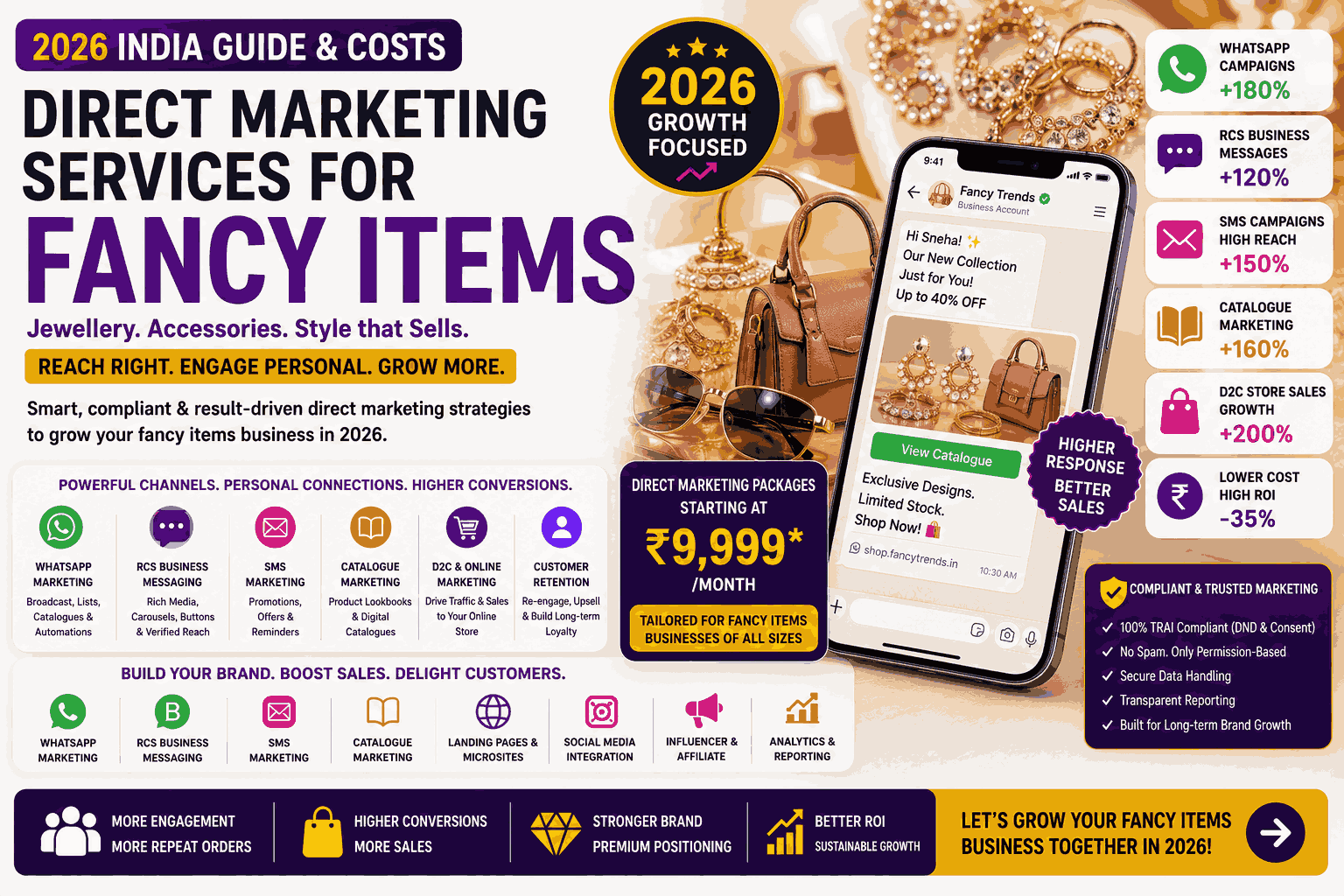
Walk through any market in India and you’ll find them — the bright, busy shops stacked with imitation jewellery, hair accessories, bangles, bindis, and gift items. The “fancy items” business is one of the country’s most vibrant retail categories, and it has quietly become a digital one. Today the seller who wins isn’t only the one with the best stall; it’s the one whose new collection lands on a customer’s phone the moment it arrives. That’s exactly where direct marketing services for fancy items come in.
Direct marketing means reaching customers directly — on WhatsApp, SMS, email, or your own store — rather than hoping a mass advertisement gets noticed. For a category built on affordable, trend-driven, frequently-bought products, it’s a near-perfect fit: low prices encourage repeat purchases, fresh designs give you a reason to message, and visual channels show off the sparkle. With advertising costs climbing in 2026, owned direct channels have become the most cost-effective way to grow.
This guide is written for Indian fancy items sellers — boutiques, D2C imitation jewellery brands, resellers, and wholesalers — who want a clear, practical picture of how direct marketing works now, the channels that perform, honest pricing, the consent rules you must follow, and how to choose a partner who drives orders rather than spam.
What Are Direct Marketing Services for Fancy Items?
Direct marketing services for fancy items are the strategy and execution that connect a seller of imitation jewellery, fashion accessories, and gift or novelty products directly with customers, using permission-based channels that invite a response. “Fancy items” here covers the classic Indian fancy-store range — artificial and imitation jewellery, earrings, bangles, hair accessories, bindis, watches, bags, and decorative gifts — sold both to consumers and, very often, wholesale to retailers.
Direct marketing vs advertising
The difference is simple but important. Advertising broadcasts a message to a wide audience and hopes the right people notice. Direct marketing speaks to a specific person — by name, on a channel they chose — and asks for a direct action: tap to view, reply to order, click to buy. Advertising builds awareness; direct marketing drives measurable sales and, crucially, builds a customer list you own rather than rent.
The core channels and components
A serious direct marketing programme for fancy items usually combines:
- WhatsApp marketing — catalogues, broadcasts, order-taking, and quick replies on India’s most-used app.
- SMS and RCS — wide reach and rich, branded messages for offers and launches.
- Email marketing — lookbooks, new-arrival drops, and low-cost nurture.
- Digital catalogues — shoppable product collections shared across channels.
- A D2C website and social commerce — your own store plus shoppable Instagram and marketplaces.
- B2B / wholesale outreach — direct updates to your retailer and reseller base.
- CRM and loyalty — segmenting customers and bringing them back with offers and referrals.
Why Direct Marketing Fits the Fancy Items Business So Well
Few categories suit direct marketing as neatly as fancy items. The products are affordable, fashion-led, and bought often — a shopper who loves earrings rarely stops at one pair. Demand spikes around festivals and weddings, designs change quickly, and the whole experience is visual, which messaging channels with images handle beautifully. And the market is booming: India’s imitation and artificial jewellery sector is valued in the region of several billion dollars and growing at roughly 10–11% a year, considerably faster than traditional gold jewellery, partly because rising gold prices are pushing shoppers toward affordable, premium-looking alternatives.
The economics are attractive too — wholesalers and resellers commonly work on healthy margins, and startup costs are low. That makes efficient marketing the deciding factor in profitability. Here’s why direct, owned channels matter more than ever in 2026: advertising costs on Meta and Google have risen sharply, so sellers are shifting budget to channels they control. WhatsApp alone reaches over 500 million users in India with open rates around 90% or higher, trust travels naturally through it, and it’s the primary digital channel for hundreds of millions of shoppers beyond the metros. For a visual, repeat-purchase category, that combination is hard to beat.
What’s Included in Professional Direct Marketing Services for Fancy Items
Here’s a clear breakdown of what a strong provider should deliver, so you can read any proposal with confidence.
| Channel / Service | What It Covers | Why It Matters |
|---|---|---|
| WhatsApp marketing | Catalogues, broadcasts, automation, order-taking | Highest engagement; commission-free repeat sales |
| SMS & RCS | DLT-compliant offers, rich cards, launches | Wide reach and time-sensitive nudges |
| Email & catalogues | Lookbooks, new-arrival drops, nurture | Low-cost storytelling and retention |
| D2C & social commerce | Own store, shoppable posts, marketplaces | Acquisition and a branded shopping home |
| B2B / wholesale outreach | Retailer broadcasts, reorder prompts, catalogues | Bulk orders and distributor growth |
| CRM & segmentation | Lists, tags, consent status, loyalty | Right message to the right buyer |
| Creative & content | Product photos, reels, festive campaigns | Fancy items sell on visuals |
| Analytics & reporting | Open, click, conversion, repeat-rate tracking | Separates real growth from noise |
The Direct Marketing Channels That Work for Fancy Items in 2026
Each channel has a job. Here’s how they compare, then how to use them.
| Channel | Open Rate | Approx. Cost | Best For |
|---|---|---|---|
| ~90–98% | ~₹0.30–1.20 / conversation | Catalogues, repeat buyers, support | |
| SMS | ~95–98% | ~₹0.15–0.20 / SMS | Wide reach, OTPs, quick offers |
| RCS | High | ~₹0.18 / message | Rich cards, branded launches |
| ~20–25% | Very low | Lookbooks, nurture, B2B |
WhatsApp commerce — your most important channel
WhatsApp is where fancy items marketing lives. You can share a full product catalogue, broadcast new collections with images, take orders in chat, and answer questions instantly. Small sellers can start with the free WhatsApp Business App; once you pass a few hundred customers, the official WhatsApp Business API (through a provider such as Wati, Interakt, or Gupshup) unlocks automation, broadcasts, and CRM integration. Meta charges per 24-hour conversation rather than per message — roughly ₹0.30–0.50 for utility messages and ₹0.80–1.20 for marketing — which is highly cost-effective at scale. Click-to-WhatsApp ads are also a powerful way to turn social discovery into a chat, and notably, a large majority of festive-season orders generated through WhatsApp come from first-time buyers.
RCS and SMS — reach and urgency
SMS still delivers near-universal reach and is read within minutes, making it ideal for OTPs, order updates, and time-sensitive sale alerts. RCS — effectively a richer, branded upgrade to SMS now supported on both Android and recent iPhones — adds product cards, carousels, and buttons, and earns noticeably higher engagement than plain text. A common, effective tactic is the SMS-to-WhatsApp bridge: a cheap SMS with a link that moves a customer into a richer WhatsApp chat. Both SMS and RCS require TRAI’s DLT registration, covered below.
Email and digital catalogues
Email is the quiet workhorse — inexpensive, owned, and perfect for lookbooks, festival collections, and slower-burn nurture. For fancy items, a well-designed catalogue or lookbook (shared by email, WhatsApp, and as a PDF) does a lot of the selling, letting customers browse a curated range and tap straight through to order.
D2C website, social commerce, and B2B outreach
A simple D2C website and shoppable Instagram give you a branded home for acquisition, increasingly helped by AR virtual try-on for jewellery. And because fancy items is heavily a wholesale business, direct B2B outreach matters as much as B2C: broadcasting new designs and reorder prompts to your base of retailers and resellers — via WhatsApp and catalogues — drives the bulk orders that often make up the largest share of revenue.
The Economics: Why Owning Your Customer Beats Renting Ads
Most marketing advice skips the money, so let’s put numbers to it. Fancy items are low-ticket but high-frequency, and resellers often enjoy margins of 30–70%. That mix rewards repeat business above almost anything else — and repeat business is exactly what owned direct channels deliver cheaply. Here’s how the main routes compare on cost and control.
| Channel | Cost / Pricing | Customer Data & Control |
|---|---|---|
| Marketplaces (Amazon/Flipkart/Meesho) | High commissions + fees | Limited — platform owns the buyer |
| Paid social / search ads | Rising CPCs + management fee | You keep the customer once acquired |
| WhatsApp / SMS / RCS | Pennies per message or conversation | Full — your opted-in list |
| Email & D2C site | Very low — mostly tools and time | Full — you own it |
Think about a single customer. Acquiring her through a paid ad or a marketplace has a real, and rising, cost — and on a marketplace the buyer effectively belongs to the platform. But once she’s on your WhatsApp list with consent, reaching her again costs a rupee or less per message, with sky-high open rates. For a category where the same customer happily buys new earrings every few weeks, that second, third, and tenth sale at near-zero marketing cost is where the profit actually lives.
So the verdict isn’t to abandon ads or marketplaces — they’re excellent for discovery. It’s to treat acquisition cost as an investment you recover through retention. Win the customer wherever you can, then move the relationship to channels you control, and track the numbers that prove it works: cost per conversation, average order value, repeat-purchase rate, opt-out rate, and customer lifetime value. On the B2B side, watch retailer reorder frequency — a reseller who reorders monthly is worth far more than the first order suggests.
How Much Do Direct Marketing Services for Fancy Items Cost in India in 2026?
Let’s be direct. Pricing depends on how many channels you run, your message volume, and how much content you need. Here are realistic 2026 ranges for the Indian market.
| Tier | Monthly Fee | What You Get | Best For |
|---|---|---|---|
| DIY + tools | ₹3,000–10,000 | WhatsApp Business tool/BSP, basic content, you run it | Small shops and resellers starting out |
| Starter | ₹15,000–30,000 | WhatsApp API setup, catalogues, campaigns, reporting | Growing boutiques and D2C sellers |
| Growth | ₹30,000–70,000 | Multi-channel (WhatsApp+SMS+email), CRM, creative, automation | Established fancy items brands |
| Full service | ₹70,000–1,50,000+ | All channels, B2B outreach, D2C, analytics, strategy | Multi-outlet brands and wholesalers |
Message costs, fees, and GST
Beyond the management fee, plan for two running costs. First, per-message or per-conversation charges: roughly ₹0.30–1.20 per WhatsApp conversation, ₹0.15–0.20 per SMS, and around ₹0.18 per RCS message, plus a BSP platform fee for the WhatsApp API. Second, content production — good product photography and reels, which do the heavy lifting in a visual category. Remember that 18% GST applies to Indian agency and platform fees, and that any ad spend for acquisition is separate from your direct-marketing fee.
A simple budgeting rule
Don’t spread spend thinly across the year. Fancy items demand is seasonal — Diwali, Navratri, wedding season, Raksha Bandhan, Valentine’s Day — so concentrate budget and your best collections around those peaks, when shoppers are primed to buy. Keep a steady, low-cost drip of WhatsApp and email activity the rest of the year to stay top-of-mind and clear inventory, and scale message volume up when a new collection lands.
Direct Marketing vs Digital Advertising for Fancy Items
These approaches are complementary, not rivals. Here’s how they compare for a fancy items business.
| Factor | Direct (owned) | Paid Ads | Marketplaces |
|---|---|---|---|
| Main job | Retain & resell | Acquire new buyers | Discovery & reach |
| Cost | Pennies per message | Rising CPCs | High commissions |
| Engagement | Very high (WhatsApp/SMS) | Variable | Platform-controlled |
| Who owns the customer? | You | You (once acquired) | The platform |
| Best for | Repeat sales, festivals, B2B | New-customer growth | Early reach, trust |
The verdict: use paid ads and marketplaces to find new customers and build initial trust, then capture those customers onto your own channels and use direct marketing — especially WhatsApp — to drive the repeat purchases that make a fancy items business profitable. The mix is what compounds.
Advantages and Disadvantages of Direct Marketing for Fancy Items
Every agency lists the upsides. Here’s an honest look at both sides.
Advantages
- Very low cost per contact — pennies per message versus rising ad costs.
- High engagement — WhatsApp and SMS open rates dwarf email and ads.
- You own the customer — an opted-in list is an asset no platform can take away.
- Perfect for repeat buys — ideal for an affordable, trend-driven, frequently-bought category.
- Visual and personal — catalogues and images show off products and feel one-to-one.
- Works for B2B too — the same channels reach retailers and resellers for bulk orders.
Disadvantages
- Consent and compliance are mandatory — TRAI/DLT for SMS and opt-in for WhatsApp aren’t optional.
- Easy to overdo — too many messages annoy customers and trigger opt-outs or bans.
- You must build the list first — direct marketing needs an audience you’ve earned.
- Message and content costs add up — fees, per-message charges, and creative are extra.
- Quality varies — a cheap “bulk blast” vendor and a strategic partner are worlds apart.
- No legitimate guarantees — credible providers don’t promise viral sales or fixed numbers.
Security, Compliance, and Trust in Direct Marketing
This is the part most pages skip — and for direct marketing it’s the most important. India regulates commercial messaging tightly, and getting it wrong means blocked messages, penalties, or a banned number. Getting it right protects both your customers and your business.
TRAI, TCCCPR, and DLT registration
Commercial SMS and voice calls in India are governed by TRAI’s Telecom Commercial Communications Customer Preference Regulations (TCCCPR), significantly tightened by a 2025 amendment. Every business that sends commercial SMS must register on the blockchain-based DLT platform as a Principal Entity, register its sender ID (header) and its message and consent templates, and route all traffic through approved operators, which scrub each message in real time against customer preferences. Since 2025, SMS headers also carry a category suffix (promotional, service, transactional, or government) so recipients can tell message types apart, and from March 2026 the old “service-explicit” category is being migrated into the promotional category. Promotional messages can generally be sent only between 10 a.m. and 9 p.m., and misuse can lead to disconnection and blacklisting for up to two years.
Consent and Do Not Disturb
Consent is the heart of the rules. You may send promotional messages only to people who have opted in or whose preferences allow that category, every promotional message must offer an easy opt-out, and customers can block marketing via the national Do Not Disturb registry (using 1909) or re-consent later. Treat consent as something you record and can prove — not a vague assumption. The same spirit applies to WhatsApp: you need genuine opt-in, must keep message quality high, and should make opting out simple, or you risk your number’s quality rating and a possible ban.
Data protection under the DPDP Act
The customer phone numbers, emails, and order history that power your direct marketing are personal data under India’s Digital Personal Data Protection Act, 2023. Collect them with clear consent, use them only for what customers agreed to, store them securely, and make opting out easy. Handled responsibly, your list becomes your most valuable, commission-free asset; handled carelessly, it’s a liability.
Honest claims, reviews, and pricing
Advertising must be truthful under ASCI norms, and any influencer collaboration must be disclosed with labels like #Ad. For jewellery specifically, product claims must be accurate — describing an item as “gold-plated,” “silver,” or “American diamond” must reflect what it actually is, in line with Legal Metrology rules on declarations (note that imitation jewellery is generally outside mandatory hallmarking, which applies to precious metals, but honest description still matters). Fake reviews are barred under India’s review standard, and the 2023 dark-patterns guidelines prohibit manipulative tactics such as false urgency and hidden charges — so skip fake “only 2 left” countdowns and surprise fees. As always, your customer list, website, and accounts should belong to your business, not your agency.
How to Choose a Direct Marketing Partner for Your Fancy Items Business
Use this as a filter when evaluating providers.
Green flags
- They handle DLT registration and consent properly, and explain the rules.
- They have real WhatsApp API (BSP) and catalogue experience for product sellers.
- They focus on building and owning your list, not just blasting messages.
- They separate management fees, message costs, and content transparently.
- They report on opens, conversions, repeat rate, and opt-outs — not just sends.
Red flags
- They offer cheap “bulk SMS/WhatsApp” with no mention of consent or DLT.
- They promise viral sales or guaranteed order numbers.
- “All-inclusive” pricing that hides per-message and content costs.
- They want to own your customer list or accounts.
- They encourage fake urgency, fake reviews, or misleading product claims.
Questions worth asking before you sign
- How will you keep us compliant with TRAI/DLT and the DPDP Act?
- How do you collect and record customer opt-in?
- Are message costs separate, and what are the per-conversation rates?
- Who owns our customer list, catalogue, and accounts?
- Can you set up WhatsApp catalogues and B2B reorder flows for retailers?
- How do you measure repeat purchases and lifetime value?
Measuring ROI — Metrics That Matter for Fancy Items Direct Marketing
Sends and followers don’t pay the bills. Track what ties to revenue, and judge each channel on its own timeline.
- Open and click rates — is your message being seen and acted on?
- Conversion rate and orders — messages that turn into sales.
- Average order value — are offers lifting or eroding the basket?
- Repeat-purchase rate and customer lifetime value — where fancy items profit lives.
- Cost per conversation / per acquisition — efficiency of each channel.
- Opt-out rate — the early warning that you’re messaging too much or off-target.
- B2B reorder frequency — how often retailers and resellers come back.
| Timeframe | What to Expect |
|---|---|
| Week 1–4 | Set up WhatsApp/DLT, build the opted-in list, first campaigns drive quick orders. |
| Month 2–3 | Segmented messaging lifts conversion; repeat buyers and B2B reorders begin to show. |
| Month 4–6+ | Owned channels compound; lower acquisition reliance, higher repeat rate and margin. |
Expert Insights — What Works for Fancy Items in 2026
A few hard-won principles from sellers winning this year:
- Build the list first. Capture every customer’s consent at the counter and checkout — your list is the business.
- Lead with WhatsApp. Catalogues and image-rich broadcasts convert best for a visual, repeat-buy category.
- Send less, send better. Trigger-based, relevant messages beat constant blasts and keep opt-outs low.
- Make visuals the star. Crisp product photos and reels do most of the selling for fancy items.
- Plan around festivals and weddings. Concentrate your best collections and budget on the peaks.
- Serve B2B, not just B2C. Reorder prompts and new-design broadcasts to retailers drive bulk revenue.
- Stay compliant by design. Opt-in, DLT, honest claims, and easy opt-outs protect your reach and reputation.
Frequently Asked Questions
What are direct marketing services for fancy items?
Direct marketing services for fancy items help sellers of imitation jewellery, fashion accessories, and gift or novelty products reach customers directly through permission-based channels rather than mass advertising. This includes WhatsApp marketing, SMS and RCS, email, digital catalogues, a D2C website, social selling, and direct outreach to retailers for wholesale. The goal is measurable, one-to-one communication that drives orders and repeat purchases while building a customer list the business owns.
How much do direct marketing services for fancy items cost in India in 2026?
In 2026, a small fancy items seller can start direct marketing for around ₹3,000–10,000 a month using a WhatsApp Business tool and basic content. Managed packages with WhatsApp API, catalogues, campaigns, and a CRM typically run ₹15,000–30,000 (starter), ₹30,000–70,000 (growth), and ₹70,000–1,50,000+ (full service). On top of fees, you pay per-message or per-conversation costs and 18% GST, while ad spend for acquisition is separate.
Which is the best direct marketing channel for selling imitation jewellery and fancy items?
For most Indian fancy items sellers, WhatsApp is the strongest channel — it has very high open rates, supports product catalogues and images, and is where customers already are, especially in tier-2 and tier-3 cities. SMS and RCS are useful for reach and time-sensitive offers, email works for lookbooks and nurture, and a D2C website plus marketplaces handle acquisition. The best results come from combining acquisition channels with WhatsApp for retention.
Is WhatsApp marketing legal for a fancy items business in India?
Yes, when done with consent. You should message only customers who have opted in, send relevant content, make opting out easy, and use the WhatsApp Business App or the official API through an authorised provider. Sending unsolicited bulk messages risks your number being blocked or banned. Customer data must also be handled under the Digital Personal Data Protection Act, 2023, with clear consent and secure storage.
What rules must I follow to send promotional SMS or WhatsApp for fancy items?
Promotional SMS in India is governed by TRAI’s TCCCPR rules and the DLT framework: you must register as a Principal Entity, register your sender ID (header) and message templates, and route messages through approved platforms, which scrub them against Do Not Disturb preferences. Promotional SMS can generally be sent only between 10 a.m. and 9 p.m., every message needs an opt-out, and consent must be recorded. WhatsApp requires customer opt-in and good message quality.
How can a small fancy items shop or reseller start direct marketing?
Start simple. Set up a WhatsApp Business profile with a product catalogue, collect customer numbers with consent at the counter or checkout, and send occasional new-arrival and festival updates with clear photos. Add a simple Instagram shop and ask happy customers for reviews. As volume grows, move to the WhatsApp API through a provider, add a CRM to segment customers, and layer in SMS or RCS and a D2C website.
Direct marketing vs social media ads for fancy items — which is better?
They do different jobs and work best together. Social media ads are excellent for acquiring new customers and showing off visual products, but costs are rising and the customer effectively belongs to the platform. Direct marketing on owned channels like WhatsApp is far cheaper per message, has higher engagement, and lets you build repeat business. The smart approach uses ads to acquire and direct channels to retain and resell.
How do I get repeat customers for a fancy items or imitation jewellery business?
Capture customer details with consent, then stay in touch through WhatsApp and email with genuinely useful, well-timed messages — new collections, festival and wedding-season picks, restocks, and loyalty offers. Because fancy items are affordable and trend-driven, customers buy often, so a steady drip of fresh designs and a simple loyalty or referral incentive turns one-time buyers into regulars and protects your margins.
Do I need DLT registration to send marketing messages?
For commercial SMS in India, yes — DLT registration is mandatory, covering your business entity, sender ID, and message templates, without which messages are blocked. For WhatsApp, you don’t use DLT, but you must use an approved Business App or API, have customer opt-in, and maintain good message quality. Email has lighter rules but still requires consent and an easy unsubscribe under data-protection norms.
Final Verdict
Direct marketing services for fancy items in 2026 are about one big idea: stop renting attention and start owning the customer relationship. For a category that thrives on affordable, trend-driven, frequently-bought products, owned channels — led by WhatsApp, supported by SMS, RCS, email, catalogues, and a D2C presence — deliver higher engagement and far lower cost than advertising alone, while building a list that’s yours to keep. With imitation jewellery and fashion accessories growing faster than traditional jewellery, the opportunity is real and expanding.
If you’re investing here, go in with clear eyes. Build an opted-in customer list, lead with visual WhatsApp marketing, serve both shoppers and your retailer base, concentrate spend around festivals and weddings, and stay fully compliant with TRAI/DLT and data-protection rules. Demand transparent pricing that separates fees, message costs, and content, and judge results by repeat purchases and lifetime value rather than vanity sends. Do that, and direct marketing becomes the most dependable, profitable engine your fancy items business has.