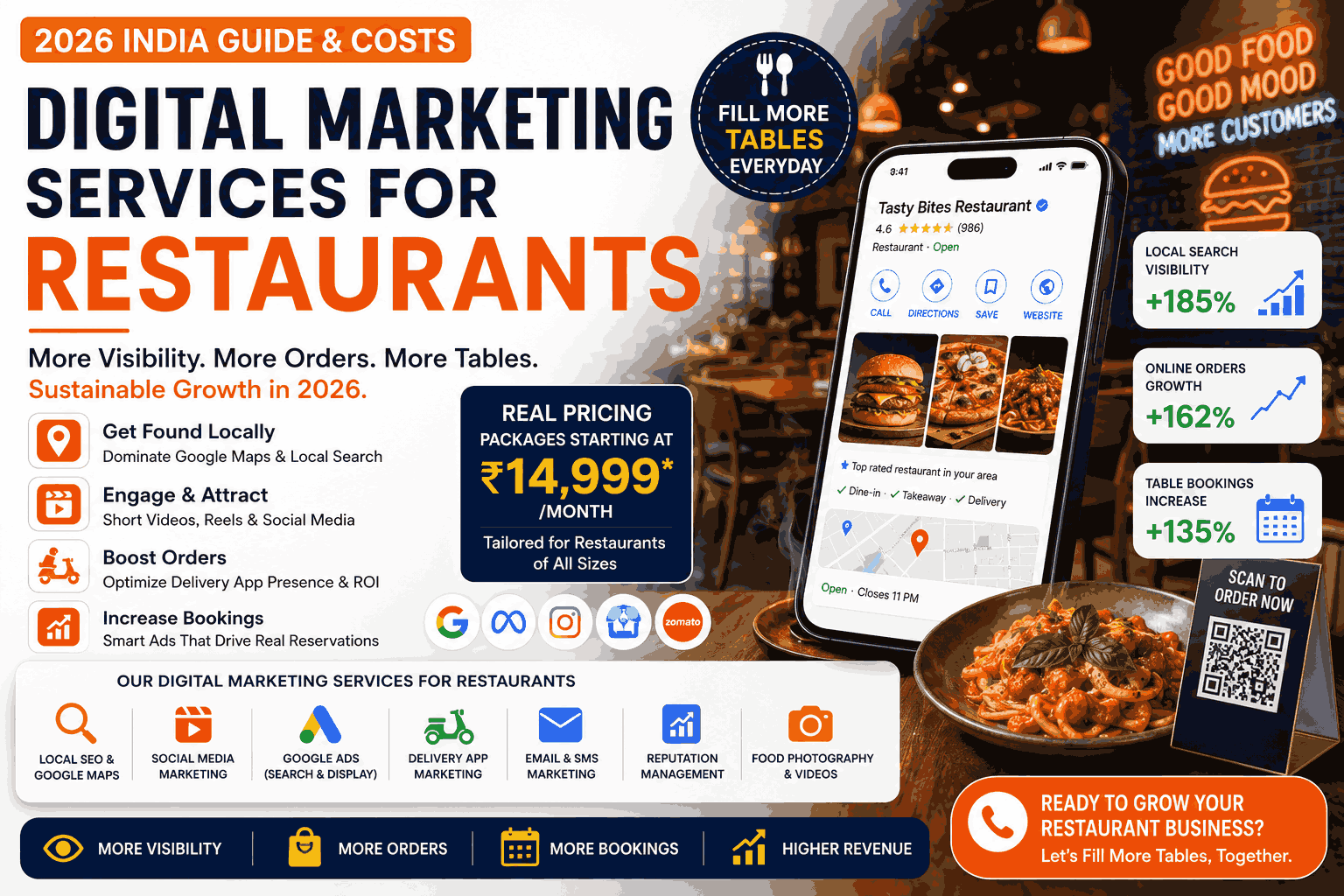
Here’s something every restaurant owner has felt: a great kitchen, food people genuinely love, and yet quiet tables on a Tuesday night. The problem usually isn’t the cooking. It’s that diners decide where to eat on their phones — scrolling Reels, reading Google reviews, comparing menus on Zomato — long before they ever walk through your door. Closing that gap is what digital marketing services for restaurants are built to do.
But 2026 has made this both more important and more complicated. Food-delivery commissions are squeezing margins harder than ever, search is shifting toward Maps and AI-generated answers, and short-form video now drives more discovery than any billboard could. The restaurants winning today aren’t the ones shouting the loudest — they’re the ones with a smart, joined-up system across search, social, reviews, delivery, and their own channels.
This guide is written for Indian restaurateurs — from a single neighbourhood cafe to a growing multi-outlet brand — who want a clear, honest picture of what works now, what it costs, the unit economics that actually determine profit, and how to choose a partner who fills seats instead of just posting pretty plates.
What Are Digital Marketing Services for Restaurants?
Digital marketing services for restaurants cover everything that gets your restaurant discovered online and converts that attention into covers, delivery orders, and loyal regulars. It’s a wide umbrella, and the disciplines underneath it work best as a connected system rather than scattered one-off efforts.
The core components
A serious restaurant marketing programme usually combines:
- Local SEO and Google Business Profile — showing up for “restaurants near me” and “best biryani in [your area].”
- Social media and short-form video — Reels and TikTok-style clips of food, prep, and atmosphere that drive discovery.
- Reviews and reputation management — earning and responding to reviews on Google, Zomato, and social.
- Food photography and videography — the single biggest driver of clicks and orders, online and on delivery apps.
- Online ordering and reservations — frictionless paths from “that looks good” to a confirmed order or table.
- Email, SMS, and WhatsApp marketing — bringing past guests back at zero commission.
- Paid advertising — Meta and Google ads to reach nearby diners quickly.
- Delivery-platform optimisation — better listings, photos, and promotions on Zomato and Swiggy.
- Influencer and user-generated content — local food creators whose followers already trust them.
Why Restaurants Can’t Skip Digital Marketing in 2026
The way people choose restaurants has fundamentally changed. Around 90% of diners research a place online before visiting, and roughly 77% look at the website or menu before deciding. About 74% use social media to pick where to eat, and a majority of younger diners say short-form food videos directly influence their choices.
Reputation is now measurable money. Studies of independent restaurants suggest that a single extra star on review platforms can lift sales by 5–9%. The flip side is just as real: about a quarter of diners say they’d avoid a restaurant entirely after seeing negative feedback online. Your reviews and your last few posts have become your storefront.
And discovery keeps moving. “Food near me” searches increasingly resolve inside Google Maps, AI-generated answers, and delivery apps rather than a list of links. Since Instagram content began being indexed by Google, a well-captioned Reel with your location can even surface in local searches. The opportunity is huge for restaurants that show up consistently — and invisible to those that don’t.
What’s Included in Professional Digital Marketing Services for Restaurants
Here’s a clear breakdown of what a strong provider should deliver, so you can read any proposal with confidence.
| Service | What It Covers | Why It Matters |
|---|---|---|
| Local SEO & Google Profile | Profile optimisation, photos, hours, posts, local keywords | Wins “near me” discovery — highest ROI |
| Social media & video | Content calendar, Reels, Stories, community management | Where diners discover and judge you |
| Reviews & reputation | Review generation, monitoring, professional responses | Drives trust and measurable sales |
| Food photography / video | Menu shots, hero dishes, short clips for ads & listings | The biggest driver of clicks and orders |
| Ordering & reservations | Website ordering, table booking, WhatsApp flows | Turns interest into revenue |
| Email / SMS / WhatsApp | Offers, win-backs, loyalty messages | Commission-free repeat business |
| Paid ads | Meta and Google campaigns targeting nearby diners | Fast reach and order volume |
| Delivery-platform optimisation | Better Zomato/Swiggy listings, photos, promos | More orders, lower wasted spend |
The Big 2026 Shifts Every Restaurant Owner Should Know
If you skim one section, make it this one. These changes are reshaping how Indian restaurants market themselves this year.
1. The food-delivery margin squeeze
Zomato and Swiggy together control roughly 90% of India’s food-delivery market, and in 2026 their costs keep climbing. Base commissions run around 15–30%, but once you add collection fees, the platform fee (hiked to about ₹17.58 per order in March 2026), subscription surcharges, GST, and the discounts restaurants are expected to fund, the all-in cost often reaches 25–35% of order value. On a ₹500 order, a restaurant can take home as little as ₹325 — and net margins on aggregator orders frequently slip below 10%.
2. New, cheaper delivery channels
The good news: the duopoly is finally facing competition. ONDC-based apps (such as magicpin and Waayu) charge roughly 3–5% commission and give restaurants full customer data, backed by a government incentive programme. Rapido’s Ownly is pushing a flat per-order fee of around ₹25–30 instead of a percentage. And direct ordering via QR menus, WhatsApp, and your own website carries no commission at all. These alternatives don’t replace the aggregators’ reach, but they change the economics of repeat business dramatically.
3. Search is shifting to Maps and AI
Diners increasingly get answers from Google Maps and AI-generated results rather than scrolling ten blue links. For restaurants, this elevates the humble Google Business Profile into a core marketing asset, and it makes Generative Engine Optimisation (GEO) — being the accurate, well-reviewed, consistently described option that AI engines recommend — genuinely important. Fresh reviews, correct details everywhere, and structured information across your site and listings are what get you surfaced.
4. Short-form video and social commerce
Short vertical video remains the highest-performing content format, and food is perfectly suited to it — a sizzling pan or a dessert reveal routinely outperforms polished studio ads. Platforms have also shortened the path from craving to order, with in-app reservation and order buttons; restaurants using Stories with a booking link see materially higher conversion to actual reservations. Authentic, phone-shot content now beats expensive production for most independents.
5. AI as a small-team time-saver
For owners without a marketing department, AI has become a practical helper rather than a buzzword. It can draft captions and email offers, power chatbots that answer queries and take bookings around the clock, and flag sentiment in reviews so you can respond fast. Used well, it helps a small team stay consistent — the single hardest part of restaurant marketing.
The Economics: Aggregators vs Direct Ordering (The Math That Matters)
Most restaurant marketing advice ignores the money. Let’s not. The most important financial decision you’ll make online is how much of your business you let the aggregators own. Here’s how the main channels compare on cost and customer data.
| Channel | Effective Cost to Restaurant | Customer Data Access |
|---|---|---|
| Zomato / Swiggy | ~25–35% all-in (commission + fees + GST), plus funded discounts | Limited |
| ONDC apps (magicpin, Waayu) | ~3–5% commission | Full |
| Rapido Ownly | Flat ~₹25–30 per order | Full |
| Direct (QR / website / WhatsApp) | 0% commission (only payment-gateway fees) | Full — you own it |
Put real numbers on it. A busy kitchen doing 100 orders a day at a ₹500 average might pay well over ₹4 lakh a month in aggregator commissions and fees. The same orders taken directly — through a QR menu, WhatsApp, or your website — cost a fraction of that, often a few tens of thousands in payment-gateway charges. That difference isn’t marketing spend; it’s pure margin you’re handing away on every repeat customer who would happily order from you directly.
The verdict isn’t “quit the aggregators.” They’re brilliant for discovery and acquiring first-time customers, and high-volume restaurants can even negotiate slightly lower rates. The verdict is: use aggregators to win new diners, then own the relationship. Capture phone numbers and order history with consent, nudge repeat orders to direct channels with WhatsApp offers, and treat every commission rupee as a customer-acquisition cost you’re trying to recover. That single mindset shift is worth more than any number of extra posts.
How Much Do Digital Marketing Services for Restaurants Cost in India in 2026?
Let’s be direct. Pricing depends on how many channels you run, how much content you need, and whether paid ads are involved. Here are realistic 2026 ranges for the Indian market.
| Tier | Monthly Fee | What You Get | Best For |
|---|---|---|---|
| DIY + tools | ₹2,000–8,000 | Scheduling and design tools; you create content | Owner-run cafes testing the waters |
| Basic | ₹15,000–30,000 | Google Profile, 1–2 social platforms, light content, reporting | Single-location restaurants |
| Growth | ₹30,000–70,000 | Local SEO, regular Reels, reviews, community management | Restaurants chasing real growth |
| Full-service | ₹70,000–1,50,000+ | All channels, paid ads, pro content, analytics | Multi-outlet brands and scaling concepts |
Two costs are almost always separate from the management fee: paid ad spend, and professional content production. Both matter enough to plan for deliberately.
Management fee vs ad spend — don’t confuse them
Your management fee and your ad spend are two different things. The fee pays the people who plan, create, post, and report. Ad spend goes directly to Meta or Google to actually show your ads. A quote bundling both into one “all-inclusive” number is hiding something. As a rule of thumb on Meta, budget at least ₹300 per day per campaign so the algorithm has enough data to optimise, and remember 18% GST applies to Indian agency fees — a ₹30,000 retainer really costs ₹35,400.
Content production costs
Great food visuals are the highest-leverage spend in restaurant marketing, and they’re usually priced per asset or per shoot. Typical 2026 ranges in India:
| Asset | Typical Cost (India) | Notes |
|---|---|---|
| Reel / short video (freelancer) | ₹500–2,000 each | Phone-shot, edited with captions |
| Reel / video (production team) | ₹5,000–25,000 each | Scripted, on-location, polished |
| Food photography shoot | ₹8,000–40,000 / session | Menu and hero shots for listings and ads |
| Nano / micro food influencer | ₹2,000–25,000 / post | Local reach, high trust |
| Macro food influencer / page | ₹25,000–2,00,000+ / post | City-wide reach |
A simple budgeting rule
Don’t guess. A practical guideline used across the industry is the 30/30/30/10 split: roughly 30% of effort on brand and content, 30% on customer acquisition (local SEO, profile, paid ads), 30% on retention (email, SMS, WhatsApp, loyalty), and 10% on experiments. As an overall figure, many growing restaurants allocate 8–15% of revenue to marketing. Spending less than around ₹15,000 a month on managed services rarely produces consistent, meaningful results — at that level, doing authentic content yourself often works better.
Advantages and Disadvantages of Digital Marketing Services for Restaurants
Every agency lists the upsides. Here’s an honest look at both sides.
Advantages
- Local, high-intent reach — you meet hungry people exactly when they’re deciding where to eat.
- Measurable results — covers, orders, average order value, and repeat rate, not just likes.
- Margin protection — owned channels let you win back the commission you lose to aggregators.
- Compounding brand equity — consistent content and reviews build a reputation that keeps paying off.
- Speed when needed — paid ads and promos can fill a slow night quickly.
- Affordable to start — authentic phone-shot video costs almost nothing but a few minutes.
Disadvantages
- It rewards consistency — sporadic posting does little; results come from showing up week after week.
- Ad spend and content are extra — the management fee is rarely the whole bill.
- Quality varies enormously — a ₹5,000 “post mill” and a strategic partner are worlds apart.
- Aggregator dependence is a trap — leaning only on Zomato and Swiggy erodes both margins and customer ownership.
- Reputation is fragile — a few ignored negative reviews can quietly cost you walk-ins.
- No legitimate guarantees — credible providers don’t promise viral fame or fixed sales numbers.
Security, Compliance, and Trust for Restaurant Marketing
Trust is the whole game in hospitality, and a few real rules sit behind it. Getting these right protects your brand and keeps you on the right side of regulators.
FSSAI and honest food claims
Every restaurant marketing in India must operate under a valid FSSAI licence, and your licence details should be displayed where required, including on packaging and listings. Marketing must not make false or exaggerated food-safety or health claims — “100% healthy” or unproven nutritional promises invite trouble. Keep menus, prices, and ingredient or allergen information accurate across your website and delivery apps, since inconsistencies frustrate customers and can breach platform and consumer rules.
ASCI and influencer disclosure
If you work with food bloggers or influencers — and most restaurants should — India’s advertising standards require that any paid or gifted collaboration be disclosed clearly and upfront, using labels like #Ad or #Sponsored rather than burying them in hashtags. Misleading superlatives such as “the best in the city” without a reasonable basis can be challenged. The Central Consumer Protection Authority can treat undisclosed promotions and fake reviews as unfair trade practices, so build disclosure into every creator brief.
Review authenticity
Fake or paid reviews are prohibited under India’s consumer-protection norms, and platforms actively police them. Don’t buy reviews or post them yourself. Instead, earn genuine ones by asking happy guests at the right moment, and respond professionally to negative feedback — a calm, solution-focused public reply often wins back a dissatisfied diner and reassures everyone else reading the thread. Silence is the worst response.
Customer data and the DPDP Act
The moment you start collecting phone numbers, emails, and order history for WhatsApp or SMS marketing, you’re handling personal data under India’s Digital Personal Data Protection Act, 2023 (DPDPA). Collect it with clear consent, use it only for what customers agreed to, store it securely, and make opting out easy. Handled responsibly, your customer list becomes your most valuable, commission-free marketing asset.
Own your assets
Finally, ownership is a form of security. Your Google Business Profile, website, domain, social accounts, and customer database should belong to your business — with any agency given access, never the other way around. If you ever change partners or scale back the aggregators, you keep your audience, your reviews history, and your data intact.
How to Choose a Restaurant Marketing Agency
Use this as a filter when evaluating providers.
Green flags
- They ask about your covers, average order value, and margins before quoting.
- They talk about owning the customer and reducing aggregator dependence, not just posting.
- They separate management fees, ad spend, and content costs transparently.
- They show results in restaurant terms — orders, reservations, repeat visits — with real tracking.
- They mention FSSAI, ASCI disclosure, and data handling without being asked.
Red flags
- “Guaranteed viral” or fixed follower/sales promises.
- “All-inclusive” pricing that hides ad spend and production costs.
- Buying reviews or followers, or vague reporting.
- They want to own your Google Profile, accounts, or customer data.
- Pricing so low that real strategy and decent content are impossible.
Questions worth asking before you sign
- How will you help us capture and market to repeat customers directly?
- How many Reels, posts, and shoots per month, and is content extra?
- Is ad spend separate, and what do you recommend for our area?
- Who owns our Google Profile, website, and customer list?
- How do you generate and respond to reviews?
- How do you keep us FSSAI, ASCI, and DPDPA compliant?
Measuring ROI — The Metrics That Actually Fill Seats
Followers and likes feel good but don’t pay rent. Track what ties to revenue, and judge each effort on its own timeline.
- Covers and order volume — the ultimate scoreboard.
- Average order value (AOV) — are promotions lifting or eroding the bill?
- Repeat-visit rate and customer lifetime value (LTV) — loyalty is where restaurants make money.
- Direct-order share — the percentage of orders bypassing aggregator commissions.
- Reservation and order referrals — bookings traced to social links and your profile.
- Review rating and volume — your most public, sales-moving metric.
| Timeframe | What to Expect |
|---|---|
| Week 1–4 | Paid ads and delivery promos can drive orders quickly; profile and listings cleaned up. |
| Month 2–3 | Local SEO and reviews start lifting discovery; repeat orders begin shifting to direct channels. |
| Month 4–6+ | Brand, social, and loyalty compound; consistent foot traffic and a healthier margin mix. |
Expert Insights — What Actually Works for Restaurants in 2026
A few hard-won principles from operators winning this year:
- Authentic beats polished. A real chef plating a dish on a phone camera consistently outperforms glossy ads. Indian diners trust real over perfect.
- Respond to every review. Professional replies to criticism convert sceptics and signal care to everyone reading.
- Own the customer. Move repeat orders to WhatsApp and direct ordering; your customer list is worth more than any single campaign.
- Win local discovery first. A complete, active Google Business Profile is the highest-ROI move most restaurants can make today.
- Invest in food visuals. Better photos and short videos lift clicks and orders across every channel, including the delivery apps.
- Use data-driven promotions. Targeted, time-limited offers fill slow shifts without permanently training customers to wait for discounts.
- Let happy guests sell for you. Encourage and reshare user-generated content — it’s free, trusted, and authentic.
Frequently Asked Questions
Digital marketing services for restaurants are the strategy and execution that get a restaurant discovered online and turn that attention into covers, orders, and repeat visits. They cover local SEO and Google Business Profile, social media and short-form video, review and reputation management, food photography, online ordering and reservations, email/SMS/WhatsApp marketing, paid ads, delivery-platform optimisation, and influencer collaborations.
In 2026, basic restaurant marketing packages in India start around ₹15,000–30,000 per month (Google Business Profile, one or two social platforms, light content). Growth packages run ₹30,000–70,000, and full-service management with paid ads and professional content ranges from ₹70,000 to ₹1,50,000+ per month. Ad spend is separate, content production (Reels, photography) is often extra, and 18% GST applies to agency fees.
For Indian restaurants, the highest-ROI foundation is Google Business Profile plus reviews and local SEO, since most diners search ‘food near me’ or ‘best [cuisine] near me.’ Instagram (Reels) and increasingly short-form video drive discovery, Facebook still reaches older and family audiences, and WhatsApp is powerful for direct orders and repeat business. Zomato and Swiggy remain essential for delivery discovery, but should be balanced with owned channels.
They are worth it for discovery and reach — together they control most of India’s food-delivery market — but not as your only channel. After commission, fees, GST, and funded discounts, restaurants often keep as little as ₹325 on a ₹500 order, and net margins on aggregator orders can fall below 10%. The smart approach is to use aggregators to acquire new customers, then move repeat orders to lower-cost direct channels.
Build owned channels alongside the aggregators. Use QR-code menus for dine-in and takeaway, take repeat orders over WhatsApp, add direct ordering to your website, and list on lower-commission networks like ONDC (around 3–5%) or flat-fee apps. Capture customer phone numbers and order history (with consent) so you can market directly. Many restaurants cut platform costs dramatically once a share of orders moves direct.
They are critical. Most diners check Google, Maps, and reviews before choosing where to eat, and research suggests a single extra star on review platforms can lift sales by 5–9% for independent restaurants. An accurate, active Google Business Profile with fresh photos, correct hours, and prompt replies to reviews is the single highest-ROI digital asset most restaurants have — and it now also feeds AI-generated answers.
Yes. Aggregator listings are rented space you don’t control, with limited customer data and rising fees. A simple, mobile-fast website with your menu, photos, location, and a direct ordering or reservation option lets you own the customer relationship, rank in Google, appear in AI answers, and take commission-free repeat orders. Think of aggregators for acquisition and your own channels for retention.
Paid ads and delivery promotions can drive orders within days. Local SEO, Google Business Profile improvements, and review growth usually show meaningful results in two to three months, while social media and brand building compound over three to six months. Anyone promising instant viral growth or guaranteed sales is overselling — consistency over a few months is what reliably fills tables.
Yes. You must display a valid FSSAI licence and avoid false food-safety or health claims. ASCI guidelines require influencers and food bloggers to clearly disclose paid or gifted collaborations with labels like #Ad, and misleading ‘best in city’ claims without basis can be challenged. Fake reviews are prohibited under consumer-protection rules, and customer data used for WhatsApp or SMS marketing falls under the Digital Personal Data Protection Act, 2023.
Final Verdict
Digital marketing services for restaurants in 2026 are no longer about the occasional Instagram post. They’re about building a connected system — local search, authentic video, glowing reviews, frictionless ordering, and direct customer relationships — that fills tables while protecting the margins the food-delivery apps keep eroding. The restaurants that thrive treat aggregators as a discovery tool, not a landlord, and they own their customers, their data, and their reputation.
If you’re investing in this, go in with clear eyes. Demand transparent pricing that separates fees, ads, and content; insist on owning your profile and customer list; judge results by covers, repeat orders, and direct-order share rather than vanity metrics; and give local SEO and brand-building the few months they need to compound. Do that, and digital marketing stops being a cost you tolerate and becomes the most dependable way to keep your dining room full and your business genuinely profitable.