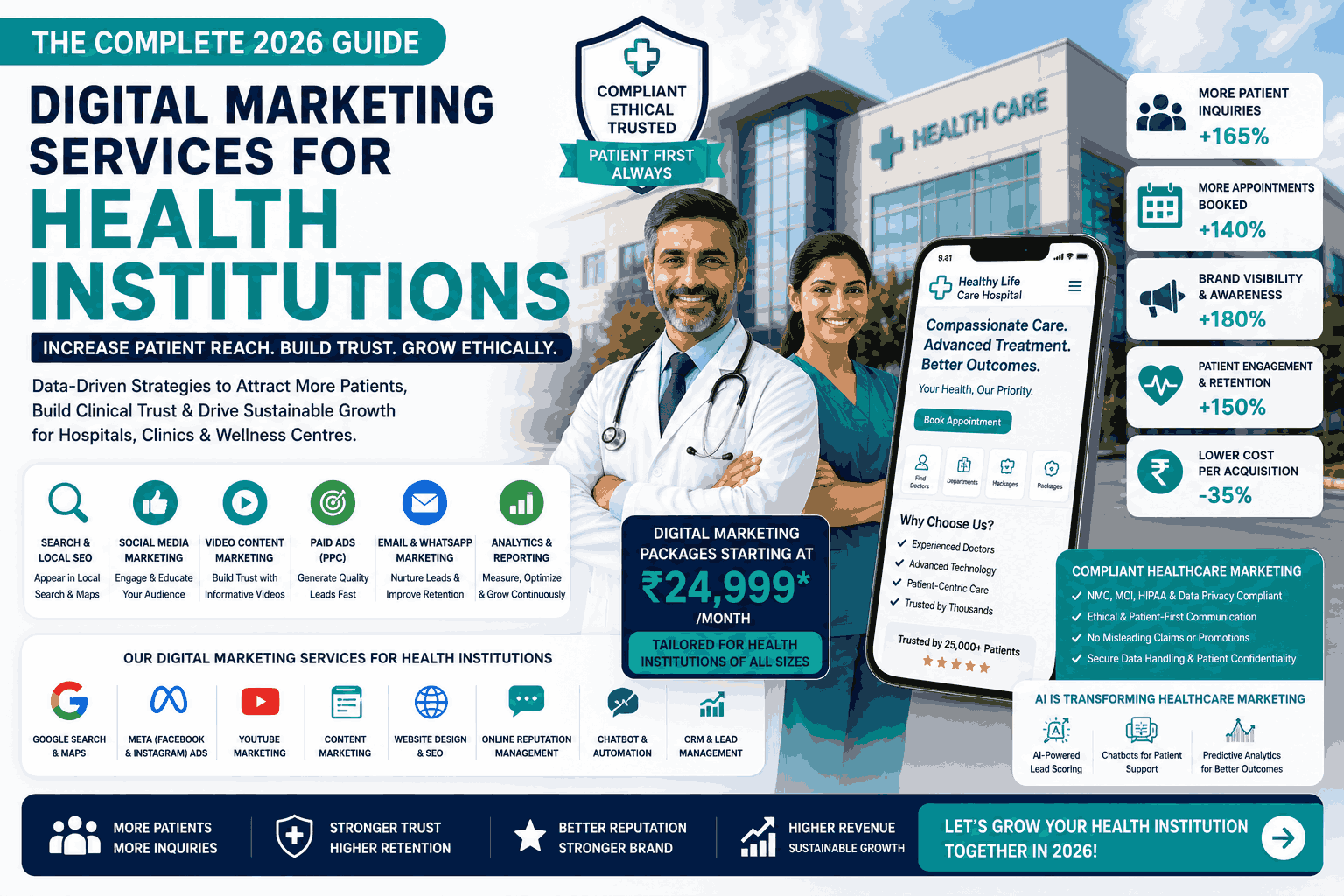
When someone experiences an unfamiliar health symptom, receives a concerning diagnosis, or simply needs to find a reliable specialist in a new city, their first action is almost always the same: they search online. A 2025 Google Health Study found that over 88% of patients use search engines to research health conditions, evaluate treatment options, and identify healthcare providers before making an appointment. For hospitals, clinics, diagnostic centres, wellness facilities, and speciality practices, this means that digital presence is not a marketing luxury — it is a patient access infrastructure.
Yet healthcare digital marketing is not like marketing a product or a gym membership. It operates in one of the most ethically, legally, and reputationally sensitive environments in any industry. Digital marketing services for health institutions must balance genuine patient need with clinical credibility, regulatory compliance, data privacy, and the profound responsibility that comes with communicating about health decisions. Done correctly, healthcare digital marketing connects the right patients with the right care. Done carelessly, it creates compliance exposure and erodes exactly the trust that healthcare brands are built on.
This guide provides a complete, honest, and up-to-date picture of every digital marketing service relevant to health institutions in 2026 — from hospitals and multi-speciality clinics to diagnostic labs, dental practices, mental health centres, Ayurveda and wellness facilities, and telemedicine platforms. What each service involves, what realistic outcomes look like, what regulations apply, what everything costs, and how to build a strategy that grows patient volume without compromising clinical integrity.
Why Health Institutions Can No Longer Afford a Passive Digital Presence
The Patient’s Digital Health Journey in 2026
The path a patient takes from recognizing a health concern to selecting a provider now runs almost entirely through digital channels. This journey typically unfolds in four stages:
- Symptom research: The patient searches for information about their symptoms, self-diagnoses possibilities, and begins forming expectations about required care — often before speaking to anyone
- Provider discovery: The patient searches for specialists, clinics, or hospitals offering relevant services — evaluating search results, Google Maps listings, healthcare portals, and social media
- Trust evaluation: The patient researches the found providers in depth — reading reviews on Practo, Google, and Justdial; checking doctor credentials and specialisation; evaluating hospital accreditations; watching facility introduction videos
- Appointment decision: Only after completing this digital research does the patient make contact — arriving with pre-formed trust or scepticism based entirely on what they found online
Health institutions that are not visible, credible, and reassuring at every stage of this journey lose patients to competitors who are. And unlike most industries where a poor choice merely costs money, healthcare decisions carry profound personal consequences — making the trust signals your digital presence projects particularly critical to patient decision-making.
Competition Has Intensified Across All Healthcare Categories
India’s healthcare market crossed ₹8.6 lakh crore in 2025, with private sector providers accounting for over 70% of hospitalisation. Major hospital chains — Apollo, Fortis, Max, Manipal, Narayana Health — invest crores annually in digital marketing and have established sophisticated patient acquisition systems that set benchmarks for the entire market. Regional and independent facilities now compete for digital visibility against these well-resourced players in addition to each other.
The rise of telemedicine platforms (Practo, Tata 1mg, Apollo 247, MFine) and health-tech aggregators has further increased the number of patient acquisition channels health institutions must maintain to stay competitive. A small ENT clinic in a tier-2 city now needs to think about its Practo profile, Google Business Profile, website SEO, and patient review management simultaneously — not just the quality of care it provides.
Complete Overview: Digital Marketing Services for Health Institutions
1. Healthcare SEO — Being Found When Patients Search
Healthcare Search Engine Optimization ensures that when patients search for symptoms, conditions, treatments, or specialists in your area, your institution appears prominently in organic search results. This is the most sustainable source of new patient discovery — and one of the most technically demanding because Google treats health content as
YMYL (Your Money or Your Life), applying its highest quality and trust standards to medical information.
Healthcare SEO in 2026 covers several critical disciplines:
- Condition and treatment pages: Clinically accurate, expert-authored pages for every condition you treat and procedure you offer — written for patient comprehension, not clinical jargon, and reviewed by qualified medical professionals
- Doctor and specialist profiles: Individual SEO-optimized pages for each physician and specialist, including credentials, specialisation, clinical experience, publications, and patient testimonials — the most searched healthcare pages after facility information
- Local SEO for healthcare: Location-specific optimization ensuring your clinic or hospital appears in ‘doctor near me’, ‘best cardiologist in [city]’, ‘orthopaedic hospital [locality]’ searches
- Technical SEO: Fast load speeds, mobile-first design, MedicalOrganization and Physician schema markup, secure HTTPS, and Core Web Vitals compliance — all directly affecting search rankings
- AI search optimization (GEO): Structuring clinical content to be cited in Google AI Overviews and AI platforms like ChatGPT and Perplexity when patients ask health questions — a genuinely new visibility opportunity in 2026
The E-E-A-T (Experience, Expertise, Authoritativeness, Trustworthiness) framework is especially consequential for healthcare content. Google’s quality raters evaluate medical content with particular rigour. Pages authored by named, credentialed medical professionals with verifiable affiliations, citing peer-reviewed sources, and maintained with regular clinical review rank measurably better than anonymously authored or AI-generated health content — and convert far more patients who value the credibility signals they find.
2. Google Ads for Healthcare — Reaching Patients at the Moment of Need
Healthcare Pay-Per-Click advertising captures patients at the exact moment they are actively seeking care — a level of intent specificity unavailable through any other advertising format. A well-structured Google Ads campaign for a hospital or clinic can deliver appointment-ready patient enquiries within days of launch.
Healthcare Google Ads campaigns include:
- Search campaigns: High-intent keywords like ‘cardiologist appointment [city]’, ‘MRI scan near me’, ‘best gynaecologist [locality]’, ‘knee replacement surgery cost India’ — capturing patients in active care-seeking mode
- Local Services Ads (LSAs): Google’s verified healthcare provider ads appearing at the top of local results with a trust badge — particularly effective for individual practices and specialist clinics
- Display remarketing: Re-engaging website visitors who explored services but did not book — useful for elective procedures where patients take time to decide
- YouTube ads: Doctor introduction videos, facility tour ads, and patient testimonial ads appearing before health-related video content
Healthcare Google Ads require careful compliance management. Google’s healthcare advertising policies prohibit certain categories of health ads without prior certification (clinical trial recruitment, certain pharmaceutical categories) and restrict specific targeting options for sensitive health conditions. A healthcare digital marketing agency with specific experience in Google’s health ad policies is important for any institution running paid search campaigns.
3. Social Media Marketing for Healthcare — Building Trust at Scale
Healthcare social media marketing is categorically different from consumer brand social media. The goal is not entertainment or aspiration — it is building credible, trustworthy, educational relationships with current and prospective patients. When done correctly, healthcare social media humanises clinical expertise and makes the healthcare experience feel accessible rather than intimidating.
Platform strategy for health institutions:
- Facebook: The leading platform for patient-age demographics in India (35–65 bracket), community health groups, specialist page followers, and appointment-generating paid ads. Health awareness campaigns, doctor Q&A live sessions, and patient journey stories perform well here
- Instagram: Health tips, medical myth debunking, doctor humanization content, facility environment photography, and health awareness visuals. Effective for reaching younger demographics and for specialties with high visual appeal (dermatology, dentistry, ophthalmology)
- YouTube: The most powerful long-term healthcare content platform. Doctor education videos, procedure explanation animations, patient testimonials, and health awareness documentaries rank in both YouTube and Google search — generating patient enquiries for years after publication
- LinkedIn: Medical professional recruitment, corporate health partnership development, research publication promotion, and positioning hospital leadership as clinical authorities
- WhatsApp Business: Appointment reminders, prescription follow-up communications, health tip broadcasts to opted-in patient communities, and chronic disease management check-ins
In 2026, doctor-led educational content — short videos of physicians explaining conditions, dispelling health myths, or answering common patient questions — has emerged as the highest-performing healthcare social media format. This content simultaneously builds specialist credibility, generates patient enquiries for specific departments, and educates the community in ways that genuinely differentiate health institutions from generic health content mills.
4. Healthcare Content Marketing — Clinical Authority in Writing
Content marketing for health institutions serves a dual purpose: attracting organic search traffic from patients researching health conditions, and building the clinical authority that differentiates a trusted healthcare provider from an anonymous health information website. In an information environment saturated with inaccurate, unverified health content, institutions that consistently publish reliable, expert-authored medical information earn a competitive advantage that no advertising budget can replicate.
High-performing healthcare content categories:
- Condition explainers: Patient-accessible guides to conditions your institution treats — symptoms, diagnosis, treatment options, prevention, and when to see a doctor
- Procedure guides: Detailed, honest explanations of what specific procedures involve — preparation, the procedure itself, recovery, risks, and outcomes — reducing patient anxiety and pre-qualifying those who decide to enquire
- Specialist insights: Blog articles and social posts authored by your physicians sharing clinical perspectives on health trends, research developments, and preventive health guidance
- Patient journey narratives: Carefully handled stories (with consent) of patient experiences within your institution — particularly powerful for elective specialties like fertility treatment, weight loss surgery, or joint replacement
- Health awareness campaigns: Seasonal and awareness month content (World Heart Day, World Mental Health Day, cancer awareness months) that generates significant social sharing and positions your institution as a community health resource
All healthcare content must be medically reviewed, attributed to qualified authors, and updated when clinical evidence evolves. Publishing outdated treatment recommendations or incorrect medical information creates both patient safety concerns and significant reputational risk. A formal content review protocol involving your clinical team is a prerequisite for any serious healthcare content programme.
5. Healthcare Website Design and Patient Experience
A health institution’s website is frequently a patient’s first contact with the organisation — and their first assessment of whether this institution is trustworthy, professional, and capable of caring for them. A technically excellent but clinically impersonal website fails patients who need reassurance. A warm, well-designed website that is impossible to navigate on mobile fails the majority of visitors who arrive on smartphones.
A high-performing healthcare website in 2026 needs:
- Mobile-first design: Over 78% of health-related searches in India happen on mobile — every page, form, and feature must function excellently on a phone screen
- Online appointment booking: Real-time appointment scheduling integrated with your hospital management system — reducing the friction between intent and commitment from a phone call to a tap
- Doctor directory with comprehensive profiles: Credentials, specialisation, clinical experience, language capabilities, consultation formats (in-person, video, home visit), consultation fees, and appointment availability
- Department and procedure pages: Clear, patient-friendly descriptions of every specialty and service you offer — organized for patient comprehension, not clinical taxonomy
- Accreditation and certification display: NABH accreditation, JCI certification, ISO certifications, and medical council registrations prominently displayed — significant trust signals for patient decision-making
- Patient testimonial and outcome data: Ethically handled, consent-obtained patient stories and where appropriate, anonymised outcome statistics for key procedures
- Emergency contact and location information: Instantly visible on every page — for healthcare, this is a safety-critical requirement, not just a UX consideration
- Fast, secure, accessible design: HTTPS across all pages, WCAG 2.1 accessibility compliance, under 2.5 second load speed on mobile
6. Online Reputation Management for Healthcare
In healthcare, where patients are making decisions about their physical wellbeing — sometimes in states of significant anxiety or vulnerability — online reviews carry exceptional decision-making weight. A 2025 survey found that 82% of patients consider online reviews as important as personal recommendations when choosing a healthcare provider, and that 72% will not consider a provider with fewer than 4 stars on Google or Practo.
Healthcare reputation management services include:
- Systematic review generation: Structured processes for requesting reviews from satisfied patients at appropriate post-consultation or post-discharge intervals — via SMS, WhatsApp, or email — with direct links to Google, Practo, and other relevant platforms
- Professional review responses: Thoughtful, HIPAA and DPDPA-compliant responses to all reviews — acknowledging patient experiences without disclosing protected health information, and demonstrating the institution’s commitment to patient satisfaction
- Monitoring across platforms: Google, Practo, Justdial, MediBuddy, Lybrate, and condition-specific patient forums where healthcare experiences are shared
- Negative review management: Professionally handling critical reviews by directing the patient to appropriate internal resolution channels — not by disputing legitimate patient experiences publicly
- Doctor-specific reputation management: Monitoring and building the individual online reputations of key physicians, whose personal brands significantly influence patient appointment decisions
7. Email and WhatsApp Marketing for Patient Retention
Patient acquisition is important — but patient retention and lifetime health relationship management is where the financial foundation of sustainable healthcare practices is built. A patient who receives excellent care, feels consistently remembered and valued between visits, and receives timely health guidance is a patient who returns, refers family members, and becomes a long-term relationship.
Email and WhatsApp marketing for health institutions:
- Appointment reminders and follow-up scheduling: Automated reminders 48 and 24 hours before appointments, reducing no-shows by 20–40%; post-visit follow-up messages checking patient recovery and scheduling the next required visit
- Preventive health reminders: Annual health check-up reminders, vaccination schedule notifications, screening programme invitations — positioned as patient care rather than promotion
- Chronic disease management support: Regular check-in messages, medication reminders, and diet or lifestyle guidance for patients managing diabetes, hypertension, or cardiac conditions — when supported by clinical guidance
- Health education newsletters: Monthly or quarterly newsletters sharing relevant health information, seasonal health tips, and institution updates — maintaining the relationship between clinical encounters
- Post-discharge care communications: Structured recovery guidance, medication reminders, and wound care instructions delivered via WhatsApp in the days following hospital discharge — improving outcomes and reducing readmission risk
All health institution email and WhatsApp communications involving patient-specific health information must operate within strict DPDPA consent frameworks. Patient consent for receiving digital health communications must be explicit, documented, and easily revocable. Mass communication must go only to patients who have specifically opted in to receive such messages.
8. Telemedicine and Digital Health Platform Marketing
The telemedicine sector has matured dramatically since the pandemic, and in 2026 digital health consultations are a standard patient expectation rather than an emergency measure. Health institutions offering telemedicine services require a distinct digital marketing approach to reach patients who prefer or require remote care.
Telemedicine-specific digital marketing includes:
- App store optimization (ASO): For institutions with proprietary telemedicine apps, optimizing app discovery in Google Play Store and Apple App Store for health-related search queries
- Platform-specific SEO: Optimizing your profile and service listing on telemedicine platforms (Practo, Tata 1mg, Apollo 247) where patients search for video consultation options
- Targeted digital advertising for remote patient acquisition: Reaching patients in geographies beyond your physical location — particularly valuable for super-specialist consultations, rare disease management, and rural patient access
- Patient education content for telemedicine adoption: Addressing common patient hesitation about video consultations — how the process works, what conditions are suitable for telemedicine, privacy protections, and how to prepare for a digital consultation
Digital Marketing Channel Comparison for Health Institutions
How each channel performs across the dimensions most relevant to healthcare patient acquisition and retention:
| Channel | Primary Purpose | Speed to Results | Cost Level | Patient Lead Quality | Long-Term ROI |
|---|---|---|---|---|---|
| Healthcare SEO | Organic patient discovery, clinical authority | 4–8 months | Medium | Very High | Excellent |
| Google Ads (PPC) | Immediate appointment-ready patient leads | Days | High | Very High | Good–Very Good |
| Meta Ads (FB + IG) | Awareness, health education, patient leads | Days | Medium | Medium–High | Good |
| YouTube (Organic) | Doctor authority content, long-term SEO | 2–5 months | Low–Medium | Medium–High | Very Good |
| Content Marketing | YMYL authority, SEO foundation, education | 4–9 months | Medium | High | Excellent |
| Email + WhatsApp | Patient retention, follow-up, loyalty | Immediate | Very Low | Very High | Exceptional |
| ORM / Reviews | Trust building, conversion rate uplift | Ongoing | Low–Medium | Indirect | Very High |
| Practo / Portal Listings | Active patient search, appointment booking | Immediate | Medium | Very High | Good |
| Telemedicine Marketing | Remote patient access, beyond geography | 1–3 months | Medium | High | Very Good |
Recommended Strategy by Health Institution Type
| Institution Type | Priority Channels | Key Message Focus | Approx. Monthly Budget |
|---|---|---|---|
| Single-Specialty Clinic | Local SEO, GBP, Google Ads, Practo, Reviews | Specialist credentials, outcomes, proximity | ₹15,000 – ₹40,000 |
| Multi-Specialty Hospital | SEO, Google Ads, YouTube, Social, Email CRM | Comprehensive care, accreditation, trust | ₹80,000 – ₹3 lakh |
| Diagnostic / Lab Centre | Local SEO, GBP, Google Ads, WhatsApp | Speed, accuracy, cost, home collection | ₹20,000 – ₹60,000 |
| Dental Practice | Instagram, Google Ads, Local SEO, Reviews | Painless treatment, aesthetics, affordability | ₹15,000 – ₹45,000 |
| Mental Health Centre | SEO, Content, Instagram, Email, Telemedicine | Safety, confidentiality, accessibility, empathy | ₹20,000 – ₹60,000 |
| Ayurveda / Wellness Centre | SEO, YouTube, Instagram, Content, Pinterest | Holistic care, natural, authenticity, science | ₹15,000 – ₹50,000 |
| Telemedicine Platform | SEO, Google Ads, App marketing, Social, Content | Convenience, accessibility, certified doctors | ₹1 lakh – ₹5 lakh+ |
| Super-Specialty Tertiary Hospital | Full funnel: SEO + PPC + Content + Video + PR + ORM | Clinical excellence, outcomes, specialisation | ₹3 lakh – ₹15 lakh+ |
2026 Updates: What Has Changed in Healthcare Digital Marketing
Google AI Overviews Are Now the First Health Information Layer
Google’s AI-generated health summaries now appear for a significant proportion of symptom and condition queries. When a patient searches ‘symptoms of diabetes’ or ‘recovery time after knee replacement’, they often receive a synthesised AI answer before seeing any individual website result. Health institutions whose clinically accurate, well-structured content is cited within these AI Overviews gain substantial brand exposure — their name appears as a trusted source in AI-generated health guidance that millions of patients consume daily.
Critically, Google’s AI Overviews for health topics prioritise content from NABH-accredited institutions, content authored by named credentialed physicians, and content citing peer-reviewed sources. This makes clinical content quality and physician attribution more commercially valuable than ever for institutional digital marketing.
NHA’s Ayushman Bharat Digital Mission (ABDM) and Digital Health Integration
The National Health Authority’s Ayushman Bharat Digital Mission — which assigns every Indian citizen a unique ABHA (Ayushman Bharat Health Account) health ID — has created new digital touchpoints between patients and health institutions. Health facilities integrated with ABDM can access and contribute to patients’ longitudinal health records, with implications for how digital marketing can target and communicate with patients while remaining within the strict data governance framework the ABDM requires. Health institutions building ABDM-integrated digital capabilities are positioning for a healthcare ecosystem where data-driven, permission-based patient communication becomes a standard of care.
Mental Health Digital Marketing Has Expanded Significantly
The destigmatisation of mental health in India has accelerated in 2025–2026, creating substantial new patient acquisition opportunity for mental health institutions, psychiatric services, and psychological wellness platforms. Digital marketing for mental health must navigate heightened sensitivity requirements: content must be supportive, non-triggering, and compliant with India’s Mental Healthcare Act 2017. Campaigns that reduce stigma and make mental health care feel accessible — rather than medicalising or dramatising mental health conditions — have shown strong engagement and referral conversion rates.
AI-Powered Diagnostic and Symptom Check Tools as Lead Generators
Health institutions that have integrated AI-powered symptom checkers, health risk assessments, or preliminary diagnostic tools into their websites are generating significant engagement and appointment conversion. These tools — when clearly positioned as preliminary screening aids that require professional medical evaluation — provide patient value, collect consented data, and create natural appointment booking pathways. In 2026, they have moved from experimental features to competitive differentiators for patient-facing digital platforms.
India’s DPDPA 2023 and Healthcare Data Marketing Compliance
India’s Digital Personal Data Protection Act (DPDPA) 2023 has specific and significant implications for health institutions. Patient health data is among the most sensitive personal data categories under DPDPA, attracting heightened protection requirements. Health institutions cannot use patient health information for marketing purposes without explicit, purpose-specific consent. This applies to remarketing campaigns that use health website visitor data, email campaigns to patient databases, and WhatsApp health communication broadcasts. Healthcare marketing agencies and technology platforms that receive patient data in the course of digital marketing work must be contractually bound to DPDPA-compliant data processing standards.
Additionally, India’s Information Technology (Amendment) Act provisions relating to sensitive personal data — which specifically includes health data — remain in force alongside DPDPA. Healthcare institutions should obtain legal review of their digital marketing data practices to ensure compliance with both frameworks simultaneously.
Telemedicine Platform Marketing Competition Has Intensified
By 2026, the telemedicine market has consolidated significantly, with Practo, Apollo 247, Tata 1mg, and MFine dominating patient digital health platform usage. Individual health institutions seeking to maintain direct patient digital relationships — rather than ceding patient access to platform intermediaries — must invest in their own digital appointment infrastructure and direct-to-patient content strategies. Institutions that rely entirely on third-party platforms for digital patient acquisition have progressively less control over patient relationship economics as platform fees and algorithm changes affect their visibility.
Honest Pros and Cons of Digital Marketing Services for Health Institutions
Advantages
- Intent-matched patient reach: Healthcare SEO and Google Ads connect you with patients who are actively seeking care — the highest-intent audience available in any marketing channel, consistently delivering higher appointment conversion rates than awareness advertising
- Clinical authority building: Consistently published, medically reviewed content positions your institution and physicians as trusted health authorities — a competitive asset that compounds over time and influences patient preference well beyond immediate appointment decisions
- Measurable patient acquisition: Every enquiry, appointment booking, and referred patient can be attributed to its digital source and costed — providing the accountability that justifies marketing budget allocation decisions
- Geographic reach beyond physical location: Telemedicine marketing, speciality condition content, and NRI patient campaigns allow health institutions to reach patients beyond their immediate geographic market — particularly valuable for tertiary and super-speciality care
- Patient retention and lifetime health relationship management: Email and WhatsApp marketing tools maintain meaningful clinical relationships between patient visits, reducing practice churn and generating the referral activity that is the most cost-effective patient acquisition channel available
- Community health education positioning: Health awareness content and social media education campaigns position your institution as a community health resource rather than a service provider — building goodwill and top-of-mind awareness that influences future care-seeking decisions
- 24/7 patient access and appointment availability: Digital booking systems, website information, and chatbot-based pre-appointment guidance provide patient access at any hour — capturing appointment bookings from patients researching health concerns outside business hours
Disadvantages
- YMYL content complexity and cost: Producing medically accurate, clinically reviewed, regularly updated content that meets Google’s E-E-A-T standards for health content requires genuine physician involvement — representing a resource investment that many healthcare institutions underestimate when planning content programmes
- Strict regulatory compliance requirements: Healthcare digital marketing must navigate DPDPA 2023, the Clinical Establishments Act, Medical Council of India (MCI) ethical guidelines for doctor advertising, ASCI healthcare advertising standards, and state-specific medical advertising regulations — requiring either significant internal compliance expertise or specialist agency support
- Patient data sensitivity creates targeting limitations: The same data protection obligations that are ethically appropriate also limit the degree to which health institutions can use patient health data for advertising targeting — reducing targeting precision compared to less regulated industries
- Review management sensitivity: Patient reviews about healthcare experiences require responses that are professional, empathetic, and DPDPA-compliant — never disclosing protected health information in a public response — a significantly more complex task than review management in most other industries
- Google Ads healthcare category restrictions: Google’s healthcare advertising policies require pre-certification for certain categories, prohibit targeting based on health conditions, and restrict some ad formats — meaning not all digital advertising strategies available in other industries are available in healthcare
- Trust erosion risk from poor content quality: Inaccurate, outdated, or misleading health content published under a healthcare institution’s name creates both patient safety concerns and significant reputational damage — the downside risk of poor-quality health marketing is substantially higher than in most industries
- Long SEO timelines for competitive specialities: Healthcare SEO for competitive terms in major cities (oncologist Mumbai, cardiologist Delhi) requires sustained 6–12 month investment before generating meaningful organic traffic — making it unsuitable as a standalone strategy for immediate patient volume needs
Trust, Compliance, and Ethical Standards in Healthcare Digital Marketing
Medical Council of India (MCI) Guidelines for Doctor Advertising
The Medical Council of India’s Code of Medical Ethics Regulations govern how registered medical practitioners may promote their services. While the NMC (National Medical Commission) replaced MCI in 2020, equivalent ethical guidelines remain in force. These guidelines prohibit medical practitioners from soliciting patients through misleading advertisements, making claims of superiority over other practitioners, or advertising in ways that could exploit patient vulnerabilities. Digital marketing content attributable to individual physicians — social media posts, blog articles, YouTube videos — must comply with these ethical guidelines.
ASCI Healthcare Advertising Guidelines
The Advertising Standards Council of India (ASCI) guidelines for healthcare advertising prohibit unsubstantiated claims of cure, misleading treatment outcome promises, and advertising that exploits patient fear or desperation. In digital marketing, these guidelines apply to Google Ads copy, social media posts, website claims, and any paid content promoting healthcare services. All health institution marketing claims about treatment outcomes, success rates, doctor credentials, and facility capabilities must be accurate, current, and supportable.
Clinical Establishments Act and Digital Representation
The Clinical Establishments (Registration and Regulation) Act 2010 and its state implementations require that clinical establishments be registered and operate within defined regulatory parameters. Digital marketing representations about clinical capabilities, services offered, specialist availability, and facility specifications must accurately reflect the registered and approved scope of the institution’s operations.
DPDPA 2023 — The Healthcare Data Marketing Framework
Patient health data is among the most sensitive personal data categories under DPDPA 2023 and requires the highest level of data protection. For health institutions, this means: (1) Explicit, purpose-specific consent must be obtained before using patient data for any marketing communication; (2) Patients must be able to withdraw consent and have their data deleted on request; (3) Health data cannot be used to build advertising audience segments without specific consent; (4) Third-party marketing technology platforms that process patient data must meet equivalent security and compliance standards. Healthcare institutions should have their digital marketing data practices reviewed by legal counsel with healthcare data expertise.
Mental Health Marketing — Additional Ethical Requirements
Content marketing and advertising targeting mental health conditions must comply with India’s Mental Healthcare Act 2017 and related Ministry of Health guidelines. Content must not stigmatise mental health conditions, must not exploit vulnerability, and must provide appropriate crisis resource information where content could reach individuals in distress. Social media content addressing mental health topics should be reviewed by qualified mental health professionals before publication.
Digital Marketing Cost Benchmarks for Health Institutions — India 2026
| Service | Agency Fee (Monthly) | Ad Spend (Separate) | Expected Outcome |
|---|---|---|---|
| Healthcare SEO + Website Optimization | ₹20,000 – ₹70,000 | None | Organic patient discovery; authority ranking in 4–8 months |
| Google Ads Campaign Management | ₹15,000 – ₹45,000 | ₹25,000 – ₹2 lakh+ | Immediate appointment enquiries from high-intent patients |
| Meta Ads (Facebook + Instagram) | ₹12,000 – ₹35,000 | ₹15,000 – ₹80,000 | Health awareness reach + patient enquiry leads |
| Medical Content Marketing | ₹20,000 – ₹60,000 | None | Clinical authority content; SEO foundation; patient trust |
| YouTube / Video Production | ₹25,000 – ₹1.5 lakh+ | None (production) | Doctor authority videos; procedure guides; patient stories |
| Email + WhatsApp Patient Retention | ₹8,000 – ₹20,000 | ₹2,000 – ₹8,000 | Appointment adherence; reduced no-shows; retention uplift |
| Practo / Portal Profile Management | ₹8,000 – ₹20,000 | ₹5,000 – ₹30,000 | Active patient search visibility; direct appointment booking |
| ORM / Review Management | ₹10,000 – ₹25,000 | None | Review growth; reputation trust signals; conversion uplift |
| Full-Service Healthcare Marketing | ₹60,000 – ₹5 lakh+ | ₹30,000 – ₹2 lakh+ | Integrated patient acquisition and retention strategy |
Important: Agency management fees and advertising spend are separate budget components. A clinic paying ₹15,000/month for Google Ads management must budget an additional ₹25,000–₹80,000 in actual Google ad spend to generate meaningful patient volumes. Always clarify both components when evaluating proposals.
Frequently Asked Questions — Digital Marketing Services for Health Institutions
For most health institutions, Google Business Profile optimization combined with structured Practo and relevant healthcare portal profile management delivers the fastest ROI on initial digital investment. These services place your institution and key physicians in front of patients actively searching for care in your specialty and location, with minimal setup time and at relatively low cost. Simultaneously, initiating healthcare SEO through clinically accurate department and condition pages builds the organic foundation that reduces patient acquisition cost progressively over the following 4–8 months.
For a single-specialty clinic or small multi-specialty practice, a starting monthly investment of ₹25,000–₹60,000 (including both agency fees and modest ad spend) is typically sufficient to cover local SEO, portal management, and targeted Google Ads for the highest-priority specialties. Large multi-specialty hospitals or telemedicine platforms investing in comprehensive strategies — including content marketing, YouTube, paid social, and CRM retention programmes — typically invest ₹1.5 lakh to ₹8 lakh or more monthly.
Yes, and these restrictions are important. The National Medical Commission (formerly MCI) ethical guidelines prohibit registered medical practitioners from making claims of clinical superiority over peers, using misleading outcome promises, or advertising in ways that exploit patient vulnerabilities. ASCI healthcare advertising guidelines prohibit unsubstantiated cure claims and misleading treatment outcome representations. These apply to all digital channels — Google Ads copy, social media posts, website claims, and YouTube content. All health institution digital marketing content should be reviewed against current NMC and ASCI guidelines before publication.
DPDPA 2023 treats health data as a sensitive personal data category requiring heightened protection. Health institutions must obtain explicit, purpose-specific consent before using patient information for marketing communications. Patient data cannot be used to build advertising remarketing audiences without specific consent for that use. WhatsApp broadcast marketing must go only to patients who have specifically opted in. Third-party marketing platforms that process patient data must operate within equivalent DPDPA standards. Healthcare institutions should have their digital marketing data practices reviewed by legal counsel with healthcare data expertise.
Negative healthcare reviews require responses that are professional, empathetic, and DPDPA-compliant. Never disclose patient-specific health information in a public review response — even to clarify or defend against a review’s claims. Acknowledge the patient’s experience respectfully, provide a direct contact channel for resolution, and demonstrate the institution’s commitment to quality care improvement. Responses should be reviewed by a senior clinical or patient relations team member before posting. Systematic positive review generation from satisfied patients is the most effective long-term strategy for managing the impact of occasional negative reviews.
The highest-performing healthcare content categories for both SEO and patient conversion are: (1) Physician profile pages with full credentials, specialization, and clinical philosophy; (2) Condition explainers that answer the questions patients actually search about specific symptoms and diseases; (3) Procedure guides that honestly explain what treatments involve, including preparation, risk, and recovery; (4) Location and accessibility content for each facility; and (5) Patient outcome stories with appropriate consent and ethical handling. All content must be authored or reviewed by qualified medical professionals, attributed clearly, and updated when clinical evidence changes.
Both serve important and distinct roles. Google Ads delivers immediate patient enquiries for specific specialties during appointment-urgent periods — it is the right tool when you need immediate results for a department launch, a specific procedure campaign, or seasonal health demand. SEO delivers compounding, lower-cost organic patient traffic that grows over time — it is the right long-term investment for building sustainable patient acquisition economics. The most effective healthcare digital marketing uses both simultaneously: paid search for immediate volume and specific campaign needs, SEO for building the organic foundation that progressively reduces the overall cost per patient acquired.
Individual physician reputation management is one of the highest-ROI activities in healthcare digital marketing, because patients often search for specific doctor names after receiving a referral or discovering the institution. Key tactics include: (1) Fully optimized, SEO-rich physician profile pages on the hospital website; (2) Physician-authored blog articles and social media posts demonstrating clinical expertise; (3) YouTube videos featuring the physician explaining conditions, treatments, or health guidance; (4) Practo and Lybrate profile optimization with accurate credentials and patient reviews; and (5) LinkedIn positioning for specialist physicians seeking peer recognition, research collaboration, or academic exposure.
Mental health digital marketing requires additional sensitivity layers beyond standard healthcare guidelines. Content must not stigmatise mental health conditions, must not use language that could be triggering or distressing, and must provide appropriate crisis resource information where content could reach individuals in acute distress. India’s Mental Healthcare Act 2017 provides the legal framework. Social media campaigns should be reviewed by qualified mental health professionals. Advertising targeting algorithms should not use health condition data for audience targeting. All paid advertising should go through Google’s sensitive health category compliance review.
Digital marketing extends a health institution’s patient catchment area beyond its immediate geography in several ways: (1) Specialty-specific SEO content targeting condition searches nationally, attracting patients seeking expert care for complex or rare conditions; (2) Telemedicine marketing enabling preliminary consultations with patients from across India; (3) NRI patient marketing through Meta’s international Indian diaspora targeting, reaching patients who want care from trusted Indian providers during home visits; (4) YouTube and content marketing that positions your physicians as national authorities in their specialties, attracting referral patients from other regions. Super-specialty centres commonly attract 20–35% of patients from outside their base city through effective specialty digital marketing.