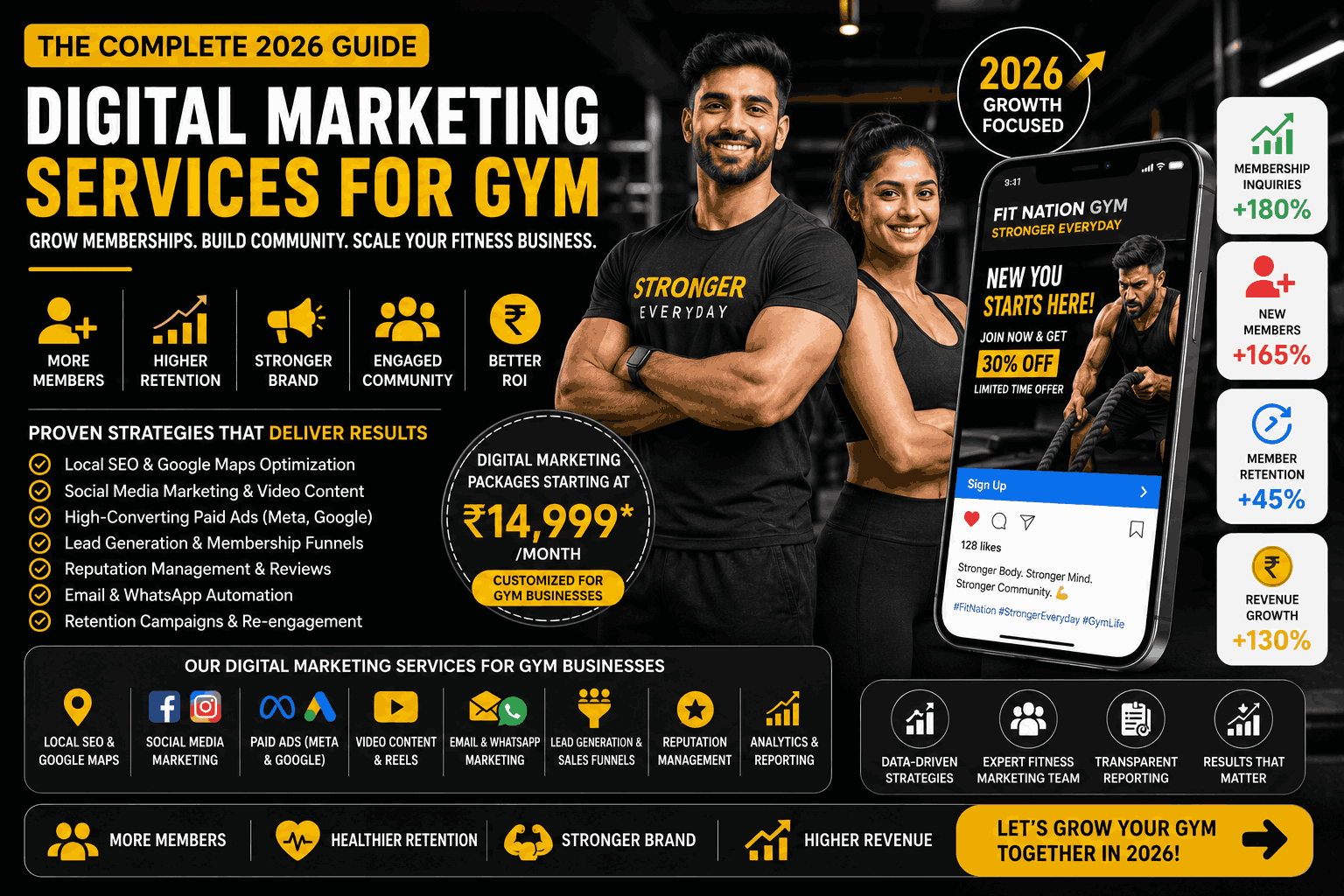
January is every gym’s best friend. New Year resolutions flood the sign-up sheet, the floor fills up, and for a few glorious weeks it feels like the whole city has decided to get fit. Then February arrives. By March, 80% of those January members have quietly disappeared — and the hard work of replacing them begins all over again. The gyms that break this exhausting cycle are not the ones with the fanciest equipment or the lowest membership fees. They are the ones that have built a digital presence strong enough to generate consistent, high-quality leads all year round — not just in January.
The Indian fitness industry surpassed ₹15,000 crore in 2025 and is projected to grow at 16–18% annually through 2030. Globally, the gym and fitness centre market exceeds $100 billion. The opportunity is significant — but so is the competition. Budget gyms, premium boutique studios, CrossFit boxes, yoga centres, and at-home fitness apps all compete for the same health-conscious consumer. In this environment, digital marketing services for gym businesses are the difference between a membership roster that grows steadily and one that stagnates.
This is the definitive 2026 guide for gym owners, fitness centre managers, and personal trainers who want to understand exactly which digital marketing services matter, what each one realistically costs and delivers, how the platform landscape has changed this year, and how to build a strategy that generates memberships month after month — not just in peak season.
The Competitive Reality: Why Gyms Need Digital Marketing More Than Ever
A decade ago, a gym could rely on a roadside hoarding, a newspaper insert, and a good location to fill its membership base. That model still contributes something — but the primary discovery channel for fitness services has moved decisively online.
A 2025 fitness industry consumer survey found that 76% of people who joined a new gym in the past 12 months discovered it through an online channel — primarily Google search, Instagram, or a referral from someone whose online content had influenced their decision. Only 18% cited offline word-of-mouth as their primary discovery mechanism. This data represents a fundamental shift in how people find and choose fitness facilities.
The competitive pressure has also intensified from unexpected directions. In 2026, gym owners are not just competing with the gym across the street — they are competing with:
- At-home fitness apps (Cult.fit, Nike Training Club, FitOn) offering convenience their physical facility cannot match
- YouTube fitness creators whose free training content reduces the perceived need for a membership
- Boutique fitness studios targeting premium segments with specialized offerings (reformer pilates, heated yoga, functional fitness)
- Corporate wellness programs that partner with gyms for bulk memberships, requiring a completely different marketing approach
The gyms winning in this environment have one thing in common: they are consistently visible in the right digital channels, they communicate their unique value clearly, and they have systems in place to convert digital interest into paid memberships and to keep those members engaged long enough to deliver real retention revenue.
Complete Guide to Digital Marketing Services for Gym Businesses
1. Local SEO — The Foundation of Gym Discovery
Local Search Engine Optimization is the cornerstone of digital marketing for any gym with a physical location. When someone in your city searches ‘gym near me’, ‘best fitness centre in [locality]’, or ‘CrossFit box [city]’, local SEO determines whether your facility appears in the top results — particularly in the Google Map Pack that dominates the first screen of local search results on mobile.
For gym businesses, local SEO encompasses:
- Google Business Profile (GBP) optimization: Complete, accurate, and regularly updated profile including hours, membership price ranges, photos of the facility and equipment, class schedules, and a direct booking or enquiry link
- Location and service-specific landing pages: Dedicated pages for ‘gym in [specific area]’, ‘personal training [city]’, ‘yoga classes [locality]’ — capturing long-tail searches with high booking intent
- NAP consistency: Ensuring your gym’s name, address, and phone number are identical across Google, Justdial, Sulekha, Facebook, and all relevant directories
- Technical SEO: Fast mobile load speeds, structured data markup using FitnessCenter and LocalBusiness schema types, Core Web Vitals compliance
- Review generation: A systematic process for collecting Google reviews from new and existing members — the volume and quality of reviews directly affects Map Pack ranking position
Local SEO for gyms has a compounding return: the investment made in month three continues paying dividends in month eighteen and beyond. Once your GBP and local pages rank consistently in the Map Pack for high-intent searches in your area, the cost per lead drops dramatically compared to paid advertising, making it the most cost-efficient long-term membership acquisition channel available.
2. Social Media Marketing — Building Community and Driving Signups
Fitness is one of the most social industries online. Transformation journeys, workout challenges, community events, and motivational content all perform exceptionally well on social platforms — and gym members who engage with your social content are significantly more likely to renew their memberships than those who do not.
Platform strategy for gym digital marketing:
- Instagram: The dominant fitness platform. Before-and-after member transformations (with consent), workout demonstration Reels, coach introduction videos, gym challenge updates, behind-the-scenes facility content, and motivational content. Instagram’s algorithm favours fitness content strongly, giving gyms genuine organic reach potential
- Facebook: Valuable for community building — Facebook Groups for gym members are powerful retention tools. Also effective for reaching the 30–50 age bracket, corporate wellness decision-makers, and running local targeted ads
- YouTube: Long-form workout content, facility tours, trainer Q&A sessions, and nutrition guides that rank in both YouTube and Google search — generating ongoing organic traffic and positioning your gym as an authority in your fitness niche
- LinkedIn: Specifically valuable for gyms targeting corporate wellness partnerships and B2B membership arrangements with companies whose employees would benefit from nearby gym access
- WhatsApp Business: Class schedule updates, member challenges, new program announcements, and retention-focused communications to opted-in member communities
The most consistently effective social content format for gyms in 2026 is authentic member transformation and community content — real members sharing real results, member milestones celebrated publicly (with permission), community workout challenges, and coach-led educational content. This content builds the social proof that converts a curious Instagram follower into a gym enquiry far more reliably than promotional posts announcing discount memberships.
3. Paid Social Advertising — Precision Lead Generation for Membership Sales
Organic social content builds community over time. Paid social advertising delivers immediate, targeted membership leads. For gym businesses, Meta’s advertising platform (Facebook and Instagram combined) offers unmatched targeting precision for physical location-based services.
High-performing paid social campaigns for gyms include:
- Geographic radius campaigns: Targeting only people within 3–8 km of your gym — ensuring ad spend reaches only people who could realistically become members
- Life event and behavioural targeting: Reaching users who have recently shown fitness-related interests, people who have moved to your area, users engaging with competitor gym pages
- Lead generation ads: Capturing name, phone number, and fitness goal directly within Meta’s platform — removing the friction of a website visit and allowing rapid follow-up
- Trial membership and free pass offers: ‘Claim your free 7-day trial’ campaigns consistently outperform general brand awareness ads in generating actual gym visits and subsequent membership conversions
- Video ads showcasing facility and community: 30–60 second ads showing the gym atmosphere, equipment, classes, and member community — reducing pre-visit anxiety that prevents uncommitted prospects from signing up
- Retargeting campaigns: Re-engaging website visitors, video viewers, and lead form openers who expressed interest but did not convert
The metric that matters most in gym paid social is not cost per click or even cost per lead — it is cost per acquired member. A lead that costs ₹200 but converts to membership at 5% represents a ₹4,000 member acquisition cost. A lead that costs ₹500 but converts at 25% is a ₹2,000 acquisition cost — far more efficient. Tracking the full funnel from ad to membership is essential for optimizing gym paid social campaigns.
4. Google Ads — Capturing High-Intent Gym Searchers
When someone searches ‘gym membership near me’ or ‘best CrossFit gym in Pune’, they are not browsing — they are actively deciding where to train. Google Ads places your gym at the top of these high-intent searches, capturing decision-ready prospects.
Gym-specific Google Ads campaigns include:
- Search campaigns targeting membership-intent keywords: ‘gym near me’, ‘fitness centre [city]’, ‘[specific training type] classes near me’, ‘personal training [locality]’
- Local Services Ads (LSAs): Google’s verified business ads appearing above traditional ads with a trust badge — particularly effective for personal training services
- Performance Max campaigns: AI-driven campaigns serving ads across Search, Display, YouTube, and Maps simultaneously — useful for gyms wanting broad reach with a single campaign structure
- Competitor campaigns: Bidding on competitor gym names to appear when someone searches for a competing facility nearby
- Remarketing display campaigns: Banner ads following website visitors across the web during their consideration phase — keeping your gym top-of-mind as they research options
Google Ads for gyms performs best with dedicated campaign-specific landing pages rather than directing traffic to a general homepage. A landing page focused on a specific offer — ‘Free 7-Day Trial Pass’ or ‘Book Your First Personal Training Session Free’ — converts paid traffic at dramatically higher rates than a general website. This distinction between driving traffic and converting traffic is what separates profitable gym PPC campaigns from those that drain budgets without delivering memberships.
5. Content Marketing and Fitness Blogging
Content marketing for gyms targets potential members during the research and consideration phase — before they are ready to sign up but while they are actively learning about fitness, comparing options, and forming preferences. A gym that consistently publishes genuinely useful fitness content becomes the trusted resource in its local market, and that trust converts to membership preference when the prospect is ready to commit.
High-performing content categories for gym websites and blogs:
- Workout guides by fitness goal: ‘Beginner strength training programme for women’, ‘How to lose fat without losing muscle’, ‘Best exercises for desk workers with back pain’
- Nutrition and recovery content: Practical advice linked to your gym’s training philosophy, reinforcing member results
- Class and programme explainers: What to expect from your first yoga class, how HIIT training works, what makes a good personal training session
- Local fitness content: ‘Best running routes in [city]’, ‘How to train for [local marathon or fitness event]’, ‘Gym vs home workout for [specific goal]’
- Member spotlight features: Real member journeys published with permission — the most persuasive content for prospects on the fence about joining
Content that demonstrates genuine fitness expertise — authored by or attributed to qualified trainers and coaches — satisfies Google’s E-E-A-T requirements for health and fitness content (a YMYL category) and builds the kind of durable search rankings that generate consistent organic traffic.
6. Website Design and Online Membership Enrollment
A gym’s website is where every digital marketing channel eventually delivers its traffic — and where the decision to sign up is made or abandoned. A poor website experience wastes every rupee spent on SEO, social media, and paid advertising.
A high-converting gym website in 2026 needs:
- Mobile-first design: The overwhelming majority of gym website traffic arrives from mobile devices; every feature must function perfectly on a phone screen
- Online membership purchase or trial booking: The ability to sign up for a membership or book a trial directly on the website without calling or visiting — removing the primary barrier between interest and conversion
- Clear class schedule with online booking: Members and prospects should be able to see what classes are available and book directly from the website or integrated app
- Facility photo and video gallery: High-quality visuals of the actual gym, equipment, classes in session, and trainers — the most important trust signal for prospective members who have not visited
- Transparent pricing: Displaying membership tiers, durations, and inclusions clearly — prospects who cannot easily find pricing on a gym website frequently abandon the research process entirely
- Member testimonials and transformation stories: Social proof embedded at key conversion points
- Fast load speed: Under 2.5 seconds on mobile — every additional second of load time measurably reduces form completion rates
7. Email Marketing and Member Retention Campaigns
The fitness industry’s most underestimated revenue opportunity is member retention. The average gym loses 30–50% of its membership base annually through natural attrition. Reducing that attrition rate by even 10 percentage points has an enormous compounding revenue impact — far greater than the equivalent improvement in new member acquisition.
Email marketing is the primary tool for driving gym member retention:
- Onboarding sequences for new members: A structured 30-day email series welcoming new members, introducing trainers, explaining how to get the most from their membership, and establishing habits that drive regular attendance — the #1 predictor of retention
- Milestone celebrations: Automated emails recognising 1-month, 3-month, 6-month, and 1-year membership anniversaries with personalised messages and occasionally rewards
- Re-engagement campaigns for inactive members: Identifying members who have not visited in 2–3 weeks and reaching out with personal trainer offers, class recommendations, or challenges before they decide not to renew
- Renewal reminders: Timely, value-reinforcing emails in the weeks before membership expiry — including renewal incentives for early commitment
- Seasonal and challenge campaigns: New Year programmes, summer transformation challenges, pre-Diwali fitness pushes — driving additional engagement and referral from existing members
8. Video Marketing and YouTube Strategy for Gyms
Video is the most consumed content format among fitness audiences. YouTube is the world’s second-largest search engine and a primary discovery platform for people researching fitness options, looking for workout guidance, and evaluating gym options in their area.
Effective gym video marketing in 2026 includes:
- Facility walkthrough videos: Comprehensive, high-quality tours showing every area of the gym — letting prospects experience the atmosphere before visiting
- Trainer introduction videos: Building personal connections between prospects and specific coaches before membership signup increases conversion rates significantly
- Workout instruction content: Demonstrating proper form, explaining programme design, and providing fitness education — positioning your trainers as credible authorities
- Member success story videos: Authentic testimonials from real members discussing their journey, filmed at the gym — the most persuasive content for undecided prospects
- Class preview videos: Short clips from actual classes showing the energy, difficulty level, and community feel — helping prospects self-select into appropriate programmes
YouTube SEO for fitness content is genuinely valuable: a ‘Complete Beginner Gym Guide for Women’ or ‘4-Week Strength Programme for Beginners’ video can rank in Google search results and generate membership enquiries for years after publication, at zero ongoing cost.
9. Online Reputation Management — Reviews Drive Membership Decisions
Gym memberships are commitment decisions — monthly or annual financial commitments to a facility people will visit repeatedly. Before making that commitment, 74% of prospective gym members read online reviews, and average star ratings directly influence whether a prospect books a trial or walks away. A gym with 300 reviews at 4.6 stars will consistently outperform a technically superior facility with 40 reviews at 4.3 stars in both local search rankings and membership conversion.
Reputation management for gyms includes:
- Systematic post-signup and post-milestone review request processes — the ideal time to ask for a review is when a new member has just achieved a personal best or completed their first month
- Professional, personalised responses to every review — both celebrating positive experiences and professionally addressing negative feedback in a way that demonstrates accountability
- Monitoring across Google, Facebook, Practo (for health and wellness), Sulekha, and Justdial
- Addressing fake negative reviews through platform dispute processes — a more common problem in the competitive gym market than many owners realise
Digital Marketing Channel Comparison for Gyms and Fitness Centres
How each major channel performs across the dimensions that matter most for gym membership growth:
| Channel | Primary Purpose | Speed to Results | Cost Level | Lead Quality | Long-Term ROI |
|---|---|---|---|---|---|
| Local SEO + GBP | Ongoing organic discovery | 2–4 months | Low–Medium | Very High | Excellent |
| Instagram (Organic) | Community, brand trust, discovery | 1–3 months | Low | Medium–High | Very Good |
| Meta Ads (Paid) | Targeted new member acquisition | Days | Medium | Medium–High | Good–Very Good |
| Google Ads | High-intent search capture | Immediate | Medium–High | Very High | Good (optimized) |
| Content Marketing/Blog | Authority, SEO, education | 3–6 months | Low–Medium | High | Excellent |
| Email Marketing | Member retention, re-engagement | 1–4 weeks | Very Low | Very High | Exceptional |
| YouTube (Organic) | Fitness authority, long-term SEO | 2–5 months | Low | Medium–High | Very Good |
| WhatsApp Marketing | Member communication, retention | Immediate | Very Low | Very High | Exceptional |
| ORM / Reviews | Trust building, conversion uplift | Ongoing | Low–Medium | Indirect | Very High |
Recommended Digital Marketing Strategy by Gym and Fitness Business Type
| Business Type | Priority Channels | Key Message Focus | Approx. Monthly Budget |
|---|---|---|---|
| Independent Local Gym | Local SEO, GBP, Instagram, Meta Ads, WhatsApp | Community, proximity, value, results | ₹15,000 – ₹35,000 |
| Premium / Luxury Fitness | Google Ads, Instagram, Content, YouTube, ORM | Experience, trainers, exclusivity, results | ₹40,000 – ₹1.2 lakh |
| CrossFit / Boutique Studio | Instagram, Meta Ads, YouTube, Community Groups | Community, performance, specialization | ₹20,000 – ₹60,000 |
| Yoga / Wellness Centre | SEO, Content, Pinterest, Instagram, Email | Mindfulness, expertise, holistic wellbeing | ₹12,000 – ₹35,000 |
| Personal Training Business | Instagram, Google Ads (LSAs), GBP, WhatsApp | Results, individual attention, expertise | ₹10,000 – ₹30,000 |
| Multi-Location Gym Chain | Full funnel: SEO + PPC + Social + CRM + Email | Consistency, brand, loyalty programme | ₹1 lakh – ₹5 lakh+ |
2026 Updates: What Has Changed in Gym Digital Marketing
Google’s AI Overviews Are Changing How People Find Gyms
Google’s AI-generated search summaries now appear for many gym-related queries, synthesising information from multiple sources to answer questions like ‘what should I look for in a gym?’ or ‘is a CrossFit gym better than a regular gym?’ Gyms whose website content, FAQ pages, and blog posts directly and authoritatively answer these questions are increasingly being cited within AI Overviews — earning brand impressions even when users do not click through to the website. This makes structured, question-answering fitness content more valuable than ever.
Instagram’s Reels Algorithm Now Rewards Fitness Education Content
Instagram’s 2025–2026 algorithm updates have meaningfully shifted which fitness content receives distribution. The platform now prioritises educational fitness content with strong save and share metrics — workout guides, form correction videos, nutrition explainers, and training programme breakdowns — over pure aesthetic or aspirational content. For gym marketers, this creates a genuine opportunity: gyms whose trainers produce genuinely educational Reels are achieving organic reach previously only available through paid advertising.
AI-Powered Fitness Apps as Both Competition and Partnership Opportunity
AI-powered fitness apps (Whoop, Apple Fitness+, Fitbify) have become more capable and more widely adopted in 2026. For gyms, these apps represent both a competitive threat — they reduce the perceived need for a gym membership among self-directed users — and a partnership opportunity. Gyms that position their offering as the community, accountability, and coaching layer that enhances what apps can do have found this framing highly effective in converting app users into gym members.
WhatsApp Channels for Fitness Community Building
WhatsApp launched Channels (broadcast-style one-to-many communication) in India in 2024, and by 2026 they have become a significant fitness community tool. Gyms using WhatsApp Channels to share daily workout tips, member spotlight features, class schedule updates, and motivational content report meaningfully higher member engagement and retention rates compared to gyms using only traditional social media. The format is intimate, low-friction, and reaches members on a platform they already use constantly.
Google Business Profile Now Supports Class Schedule Display
Google has expanded GBP capabilities for fitness businesses in 2026, including direct class schedule display and booking integration with platforms like Mindbody, Glofox, and Fit Booking. Gyms with this integration active see significantly higher conversion rates from GBP profile views to actual bookings, as the friction between discovery and commitment is dramatically reduced.
DPDPA 2023 Compliance for Gym Member Data
India’s Digital Personal Data Protection Act (DPDPA) 2023 applies directly to gyms collecting member data through digital channels — online membership forms, lead generation ads, WhatsApp opt-ins, and email newsletters. Gyms must obtain explicit, documented consent for each use of member personal data and must maintain records of that consent. For gym owners using CRM platforms to track member attendance and automate re-engagement campaigns, ensuring these systems are DPDPA compliant — particularly around data storage, access control, and deletion on request — has become an operational requirement, not just best practice.
Honest Pros and Cons of Digital Marketing Services for Gyms
Advantages
- Hyper-local targeting precision: Paid social and Google Ads can reach exclusively people within commuting distance of your gym, ensuring marketing spend converts to physically accessible prospects
- Measurable full-funnel tracking: From ad impression through to membership signup and renewal, every step of the member acquisition journey is trackable and optimizable
- Community content advantage: Fitness content — transformation stories, workout challenges, member milestones — performs organically better than almost any other business category on social media, giving gym marketing disproportionate organic reach potential
- Retention lever via email and WhatsApp: Digital tools can identify and re-engage at-risk members before they cancel, directly protecting the recurring revenue that is the financial foundation of a gym business
- Year-round lead pipeline: Unlike traditional marketing that generates peaks around New Year, well-executed digital marketing generates consistent inbound leads throughout the year — reducing the boom-and-bust cycle most gyms experience
- Compounding SEO returns: Local SEO and content marketing investments made today continue generating leads at no additional per-click cost for years — unlike paid advertising, which stops the moment spend stops
- B2B corporate wellness opportunity: LinkedIn and targeted digital campaigns can open corporate membership arrangements that dramatically increase revenue per account compared to individual memberships
Disadvantages
- Content creation demands are real: Consistent, quality Instagram and YouTube content requires either significant time from trainers and staff or investment in a content creator — it is a genuine ongoing operational commitment
- Paid advertising requires ongoing management: Google Ads and Meta campaigns need continuous monitoring, testing, and optimization — set-and-forget campaigns typically waste budget within weeks
- Seasonal performance variance: Even with strong digital marketing, the fitness industry’s seasonality creates natural lead volume variation — January and September are significantly easier months than April and July regardless of marketing quality
- Review sensitivity: A single negative member experience that results in a public 1-star review can disproportionately impact new member conversions — requiring active reputation management as a permanent operational function
- Attribution complexity: Accurately attributing a membership signup to its digital marketing source requires proper tracking setup (GA4, Meta Pixel, call tracking) — which many gyms lack, making ROI measurement imprecise
- Membership management software integration: Digital marketing tools work significantly better when integrated with gym management software (Mindbody, Glofox, PerfectGym) — a technical setup requirement that carries both cost and complexity
- DPDPA compliance overhead: Managing consent records for member data across digital marketing channels requires consistent processes that add administrative workload to gym operations
Trust, Safety, and Regulatory Compliance in Gym Digital Marketing
ASCI Guidelines for Fitness Advertising
The Advertising Standards Council of India (ASCI) has specific requirements for fitness and health service advertising. Claims about weight loss results, muscle gain timelines, body transformation outcomes, and supplement efficacy in gym advertising must be substantiated and must not be misleading. ‘Guaranteed results’ claims and specific outcome promises (‘Lose 10 kg in 30 days’) carry regulatory risk and create unrealistic member expectations that harm retention. Accurate, honest claims about what your gym’s programmes can achieve are both ethically appropriate and strategically superior — they attract members who will actually stay.
Member Transformation Content and Consent
Using member before-and-after photos, transformation stories, or fitness journey content in digital marketing requires explicit, documented consent from the member. Consent should be specific about how and where the content will be used (Instagram posts, website, paid advertisements) and members should have the ability to withdraw consent. Verbal consent is insufficient — written or documented digital consent protects both the member and the gym.
Health and Safety Claims in Fitness Content
Gym content that provides fitness or nutritional advice falls into the YMYL (Your Money or Your Life) category under Google’s quality standards. This means content must be produced or reviewed by qualified fitness professionals, must contain accurate and responsible health information, and must not make irresponsible claims. Nutritional advice should be attributed to qualified nutritionists or dietitians. Medical claims about fitness outcomes must not overstate what exercise can achieve without medical supervision. This standard both satisfies Google’s ranking requirements and protects your gym from liability.
Data Security for Online Membership Enrollment
Gyms collecting payment information, health data, and personal details through digital membership enrollment must ensure adequate security measures: SSL certification on all web pages handling personal data, PCI DSS compliance for any payment processing, and secure data storage for member health information. Member data breaches in fitness businesses have resulted in significant regulatory action under DPDPA — data security is not optional for any gym operating digital enrollment.
Digital Marketing Cost Benchmarks for Gyms in India — 2026
| Service | Agency Cost (Monthly) | Ad Spend (Separate) | Expected Outcome |
|---|---|---|---|
| Local SEO + GBP Management | ₹10,000 – ₹25,000 | None | Map Pack rankings, organic enquiries in 2–4 months |
| Instagram Management (Organic) | ₹10,000 – ₹25,000 | None | Community growth, brand presence, follower engagement |
| Meta Ads (Facebook + Instagram) | ₹8,000 – ₹20,000 | ₹10,000 – ₹40,000 | 20–80 qualified leads/month depending on budget and targeting |
| Google Ads (Search) | ₹10,000 – ₹25,000 | ₹10,000 – ₹50,000 | Immediate high-intent traffic; 10–50 leads/month |
| Content Marketing / Blog | ₹8,000 – ₹20,000 | None | SEO authority build; organic traffic growth over 3–6 months |
| Email + WhatsApp Retention | ₹5,000 – ₹15,000 | ₹500 – ₹3,000 | Improved member retention; reduced churn; rebooking uplift |
| YouTube Content | ₹10,000 – ₹35,000 | None | Brand authority; long-term organic discovery; trust building |
| Full-Service Gym Marketing | ₹35,000 – ₹1.5 lakh+ | ₹20,000 – ₹1 lakh+ | Coordinated multi-channel membership growth strategy |
Note: Agency fees and ad spend are separate line items. A gym paying ₹15,000/month in agency fees for Meta campaign management should budget an additional ₹15,000–₹40,000 in actual Meta ad spend. Always clarify these two cost components when evaluating proposals.
Frequently Asked Questions — Digital Marketing Services for Gym
Google Business Profile optimization combined with a systematic review generation process delivers the highest immediate ROI for most gyms. A fully optimized GBP — with accurate hours, complete service listings, a booking link, and regular photo uploads — positions your gym prominently in local search results where people are actively looking to join a gym nearby. Paired with consistent review requests to new and existing members, this foundation generates measurable membership enquiries within 4–8 weeks at minimal ongoing cost.
For an independent gym starting with digital marketing, a realistic monthly investment covering local SEO, basic Instagram management, and a modest Meta Ads campaign (including ad spend) ranges from ₹25,000–₹50,000 per month. Premium gyms and multi-location chains investing in comprehensive strategies — including Google Ads, content marketing, YouTube, and CRM-based retention campaigns — typically invest ₹75,000–₹2 lakh or more monthly. Always separate agency management fees from advertising spend in any budget discussion.
Member churn is primarily addressed through retention-focused digital tools rather than acquisition campaigns. An automated 30-day email onboarding sequence that establishes strong early habits has been shown to improve 3-month retention significantly. WhatsApp-based member communities increase social connection to the gym and reduce dropout. Automated re-engagement campaigns targeting members who have not visited in 2–3 weeks — offering a personal trainer check-in or a class recommendation — catch at-risk members before they cancel. The data needed for these campaigns requires integration between your gym management software and your CRM or email marketing platform.
Both platforms serve different but complementary purposes. Instagram is the primary discovery and community platform for gym marketing — its visual format is ideal for transformation content, workout Reels, and facility showcase, and the platform’s fitness-content algorithm provides genuine organic reach. Facebook is more effective for reaching the 30–50 demographic, for running community groups that improve member retention, for corporate wellness decision-maker targeting, and for certain paid advertising audiences. The most effective gym social strategy uses both platforms simultaneously with differentiated content approaches for each.
Paid advertising (Google Ads and Meta Ads) can generate membership enquiries within days of launch, with properly optimized campaigns typically delivering consistent leads within 30–60 days. Local SEO improvements typically take 2–4 months before noticeably improved Map Pack rankings produce measurable enquiry increases. Content marketing and YouTube require 3–6 months before meaningful organic traffic volume. The most effective approach combines paid advertising for immediate leads and SEO/content for long-term organic growth — the two channels complement each other well.
The five elements that most directly improve gym website conversion rates are: (1) Online membership purchase or free trial booking capability — removing the phone call barrier; (2) A comprehensive photo and video gallery showing the actual facility and atmosphere; (3) Transparent pricing for all membership tiers; (4) Real member testimonials and transformation stories prominently placed; and (5) Fast load speed on mobile (under 2.5 seconds). A website that clearly answers ‘What does this gym look like?’, ‘How much does it cost?’, and ‘Do people like it here?’ at first glance will consistently outperform a well-designed but information-sparse competitor.
Yes, but only with explicit documented consent from the member. Consent must be specific about how the images will be used — Instagram posts, paid Facebook ads, and website use are different consent categories and should ideally be covered separately. Consent should be in writing or documented digitally. Additionally, ASCI guidelines require that transformation results be genuine and achievable, and that any context relevant to the transformation (duration, training programme, dietary changes) be represented accurately. Misleading transformations — whether through editing, unrealistic timelines, or atypical results presented as typical — carry both regulatory and reputational risk.
The most effective approach is a simple, systematic process: immediately after a member achieves a personal milestone — completing their first month, hitting a personal best, finishing a programme — send them a direct Google review link via WhatsApp with a personal message from their trainer. This timing, when the emotional satisfaction of progress is highest, produces significantly higher response rates than generic end-of-month review requests. Aim to generate a minimum of 5–10 new reviews per month consistently, rather than in occasional bursts, as Google’s ranking algorithm values recency and volume of reviews together.
Gyms operating digital marketing in India face several compliance considerations: DPDPA 2023 requires explicit consent for collecting and using member personal data through digital channels including lead generation ads, email lists, and WhatsApp broadcasts. ASCI guidelines govern fitness advertising claims, requiring substantiation of results and prohibiting misleading outcome promises. Consumer Protection Act 2019 applies to service promises made in advertising. Gyms providing nutritional advice must ensure it is attributed to qualified professionals. Data security standards (SSL, PCI DSS for payments) apply to online membership enrollment. Legal review of data collection processes and advertising content is advisable before scaling digital campaigns.
For most single-location gyms, a hybrid model works best: one part-time or full-time person handling daily content creation — Instagram posts, member photos, WhatsApp communications — combined with a specialist agency managing technical SEO, paid advertising campaigns, and analytics. Full in-house management requires skills across SEO, paid ads, content, and analytics that are rarely found in one affordable hire. Full agency management removes the authentic, community-driven content that performs best for gym social media. The hybrid approach captures the strengths of both while managing cost.