A decade ago, a builder launching a new residential project could rely on a combination of site hoardings, newspaper inserts, a broker network, and a property expo presence to fill the inquiry register. Today, that same approach still contributes something — but the buyer who will ultimately write the booking cheque almost certainly started their search on Google, explored the project on Instagram, watched a walkthrough video on YouTube, and read reviews on Housing.com before ever picking up the phone. If your project was invisible during that digital research journey, the booking went to a competitor who was not.
The Indian real estate market crossed ₹3.47 lakh crore in residential sales in FY2025, with demand driven increasingly by a digitally literate, research-intensive buyer. A 2025 National Real Estate Development Council (NAREDCO) report confirmed that over 85% of homebuyers now begin their property search online, and 62% say digital content — virtual tours, project videos, social media presence — directly influenced their shortlisting decision. For builders operating in this environment, digital marketing services for builders are not supplementary to their sales strategy — they are the foundation of it.
This guide gives you the complete, honest, and up-to-date picture of every digital marketing service that matters for property builders and developers in 2026 — what each service does, what results are realistic, what compliance requirements apply, what everything costs, and how to build a strategy that generates consistent, qualified project leads regardless of the season.
Why Builders Cannot Afford Weak Digital Marketing in 2026
The builder who invests in strong digital marketing is not just competing for the same buyer pool with better tools — they are accessing a fundamentally different and larger buyer pool than builders who rely on traditional channels alone. Here is why the gap has become decisive in 2026.
The Indian Homebuyer’s Digital Research Journey
Today’s property buyer — whether purchasing a ₹45 lakh apartment in Pune or a ₹4 crore luxury villa in Bengaluru — conducts exhaustive online research before engaging with any sales channel. This research journey typically spans:
- Initial discovery: Google search for properties by location, budget, and configuration — or discovery via Instagram reels showcasing project walkthroughs
- Shortlisting: Comparing projects on Housing.com, MagicBricks, 99Acres, and the builder’s own website — evaluating location, specifications, pricing, RERA registration, and builder reputation
- Trust validation: Reading Google reviews, checking RERA project details, watching YouTube walkthroughs, and researching the builder’s completed project portfolio online
- Engagement: Only after this research do most buyers contact the builder — arriving with specific, informed questions and a high degree of brand pre-qualification
Builders whose digital footprint is thin or inconsistent are eliminated during the shortlisting phase — before a single sales conversation occurs. The builder with a professional website, comprehensive RERA-verified listings, consistent social content, and strong reviews survives shortlisting and competes for the booking. The one without these assets frequently does not.
Competition Has Intensified on Every Digital Front
Large national developers — Godrej Properties, Prestige Group, DLF, Lodha — invest crores in digital marketing and set buyer expectations for what a builder’s digital presence should look and feel like. Buyers in tier-2 and tier-3 cities increasingly apply these standards to regional and local builders. A builder operating in Nagpur, Coimbatore, or Lucknow now competes for digital attention against national players with mature digital capabilities, alongside local competitors who have accelerated their own digital investment.
Standing still in this environment is not a neutral choice — it is a decision to cede ground progressively to better-marketed competitors.
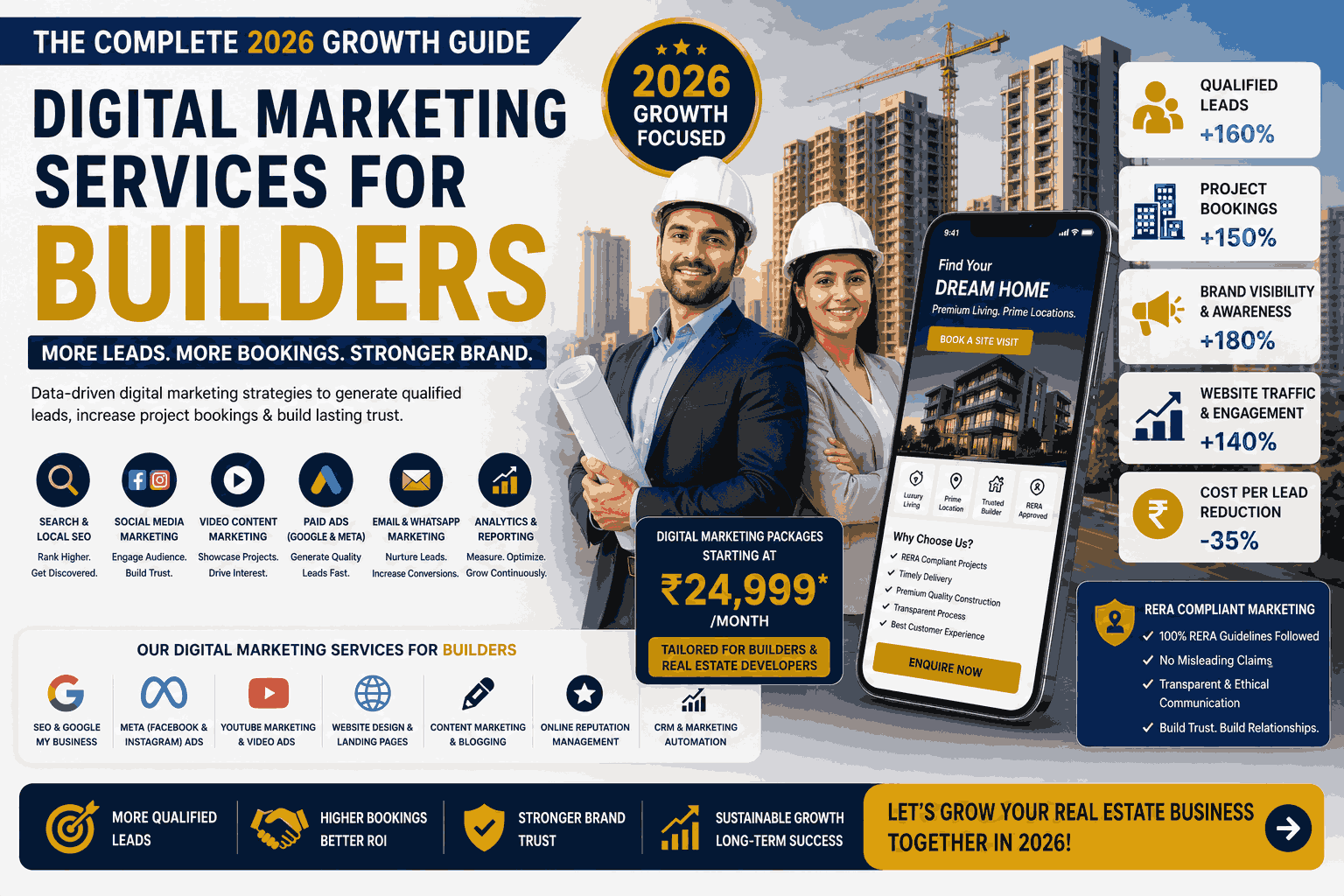
Complete Overview: Digital Marketing Services for Builders
1. Search Engine Optimization (SEO) for Builders and Developers
Real estate SEO for builders targets the queries potential buyers type when actively researching property purchases — ‘new flats in [city]’, ‘3BHK apartments near [location]’, ‘RERA approved projects in [area]’, ‘builder reviews [brand name]’. Ranking prominently for these searches represents access to the highest-intent buyer traffic available online.
Builder SEO in 2026 covers:
- Project-specific landing pages: Dedicated, SEO-optimized pages for each project targeting location-based, configuration-based, and buyer-intent keywords
- Builder brand SEO: Ensuring your company name, completed project portfolio, and management credentials appear authoritatively when buyers search your brand
- Location and locality content: Neighbourhood guides, connectivity analyses, infrastructure development content that attracts buyers researching areas where you build
- Technical SEO: Site speed, mobile-first design, Core Web Vitals compliance, structured data using RealEstateListing and LocalBusiness schema types
- RERA-integrated content: Ensuring RERA registration numbers, project details, and statutory disclosures are clearly visible and indexed — both a compliance requirement and an SEO trust signal
- AI search optimization (GEO): Structuring content to be cited in Google AI Overviews and AI platforms like Perplexity and ChatGPT when buyers ask questions like ‘best builders in [city]’ or ‘upcoming residential projects in [locality]’
Builder SEO has an exceptional long-term ROI because organic search leads — buyers who find your project through a non-paid Google search — arrive pre-qualified by their own search intent. A buyer who finds your ‘2BHK flats in [specific area] under ₹60 lakh’ page through organic search has already defined their budget and location preference. The conversion rate from organic search to site visit enquiry consistently exceeds that from broader awareness channels.
2. Google Ads and Performance Marketing for Project Launches
When a new project launches or when you need to accelerate bookings during a specific window, Google Ads for builders delivers immediate visibility to high-intent property searchers. Unlike SEO, which builds over months, a well-structured Google Ads campaign can place your project at the top of relevant search results within hours of launch.
Builder-specific Google Ads campaigns include:
- Search campaigns: High-intent keywords targeting active property searchers — ‘flats for sale in [locality]’, ‘2BHK ready possession [city]’, ‘new residential project [area]’
- Display remarketing: Banner and visual ads following website visitors across the web during their consideration phase — keeping your project front-of-mind as buyers research multiple options
- YouTube pre-roll ads: Project walkthrough or drone footage ads appearing before relevant real estate content — combining reach with visual project showcase
- Performance Max campaigns: Google’s AI-driven cross-channel campaigns appearing across Search, Display, YouTube, and Maps simultaneously — particularly effective for project launch phases requiring broad reach
- Google Discovery ads: Visual ads appearing in Google’s Discover feed, reaching buyers who match your target audience profile even before they actively search
The most critical success factor in builder Google Ads is the post-click landing page experience. Sending paid traffic to a general website homepage wastes significant budget. Project-specific landing pages with high-quality renders, floor plans, pricing, RERA details, site location map, and a prominent enquiry form consistently convert at 3–5 times higher rates than generic pages. This distinction between traffic generation and conversion optimization is what separates profitable builder PPC campaigns from expensive ones.
3. Social Media Marketing — Where Property Aspirations Are Born
Property purchase is one of the most aspirational decisions a buyer makes. Social media platforms are where those aspirations are formed, reinforced, and channelled into active intent. Builders who are present and compelling on social media influence buyer preferences weeks and months before those buyers begin formal property research.
Platform strategy for builder digital marketing:
- Instagram: High-quality architectural renders, drone site footage, construction progress updates, completed project showcases, interior design inspiration, buyer testimonial videos, and neighbourhood lifestyle content. Instagram’s visual format is ideal for property — buyers respond viscerally to beautiful imagery of the home they could own
- Facebook: Reaching the 35–55 age bracket that makes the majority of home purchase decisions, running community groups for project residents, and targeting buyers by life stage (recent marriage, expanding family, retirement planning), income bracket, and geographic location
- YouTube: The most underutilised and highest-potential platform for builders. Project walkthrough videos, construction timelapse content, completed project tours, location advantage videos, and buyer testimonials all perform exceptionally well in YouTube search — and frequently rank in Google video results too
- LinkedIn: Corporate housing tie-ups, commercial project marketing, investor-focused content for commercial and retail real estate, and premium developer brand building targeting HNI audiences
- WhatsApp Business: Project launch announcements to opted-in prospect databases, payment schedule communications, construction update videos for booked buyers, and pre-launch priority access offers
In 2026, construction progress content — regular updates showing actual construction milestones, quality checks, material specifications, and site activity — has emerged as one of the highest-engagement content categories for builders. In a market where buyer confidence in builder delivery has historically been a concern, transparency about construction progress builds trust that translates directly into booking decisions and referral conversions.
4. Paid Social Media Advertising — Precision Targeting for Homebuyers
Meta’s advertising platform (Facebook and Instagram combined) offers property builders unparalleled targeting precision for reaching specific buyer segments with project-relevant messaging.
High-performing paid social campaigns for builders include:
- Life event targeting: Reaching users who have recently married, had a child, or changed jobs — life events strongly correlated with home purchase consideration
- Income and affluence targeting: Targeting users whose demographic profile matches your project’s pricing segment — critical for luxury and premium projects avoiding mass-market audience wastage
- Geographic targeting with intent signals: Targeting users in specific cities or localities who have shown real estate interest signals through their platform behavior
- Lead generation ads: Capturing buyer name, phone number, configuration preference, and budget directly within Meta — enabling rapid, specific follow-up by your sales team
- Video walkthrough ads: 60–90 second project walkthrough videos in Meta feed ads consistently outperform static image ads in both watch time and lead conversion rate for property
- Lookalike audience campaigns: Uploading your existing buyer database to Meta to generate lookalike audiences — targeting people whose digital profiles match your existing customers
For property developers, the cost per site visit booked is the most meaningful metric for paid social campaigns — not cost per lead. A lead that converts to a site visit at 15% is worth more than a cheaper lead that converts at 3%, even if the lead cost is higher. Tracking the full funnel from ad to lead to site visit to booking is essential for optimizing builder paid social investment.
5. Builder Website Design and Project Microsites
A builder’s website and project-specific microsites are the central hub of the entire digital marketing ecosystem — every channel eventually directs qualified buyers here. A poorly designed or slow website wastes every rupee invested in SEO, social media, and paid advertising.
A high-converting builder website in 2026 must include:
- Mobile-first design: Over 72% of Indian property website traffic now arrives from mobile devices
- Project pages with comprehensive detail: Floor plans, pricing range, specifications, amenities, location map with connectivity highlights, nearby infrastructure, and construction stage updates — all visible without requiring an enquiry
- RERA registration display: Prominent RERA registration numbers for all projects — both a legal requirement and a significant buyer trust signal
- Virtual tour and 3D walkthrough integration: Interactive 360-degree walkthroughs of sample flats and common areas — the most effective tool for converting remote buyers who cannot visit the site immediately
- Completed project portfolio: A well-documented gallery of delivered projects with handover photos and buyer testimonials — the most persuasive proof of builder credibility
- Online enquiry and site visit booking forms: Easy, low-friction enquiry forms with specific fields for project interest, configuration preference, and budget range — enabling your sales team to prioritise follow-up effectively
- Fast load speed: Under 2.5 seconds on mobile — property websites that load slowly lose buyers who are comparing multiple projects simultaneously
6. Property Portal Listing Management
Housing.com, MagicBricks, 99Acres, and NoBroker collectively handle hundreds of millions of property searches monthly in India. Optimising your project listings on these platforms is a distinct and important service within the builder digital marketing ecosystem.
Portal listing optimisation includes:
- Complete, accurate project data: Every amenity, specification, floor plan variation, pricing tier, and location detail fully populated — incomplete listings rank lower and convert fewer buyers
- High-quality visual content: Professional project renders, aerial drone footage, completed unit photos, and video walkthroughs — significantly improving listing click-through and enquiry rates
- Featured and priority placement: Strategic investment in featured listings during peak booking periods for maximum visibility
- Review and rating management: Responding to buyer reviews on portals and actively encouraging satisfied buyers to leave reviews
- Lead response time management: Portal leads that receive callbacks within 5 minutes convert at dramatically higher rates than those followed up hours later — integration between portal CRM and your sales team’s workflow is critical
7. Content Marketing and Real Estate Thought Leadership
Content marketing for builders operates at two levels: SEO-driven content that attracts organic search traffic from active property researchers, and authority-building content that positions your brand as a credible, knowledgeable market participant in the eyes of both buyers and industry stakeholders.
High-performing builder content categories:
- Location and infrastructure guides: ‘Why [locality] is emerging as a residential hub’, ‘Upcoming metro connectivity in [area] — impact on property values’, ‘Social infrastructure within 5km of [project name]’
- Buyer education content: ‘Complete guide to RERA for homebuyers in [state]’, ‘Stamp duty and registration charges in [city] 2026’, ‘How to evaluate a builder’s financial credibility before booking’
- Market analysis: Quarterly or annual property market outlook for cities where you operate — establishing your brand as an informed market voice
- Project construction updates: Monthly blog or video updates showing actual construction progress, quality certifications, and milestone achievements
- Completed project case studies: Detailed stories of delivered projects — timeline, challenges, quality innovations, buyer satisfaction — demonstrating your execution capability
Content that demonstrates genuine real estate expertise — authored by or attributed to qualified architects, engineers, legal experts, or senior management — satisfies Google’s E-E-A-T requirements for YMYL property content and builds the durable organic authority that generates consistent inbound buyer interest.
8. Video Marketing and Virtual Property Experience
Property decisions involve the largest single expenditure most buyers will ever make. Video content reduces purchase anxiety by letting buyers experience the project deeply before committing to a site visit — and helps buyers who cannot visit in person (NRI buyers, buyers relocating from other cities) make informed decisions.
Essential video content for builders in 2026:
- Project walkthrough videos: Comprehensive, professionally produced tours of sample flats, amenities, common areas, and surroundings
- Drone aerial footage: Project site overview, surroundings, connectivity to key landmarks — particularly impactful for plotted developments and large township projects
- Construction progress timelapses: Monthly timelapse content compiled from consistent site camera footage — highly engaging and trust-building
- Buyer testimonial videos: Authentic interviews with actual buyers discussing their purchase journey, decision factors, and satisfaction with delivery
- Virtual reality and 360-degree tours: Matterport or similar 360-degree sample flat experiences embedded in project websites and portal listings
- Founder and management videos: Builder leadership addressing project quality commitments, delivery track record, and buyer assurance — humanising the brand in a trust-sensitive market
9. Email Marketing and CRM-Based Lead Nurturing
The real estate sales cycle is long — from initial enquiry to booking can span weeks, months, or in some cases over a year. During that extended consideration period, buyers are simultaneously evaluating competing projects, managing financial planning, and navigating life circumstances that affect their readiness to commit.
Email marketing and CRM integration keeps your project present and persuasive throughout this journey:
- Automated enquiry response sequences: Immediate email delivery of project brochure, floor plans, pricing, RERA details, and site visit invitation within minutes of every online enquiry
- Segmented nurture sequences: Different email journeys for different buyer segments — first-time buyers need education and reassurance; investors need ROI data; upgrade buyers need lifestyle and status content
- Construction update newsletters: Monthly emails to enquiry database showing actual construction progress — maintaining interest and building confidence among prospects who are not yet ready to book
- Pre-launch priority access campaigns: Building exclusivity and urgency for new projects among an engaged, opted-in prospect database
- Post-booking communication: Structured communication programme for booked buyers covering payment schedules, construction milestones, legal process updates, and possession preparation — reducing post-booking anxiety and cancellations
10. Online Reputation Management for Builders
In a market shaped by high-profile builder defaults, project delays, and quality disputes that have received significant media attention in recent years, online reputation is a primary booking driver for builders. A buyer considering a ₹80 lakh apartment does not make that commitment without thoroughly researching the builder’s delivery record, and online reviews are the primary source for that research.
Reputation management services for builders:
- Proactive review generation from satisfied buyers at delivery and after possession — the most credible review source and the most impactful timing
- Professional management of negative reviews on Google, Housing.com, MagicBricks, and 99Acres — responsive, solution-oriented responses that demonstrate accountability
- Social listening for brand mentions in real estate forums, Facebook groups, WhatsApp community groups, and Reddit — where buyer concerns about builders surface before they escalate publicly
- Crisis communication strategy: Pre-prepared response frameworks for the project delay announcements, construction issue escalations, or consumer complaint forum notices that builders occasionally face
- RERA complaint response management: Ensuring RERA-related complaints are addressed promptly and that online references to RERA actions are contextualized with the builder’s response and resolution
Digital Marketing Channel Comparison for Builders and Developers
How each major channel performs across the dimensions that determine builder marketing ROI:
| Channel | Primary Purpose | Speed to Results | Cost Level | Lead Quality | Long-Term ROI |
|---|---|---|---|---|---|
| SEO + Builder Website | Organic high-intent buyer discovery | 3–6 months | Medium | Very High | Excellent |
| Google Ads (PPC) | Immediate search visibility; project launches | Days | High | Very High | Good (optimized) |
| Meta Ads (FB + IG) | Targeted buyer awareness and leads | Days | Medium–High | Medium–High | Good–Very Good |
| YouTube (Organic + Ads) | Project showcase; brand authority | 1–4 months | Medium | Medium–High | Very Good |
| Portal Listing Optimization | Active buyer search visibility | Immediate | Medium–High | Very High | Good |
| Content Marketing | SEO foundation; buyer education | 4–8 months | Medium | High | Excellent |
| Email + CRM Nurturing | Lead-to-booking conversion; retention | 2–6 weeks | Low | Very High | Exceptional |
| WhatsApp Marketing | Prospect engagement; buyer communication | Immediate | Very Low | Very High | Exceptional |
| ORM / Reviews | Trust building; conversion rate uplift | Ongoing | Low–Medium | Indirect | Very High |
Recommended Digital Marketing Strategy by Builder Type and Project Category
| Builder / Project Type | Priority Channels | Key Message Focus | Approx. Monthly Budget |
|---|---|---|---|
| Affordable Housing (₹25–60L) | Google Ads, Meta Ads, Portal Listings, Local SEO | EMI affordability, location, RERA approval, delivery track record | ₹50,000 – ₹1.5 lakh |
| Mid-Segment Residential | SEO, Google Ads, YouTube, Meta Ads, Email CRM | Lifestyle, specifications, connectivity, builder credibility | ₹1 lakh – ₹3 lakh |
| Premium / Luxury Developer | SEO, YouTube, Meta Ads, LinkedIn, PR, WhatsApp | Exclusivity, architecture, brand prestige, lifestyle experience | ₹3 lakh – ₹10 lakh |
| Plotted Development | SEO, Google Ads, Meta Ads, Drone Video, Content | Investment returns, location growth, flexibility, RERA compliance | ₹75,000 – ₹2.5 lakh |
| Commercial / Office Space | LinkedIn, SEO, Content Marketing, Google Ads | ROI, tenant profile, connectivity, investment security | ₹1 lakh – ₹3.5 lakh |
| Township / Large Project | Full funnel: SEO + PPC + Social + Video + CRM + PR | Master plan, lifestyle ecosystem, long-term community value | ₹5 lakh – ₹20 lakh+ |
2026 Updates: What Has Changed in Builder Digital Marketing
Google AI Overviews Are Reshaping Property Research
Google’s AI-generated search summaries now appear for many property research queries — ‘best builders in [city]’, ‘upcoming projects in [locality]’, ‘is [builder name] reliable’. Builders whose website content, project pages, and FAQ sections directly and authoritatively answer these questions are being cited in AI Overviews, earning brand impressions and search presence even when buyers do not click through. Content specifically structured to answer buyer questions — ‘Is [builder] RERA registered?’, ‘What projects has [builder] delivered on time?’ — is now a strategic asset for AI search visibility.
Virtual and Augmented Reality Has Become a Standard Expectation
In 2026, buyers comparing premium residential projects expect immersive digital experiences as standard. 360-degree virtual tours, AR-enabled flat configuration tools (where buyers can visualize different interior finishes), and interactive floor plan explorers are no longer differentiators — they are baseline expectations. Builders without these digital experiences are perceived as dated in premium market segments, regardless of actual project quality.
RERA Digital Compliance Requirements Have Expanded
Across multiple states, RERA authorities have strengthened requirements for how builders represent projects in digital advertising. Website project pages, social media posts promoting specific projects, and paid digital advertisements must display RERA registration numbers, accurate possession dates, and substantiated amenity descriptions. RERA authorities in Maharashtra (MahaRERA), Karnataka (K-RERA), and Delhi NCR have issued specific guidance on digital advertising compliance. Non-compliant digital campaigns — including those on Google Ads and Meta — carry formal penalty risk. All builder digital marketing content must be reviewed against current state RERA guidelines before publication.
NRI Buyer Digital Marketing Has Grown Significantly
India’s NRI property buyer segment has grown substantially in 2025–2026, driven by favourable currency differentials and increased confidence in Indian real estate. NRI buyers conduct their entire research journey online — they cannot visit projects before booking in many cases. Builders who have invested in comprehensive digital project experiences — virtual tours, detailed specification documentation, transparent RERA data, video testimonials from delivered project buyers — are capturing disproportionate NRI buyer share. Targeted NRI buyer campaigns through Meta’s international audience targeting and LinkedIn have become a meaningful channel for premium builders.
WhatsApp Business API for Builder Sales Team Integration
In 2026, leading builders have integrated WhatsApp Business API with their CRM platforms to create seamless, automated buyer communication pipelines. Lead enquiries from Google Ads, portal listings, and website forms are automatically sent a WhatsApp message with project brochure, floor plans, and site visit invitation within minutes of enquiry submission. This immediate response capability — far exceeding what most builders’ phone-based sales teams can achieve — has produced documented improvements in site visit booking rates of 25–40% among early adopters.
India’s DPDPA 2023 — Compliance for Builder Digital Marketing
India’s Digital Personal Data Protection Act (DPDPA) 2023 applies directly to builders collecting buyer data through digital channels. Online enquiry forms, lead generation ads, WhatsApp opt-ins, and CRM databases all involve personal data processing that requires explicit, documented consent under DPDPA. Builders must provide clear privacy notices at all digital data collection points, limit data use to stated purposes, and maintain consent records. Channel partners and broker networks that receive buyer lead data from digital campaigns must also operate within DPDPA compliant data sharing agreements. Legal review of data collection and processing practices is strongly advisable for builders running digital campaigns at scale.
Honest Pros and Cons of Digital Marketing Services for Builders
Advantages
- Intent-matched lead quality: Buyers who find your project through Google search or portal listings are actively researching property — their enquiry intent is far higher than responses to awareness advertising, resulting in higher site visit and booking conversion rates
- Measurable full-funnel attribution: From the first ad impression through to booking, every step of the buyer journey can be tracked, attributed to its source, and optimized — a level of accountability traditional real estate advertising cannot provide
- Geographic and demographic precision: Digital advertising reaches specific buyer segments — by city, locality, income bracket, life stage, and property interest — eliminating the significant waste inherent in mass-market traditional advertising
- 24/7 project visibility: Your website, portal listings, and social channels represent your project continuously — capturing buyers researching during evenings and weekends when your sales office is closed
- NRI buyer reach: Digital channels are the only practical way to reach and engage with NRI buyers who conduct their entire research journey from abroad — a segment that makes high-value purchases with lower negotiation sensitivity than domestic buyers
- Compounding SEO returns: Builder website SEO and content marketing investments deliver organic lead traffic that grows over time without proportional ongoing cost — significantly reducing cost per lead compared to paid channels over 12–24 month periods
- Trust building at scale: Consistent digital presence — construction progress content, RERA transparency, buyer testimonials, review management — builds the buyer trust that is the most commercially valuable asset a builder can hold
Disadvantages
- High initial investment for quality digital assets: Professional project renders, virtual tours, drone footage, and well-designed project microsites require significant upfront investment — particularly challenging for smaller builders with limited marketing budgets
- Extended time to organic results: SEO and content marketing require 4–8 months before generating meaningful organic traffic — making them unsuitable as standalone strategies for project launches requiring immediate lead volume
- RERA compliance complexity: All digital marketing content for real estate projects must be reviewed against state-specific RERA guidelines — an ongoing compliance obligation that requires either in-house legal resource or agency expertise
- Portal dependency risk: Heavy reliance on property portals for lead volume creates commercial dependency on platforms that increase listing costs and can change lead distribution algorithms affecting builder visibility
- Lead quality variance in paid channels: Google Ads and Meta campaigns generate enquiries across a range of readiness levels — managing the high volume of early-stage enquiries to identify and prioritise booking-ready buyers requires capable CRM systems and trained sales teams
- Algorithm volatility: Changes to Google search ranking factors, Meta ad targeting capabilities, or portal listing algorithms can significantly impact lead volume from specific channels with limited advance warning
- Data privacy compliance overhead: Managing DPDPA-compliant buyer data collection, consent records, and partner data sharing across a complex real estate marketing ecosystem requires legal and operational resources that represent genuine overhead for builders
RERA Compliance, Trust, and Regulatory Standards in Builder Digital Marketing
RERA Advertising Compliance — A Non-Negotiable Baseline
The Real Estate (Regulation and Development) Act 2016, administered through state RERA authorities, imposes specific obligations on how builders advertise and market projects. In digital marketing, this means all project advertisements — including Google Ads, Meta social ads, website project pages, portal listings, and WhatsApp project promotions — must display the valid RERA registration number for the project. Advertising projects before RERA registration is obtained is a specific violation. Making claims about amenities, possession dates, pricing, or specifications that are not accurately reflected in the RERA-registered project details is also prohibited.
State RERA authorities including MahaRERA (Maharashtra), TNRERA (Tamil Nadu), HRERA (Haryana), and K-RERA (Karnataka) have each issued specific digital advertising guidelines that builders operating in their jurisdictions must follow. Working with a digital marketing agency that understands state-specific RERA requirements is strongly advisable for builders with multi-city or multi-project digital marketing programmes.
Consumer Protection and Advertising Claims
The Consumer Protection Act 2019 and the Advertising Standards Council of India (ASCI) guidelines apply to builder advertising. Claims about possession dates, construction quality, amenity specifications, and investment returns in digital ads must be accurate and substantiated. Aggressive possession timeline promises or guaranteed return claims — common in some property advertising — carry both regulatory risk and buyer relationship risk when delivery reality diverges from marketing representation.
Builder Financial Credibility and Digital Trust Signals
In a market where buyer concern about builder financial stability and project delivery is genuinely high, digital marketing that demonstrates builder credibility and delivery track record converts significantly better than project-feature-focused advertising. Displaying completed project portfolios with handover dates, third-party construction quality certifications, banking and financial partner information (IIFL, HDFC, LIC approved lending), and transparent RERA project histories builds the trust that makes buyers confident enough to write booking cheques.
Data Security for Online Buyer Data Collection
Builders collecting buyer personal and financial data through online enquiry forms, payment interest forms, and digital booking platforms must implement adequate data security: SSL across all web pages handling personal data, secure data storage and access controls, and regular security audits. Buyer data breaches in the real estate sector have attracted regulatory attention under DPDPA. For builders using third-party CRM platforms or sharing lead data with channel partners, ensuring these platforms are contractually bound to data security standards equivalent to your own obligations is an important risk management measure.
Digital Marketing Cost Benchmarks for Builders — India 2026
| Service | Agency Fee (Monthly) | Ad Spend (Separate) | Expected Outcome |
|---|---|---|---|
| SEO + Website Optimization | ₹20,000 – ₹60,000 | None | Organic search rankings; compounding lead growth from month 4–6 |
| Google Ads Campaign Management | ₹15,000 – ₹40,000 | ₹30,000 – ₹2 lakh+ | Immediate high-intent enquiries; typically 20–80 leads/month |
| Meta Ads (FB + Instagram) | ₹12,000 – ₹35,000 | ₹20,000 – ₹1.5 lakh | Buyer awareness + leads; 30–120 leads/month depending on budget |
| Content Marketing / Blogging | ₹15,000 – ₹35,000 | None | SEO authority; buyer education traffic; 3–6 month build |
| Portal Listing Management | ₹10,000 – ₹25,000 | ₹15,000 – ₹50,000 | Portal lead volume; featured visibility on MagicBricks, 99Acres |
| Video Production | ₹30,000 – ₹2 lakh+ | None (production cost) | Project walkthroughs, testimonials, construction updates |
| Email + CRM Nurturing | ₹8,000 – ₹20,000 | ₹2,000 – ₹8,000 | Enquiry-to-site-visit conversion; lead nurturing through cycle |
| WhatsApp Business Automation | ₹8,000 – ₹20,000 | ₹2,000 – ₹10,000 | Instant lead response; buyer communication automation |
| ORM / Reputation Management | ₹10,000 – ₹25,000 | None | Review growth; negative review response; brand trust uplift |
| Full-Service Builder Marketing | ₹80,000 – ₹5 lakh+ | ₹50,000 – ₹3 lakh+ | Integrated multi-channel lead generation and conversion strategy |
Important: Agency fees and advertising spend are separate budget line items. A builder paying ₹25,000/month in Google Ads management fees should budget an additional ₹50,000–₹2 lakh in actual Google ad spend depending on market competitiveness and required lead volume. Always obtain a clear breakdown of both components in any agency proposal.
Frequently Asked Questions — Digital Marketing Services for Builders
For most builders, the highest immediate-impact investment is a combination of Google Ads targeting high-intent property search terms and a well-designed project-specific landing page with a clear enquiry form. This combination delivers immediate, measurable lead volume from buyers actively searching for properties in your segment and location. Simultaneously, initiating local SEO and Google Business Profile optimization builds organic visibility that reduces cost per lead progressively over the following 3–6 months.
For a mid-segment residential builder running a single active project, a realistic monthly investment covering SEO, Google Ads, Meta Ads, and basic content (including both agency fees and ad spend) ranges from ₹1.5 lakh to ₹4 lakh per month. Premium and luxury developers with multiple active projects typically invest ₹5 lakh to ₹15 lakh or more monthly. Costs scale significantly with project launch phase intensity and the number of simultaneous active projects being marketed.
Yes — across all states where RERA is operational, builders are legally required to display the valid RERA registration number for a project in all advertising and marketing materials, including digital advertisements on Google, Facebook, Instagram, property portals, and project websites. Advertising a project before obtaining RERA registration is specifically prohibited. State RERA authorities have issued formal penalties for non-compliant digital advertising. All builder digital marketing content should be reviewed against current state RERA guidelines before any campaign goes live.
NRI buyers are best reached through a combination of Meta advertising targeting Indian diaspora audiences in key NRI markets (UAE, USA, UK, Canada, Singapore, Australia) with project-specific ads, comprehensive virtual tour content enabling remote property evaluation, dedicated NRI buyer landing pages addressing their specific concerns (payment schedules for overseas buyers, legal requirements for NRI property purchase, banking and repatriation norms), and YouTube content that NRI property researchers actively consume. WhatsApp-based inquiry handling is particularly important for NRI leads due to time zone constraints on phone communication.
Paid campaigns (Google Ads and Meta Ads) generate enquiries within days of launch and typically begin producing site visits within 2–4 weeks when paired with effective follow-up. Converting those site visits to bookings depends on project readiness, pricing positioning, and sales team effectiveness. Organic channels — SEO, content marketing, YouTube — require 4–8 months before generating meaningful independent lead volume, but deliver lower cost per lead at scale. A full-funnel digital marketing strategy combining paid and organic channels typically shows clear booking attribution within 60–90 days of launch.
Based on conversion data across builder digital marketing, the five highest-performing content types for property sales are: (1) Professional walkthrough videos showing actual sample flat experience, (2) Drone aerial footage showing project site, surroundings, and connectivity, (3) Construction progress updates demonstrating delivery confidence, (4) Authentic buyer testimonial videos from delivered project purchasers, and (5) Location advantage content showing proximity to key infrastructure and lifestyle amenities. Static renders and brochure content, while necessary, convert at significantly lower rates than video content for serious buyers.
Both play essential and complementary roles. Property portals (Housing.com, MagicBricks, 99Acres) provide access to millions of actively searching buyers who begin their search on these platforms and would not necessarily find the builder’s own website independently. The builder’s own website provides deeper project information, brand trust signals, RERA documentation, completed project portfolio, and a more controlled buyer journey than portals allow. The most effective builder marketing maintains optimised presence on both — using portals for active buyer discovery and the builder’s own website for converting shortlisted buyers into site visit bookings.
A builder’s project website converts best when it provides: (1) Comprehensive project specifications without requiring an enquiry, (2) All available floor plans with pricing ranges clearly displayed, (3) RERA registration number and project details prominently visible, (4) Virtual tour or 360-degree walkthrough of sample flat and amenities, (5) Completed project portfolio with delivery dates and buyer testimonials, (6) Location advantage section with proximity to key infrastructure, (7) Online site visit booking form with specific date and time selection, and (8) Fast mobile load speed under 2.5 seconds. Websites that require buyers to call or enquire before receiving basic project information lose a significant portion of the comparison-stage buyers they attract.
DPDPA 2023 requires that builders obtain explicit, documented consent from buyers before collecting and using their personal data through digital channels — including Google lead generation ads, Meta lead forms, website enquiry forms, and WhatsApp opt-ins. Buyers must be informed of how their data will be used (follow-up calls, email marketing, channel partner sharing) and must actively consent to each use type. Data sharing with broker networks and channel partners must be covered by DPDPA-compliant data processing agreements. Builders should review their website privacy policies, enquiry form consent mechanisms, and CRM data practices with legal counsel to ensure full compliance.
For most builders, a hybrid model delivers the best results: an in-house marketing manager or team responsible for brand consistency, project content oversight, RERA compliance review, and sales-marketing alignment, combined with a specialist real estate digital marketing agency managing technical SEO, paid advertising campaigns, analytics, and platform optimization. Full in-house management rarely achieves the technical depth in SEO, PPC, and analytics that specialist agencies provide. Full agency management often lacks the brand and compliance knowledge that in-house teams bring. The hybrid approach captures the strengths of both while managing total cost efficiently.