Most businesses don’t have a marketing problem — they have a coordination problem. The SEO agency does its thing, the ads run somewhere else, social posts go out on their own schedule, and email lives in a different tool entirely. Each channel reports its own “wins,” yet the customer experiences a muddle of mixed messages, and nobody can say what actually drove the sale. That gap is exactly what integrated digital marketing services are built to close.
Integrated digital marketing means running all your channels — SEO, content, social, paid ads, email, automation, and more — as one coordinated system, with shared data, consistent messaging, and a single way of measuring what works. It matters more in 2026 than ever, because the lines between channels have collapsed. People now drift seamlessly between a search result, a Reel, a question to an AI assistant, and a YouTube clip before they buy, never once thinking in terms of “channels.” Your marketing has to behave the same way.
This guide is written for business owners and marketers in India who are tired of disconnected effort and want a clear picture of how integration works, what it includes, what it costs, and how to measure it. As you’ll see, the goal isn’t to do more marketing — it’s to make every part of your marketing pull in the same direction, so the whole becomes far greater than the sum of its parts.
What Are Integrated Digital Marketing Services?
Integrated digital marketing services coordinate every digital channel under one strategy, one set of goals, shared customer data, and consistent messaging — so that each channel reinforces the others across the full customer journey, from first discovery to purchase and loyalty. Instead of isolated campaigns, you get a connected system where the parts talk to each other.
Integrated vs siloed marketing — the core difference
It helps to be precise here, because “multichannel” and “integrated” are often confused. Being on many channels is not the same as being integrated. Multichannel simply means you’re present on several platforms. Integrated (or omnichannel) means those platforms share data, context, and intent, and present one consistent experience. The difference is coordination: in a siloed setup, channels compete for credit and contradict each other; in an integrated one, they cooperate toward a shared outcome.
The channels that get integrated
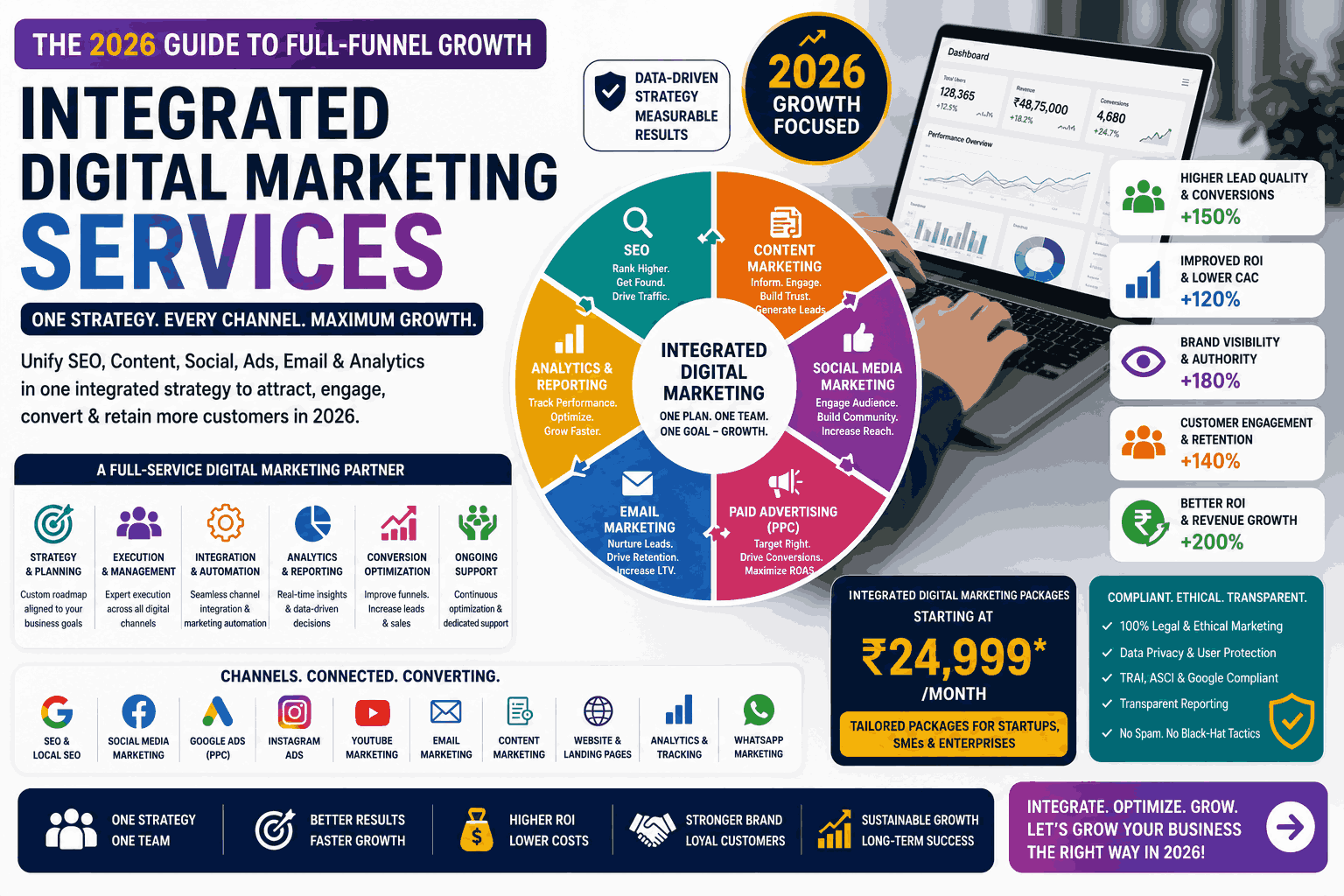
An integrated programme typically brings together:
- SEO and AEO/GEO — organic visibility across Google and AI answer engines.
- Content marketing — an interconnected content ecosystem, not isolated posts.
- Social media and short-form video — discovery, engagement, and community.
- Paid search and paid social — fast, targeted reach and conversions.
- Email and WhatsApp marketing — owned channels for nurture and retention.
- Marketing automation and CRM — orchestration and customer data.
- Conversion rate optimisation and landing pages — turning traffic into action.
- Analytics and attribution — one source of truth for measurement.
Why Integration Matters More Than Ever in 2026
The single biggest shift in 2026 is the collapse of channel boundaries. Search, social, video, shopping, and AI assistants increasingly overlap, and customers move fluidly between them — watching a short video, reading a snippet in Google Discover, asking a follow-up question in ChatGPT, then clicking a result — without ever thinking about which “channel” they’re in. If your marketing is split into silos, you simply can’t meet customers in that fluid journey.
Three forces make integration essential. First, customers research across many touchpoints before buying, so a single channel leaves gaps. Second, the rise of AI search and zero-click results means brand visibility and a consistent presence across formats matter more than any one ranking. Third, with privacy tightening and third-party cookies fading, first-party data — information customers share with you directly — has become the foundation of both personalisation and measurement, and that data only works when it’s unified across channels.
There’s a hard commercial reason too. When channels run in silos, the typical results are inconsistent messaging, duplicated or wasted spend, and broken attribution that makes good decisions impossible. Industry experience suggests that moving from a fragmented approach to a properly orchestrated one can substantially lift — sometimes even double — the revenue contribution of digital marketing, simply by making the parts work together.
What’s Included in Integrated Digital Marketing Services
Here’s how the main pillars fit together — and, crucially, how each one connects to the rest.
| Pillar | What It Does | How It Connects |
|---|---|---|
| SEO & AEO/GEO | Earns organic and AI-answer visibility | Content and PR feed it; data guides it |
| Content marketing | Builds authority and answers intent | Powers SEO, social, email, and ads |
| Social & video | Drives discovery and engagement | Amplifies content; feeds retargeting |
| Paid search & social | Delivers fast, targeted reach | Uses content and first-party audiences |
| Email & WhatsApp | Nurtures and retains customers | Activates CRM data; supports all stages |
| Automation & CRM | Orchestrates journeys and data | The connective layer for every channel |
| CRO & landing pages | Converts traffic into action | Improves ROI of all traffic sources |
| Analytics & attribution | Measures the full funnel | One source of truth for every decision |
How Integrated Digital Marketing Works — Across the Full Funnel
The power of integration shows up when you map channels to the customer journey, with a shared data layer underneath connecting it all.
Awareness — getting discovered
At the top of the funnel, SEO, content, social media, short-form video, and PR work together to make you visible wherever people look — including AI answer engines. The same core message and content are adapted across formats, so a blog, a Reel, and an AI-cited answer all reinforce one another rather than competing.
Consideration — building trust
As people evaluate you, retargeting ads, email and WhatsApp sequences, reviews, case studies, and deeper content keep you present and credible. Because channels share data, someone who read a guide can be shown a relevant follow-up rather than a generic ad, which is where integration starts to compound.
Conversion — turning interest into action
At the decision point, conversion rate optimisation, well-built landing pages, paid search capturing high intent, and timely offers do the heavy lifting. Consistent messaging from earlier stages means there’s no jarring disconnect when a customer is ready to act.
Retention and advocacy — keeping and growing customers
After the sale, email, WhatsApp, loyalty programmes, and community turn one-time buyers into repeat customers and advocates. This is where owned channels and first-party data pay off most, and where integrated marketing protects margins by reducing the need to keep buying new customers.
The data layer that connects everything
Underneath all four stages sits the real engine of integration: unified customer data. A shared view — often through a CRM or customer data platform — lets every channel act on the same, up-to-date understanding of each customer, and lets you measure the journey end to end instead of letting each channel claim isolated credit.
The Big 2026 Shifts Shaping Integrated Marketing
Several developments are reshaping how integrated marketing is run this year.
1. AI as the connective layer
AI has moved from a content gimmick to the layer that makes integration practical. It interprets customer behaviour, predicts the next best action, personalises creative and timing, and increasingly reallocates budget across channels automatically — shifting spend toward whatever is delivering the best return in real time. The competitive gap in 2026 isn’t between brands that use AI and those that don’t; it’s between brands with rich, unified data and those guessing at what customers want.
2. AI search and answer-engine optimisation
Search is becoming answer-led. Optimising for AI Overviews and assistants like ChatGPT, Gemini, and Perplexity (AEO/GEO) now sits alongside traditional SEO as one unified visibility effort. With zero-click results rising, being a consistently cited, trustworthy presence across formats matters more than chasing a single ranking — and that consistency is only possible with an integrated content and data strategy.
3. First-party data and privacy-first marketing
As third-party cookies fade and privacy rules tighten, first-party and zero-party data — collected with consent — have become the backbone of integrated marketing. Brands that use this owned data for personalisation see markedly higher engagement, while staying compliant. The unified customer profile is now both the personalisation engine and the measurement foundation.
4. Unified measurement and attribution
Measurement is shifting decisively away from last-click and vanity metrics toward connected, revenue-linked reporting — multi-touch attribution, incrementality testing, and marketing-mix modelling that reveal how channels truly work together. The conversation has moved from isolated channel reports to shared revenue reporting that the whole business can trust.
5. Marketing automation and personalisation at scale
Automation has evolved from scheduled workflows into something closer to an operating layer that connects data, content, orchestration, and measurement. Good systems now coordinate rather than fire blindly — they know what a customer has already seen, pick the right channel for the moment, and hold back when another touchpoint has already moved them forward. That coordination is the essence of integration.
The Economics: Why Integration Beats Silos
Let’s talk money, because that’s where integration earns its keep. Running channels in silos is expensive in ways that don’t always show up on a single invoice — and integration fixes most of them. Here’s the contrast.
| Dimension | Siloed Channels | Integrated Approach |
|---|---|---|
| Messaging | Inconsistent, sometimes contradictory | Consistent across every touchpoint |
| Budget | Duplicated effort and wasted spend | Reallocated to what performs |
| Data | Fragmented; no single view | Unified customer profile |
| Attribution | Last-click; channels claim credit | Full-funnel, revenue-linked |
| Customer journey | Disjointed handoffs | Seamless across stages |
| Result | Capped, hard-to-prove ROI | Compounding, measurable growth |
Think of it like a portfolio. A siloed setup is a handful of investments managed by people who never speak to each other — some overlap, some cancel out, and you can’t see the blended return. An integrated approach manages the whole portfolio together, shifting budget toward what’s working and cutting what isn’t, with one clear view of performance. The metric that matters is the blended one: your overall cost to acquire a customer, the lifetime value of that customer, and the ratio between them — not whether one channel looks good in isolation.
This is also why integration tends to improve capital efficiency rather than just “do more.” By removing duplicated spend, sharpening targeting with shared data, and retaining customers through owned channels, the same budget works harder. The goal isn’t a bigger marketing bill; it’s a better return on the one you already have.
Integrated Agency vs Point Services vs In-House
How should you actually run integrated marketing? Here’s an honest comparison of the common models.
| Factor | Point / Siloed Vendors | In-House Team | Integrated Agency |
|---|---|---|---|
| Coordination | Low — separate vendors | High, if well-led | High — one strategy |
| Cost | Adds up across vendors | Salaries + tools (high) | One retainer + spend |
| Breadth of skills | Deep but narrow each | Limited by headcount | Broad across channels |
| Data & attribution | Often fragmented | Unified if resourced | Unified by design |
| Best for | One-off needs | Large, mature brands | Most growing businesses |
The verdict: a few large organisations can build a fully integrated in-house team, and point vendors suit specific one-off needs. But for most growing businesses, an integrated agency — or a single coordinated team owning the whole strategy and data — delivers the coordination, breadth, and unified measurement that make integration actually work, without the cost of hiring every specialism in-house.
How Much Do Integrated Digital Marketing Services Cost in India in 2026?
Let’s be direct. Integrated programmes cost more than a single channel because they do more and tie it together — but they typically use the total budget more efficiently. Here are realistic 2026 ranges for the Indian market.
| Tier | Monthly Fee | What You Get | Best For |
|---|---|---|---|
| Starter | ₹30,000–50,000 | Coordinated SEO, content, social, basic ads & email | Small businesses going beyond one channel |
| Growth | ₹50,000–1,20,000 | Multi-channel mix, automation, CRO, reporting | Established SMEs scaling up |
| Full integrated | ₹1,20,000–3,00,000+ | All channels, data layer, attribution, strategy | Brands wanting full-funnel growth |
| Enterprise | ₹3,00,000+ | Advanced data, multi-market, dedicated team | Large brands and groups |
Management fee vs ad spend and tools — and GST
The management fee is not the whole bill. Two costs sit alongside it: paid media spend (what goes to Google, Meta, and others), and technology — analytics, automation, or a customer data platform. A quote that hides these in one “all-inclusive” number is doing you no favours. Remember too that 18% GST applies to Indian agency fees, so a ₹1,00,000 retainer really costs ₹1,18,000.
A simple budgeting rule
Don’t guess. Many growing businesses allocate roughly 7–15% of revenue to marketing, then divide it across the funnel — awareness, conversion, and retention — rather than pouring it all into one stage. The advantage of an integrated approach is that you can shift budget between channels as the data shows what’s working, instead of being locked into a fixed split. Start with enough to run a few channels well; spreading too little across too many produces weak results everywhere.
Advantages and Disadvantages of Integrated Digital Marketing Services
Every agency sells the upside. Here’s an honest look at both sides.
Advantages
- Channels amplify each other — content fuels SEO, social, email, and ads at once.
- Consistent brand experience — one message across every touchpoint builds trust.
- Better capital efficiency — less wasted spend, budget shifted to what works.
- Clearer attribution — full-funnel measurement shows what truly drives results.
- Stronger retention — owned channels and data turn buyers into repeat customers.
- Future-ready — built around first-party data, AI search, and privacy from the start.
Disadvantages
- Higher upfront cost and setup — more moving parts than a single channel.
- Needs coordination and data discipline — silos and messy data undermine it.
- Takes time to fully compound — the biggest gains build over several months.
- Harder to find true generalist partners — many agencies are channel specialists.
- Tooling adds expense — automation and analytics platforms cost extra.
- No legitimate shortcuts — credible providers don’t promise instant, guaranteed results.
Security, Compliance, and Trust in Integrated Marketing
Because integration runs on unified customer data, doing it responsibly is both a legal duty and a trust advantage. A good partner builds these in from the start.
First-party data and the DPDP Act
The unified customer profile that powers integrated marketing is personal data under India’s Digital Personal Data Protection Act, 2023. Collect it with clear consent, use it only for the purposes customers agreed to, store it securely, and make opting out easy. A single, connected data layer is powerful, but it also concentrates responsibility — so consent, purpose limitation, and good data governance are non-negotiable.
Honest advertising and transparency
Across every channel, marketing must be truthful under ASCI norms, and any influencer or sponsored content must be disclosed clearly. India’s dark-pattern guidelines also prohibit manipulative tactics such as false urgency, hidden charges, and basket sneaking — so an integrated checkout and campaign journey should be transparent end to end, not just on the surface.
Data security and ownership
Unifying data raises the stakes if it’s mishandled, so secure storage, access controls, and careful vendor selection matter. Just as importantly, your data and accounts should belong to you — your website, analytics, ad accounts, CRM, and customer database — with any agency given access, never the other way around. If you ever change partners, you keep the asset that integration is built on.
Consistency as a trust signal
Finally, consistency itself builds trust. When your message, tone, and promises line up across search, social, email, and support, customers feel they’re dealing with one coherent, credible brand — and both people and AI systems reward that coherence. Integration isn’t only an efficiency play; it’s a trust play.
How to Choose an Integrated Digital Marketing Agency
Use this as a filter when evaluating providers.
Green flags
- They start with strategy and your customer journey, not a channel pitch.
- They unify data and measure across the full funnel, not channel by channel.
- They separate management fees, ad spend, and tooling transparently.
- They talk about first-party data, consent, and the DPDP Act without prompting.
- They report on blended CAC, LTV, conversions, and revenue — not vanity metrics.
Red flags
- They pitch one channel as a silver bullet, or promise guaranteed results.
- “All-inclusive” pricing that hides ad spend and tool costs.
- They can’t explain how they’ll connect channels and data.
- They want to own your accounts, data, or customer database.
- They rely on last-click reporting and weekly CSV exports to “prove” ROI.
Questions worth asking before you sign
- How will you connect our channels and data into one strategy?
- How do you measure ROI across the full funnel, not just last click?
- Are ad spend and tools separate, and what do you recommend for us?
- How do you collect and protect first-party data under the DPDP Act?
- Who owns our website, accounts, analytics, and customer data?
- What does the first 90 days of integration look like?
Measuring ROI — Metrics That Matter for Integrated Marketing
Integration only proves its worth if you measure the whole, not the parts. Track outcomes tied to revenue, and judge the system on its combined effect.
- Blended customer acquisition cost — the true, all-in cost to win a customer.
- Customer lifetime value and LTV:CAC — the ratio that shows sustainable growth.
- Full-funnel conversion — how efficiently people move from awareness to purchase.
- Assisted conversions and multi-touch attribution — how channels work together.
- Retention and repeat rate — where owned channels and loyalty pay off.
- Share of search and AI visibility — your presence across Google and answer engines.
| Timeframe | What to Expect |
|---|---|
| Month 1 | Strategy, data and tracking set up; quick wins from removing waste and fixing targeting. |
| Month 2–3 | Channels start reinforcing each other; paid efficiency improves and content gains traction. |
| Month 4–6+ | Organic, retention, and attribution compound; blended CAC falls and growth becomes durable. |
Expert Insights — Making Integration Work in 2026
A few hard-won principles from teams running integration well:
- Start with the customer journey, not channels. Map how people actually discover and decide, then assign channels to stages.
- Make data the foundation. Unified, consented first-party data is what turns separate channels into one system.
- Keep messaging consistent. One voice and promise across every touchpoint compounds trust and recognition.
- Treat content as an ecosystem. Interconnected content beats isolated posts for SEO, social, and AI visibility.
- Measure the whole, not the parts. Judge success by blended CAC, LTV, and revenue, not channel vanity metrics.
- Let data move the budget. Shift spend toward what’s working instead of locking into a fixed split.
- Build privacy in from day one. Consent and good governance protect both customers and your results.
Frequently Asked Questions
Integrated digital marketing services bring all your marketing channels — SEO, content, social media, paid ads, email, automation, and more — under one coordinated strategy, shared data, and consistent messaging, instead of running them in disconnected silos. The aim is to guide a customer smoothly across the whole journey, from first discovery to purchase and loyalty, with every channel reinforcing the others and a single source of truth measuring what actually drives results.
Regular digital marketing often runs each channel separately — one team or agency does SEO, another runs ads, another posts on social — with separate goals and no shared view of the customer. Integrated marketing connects them: channels share data and context, messaging stays consistent, and success is measured across the full funnel rather than channel by channel. The difference is coordination, and it typically means less wasted spend, clearer attribution, and stronger overall results.
In 2026, integrated packages in India usually start around ₹30,000–50,000 per month for a coordinated starter setup, rising to ₹50,000–1,20,000 for growth-stage programmes across several channels. Full integrated management for established brands typically ranges from ₹1,20,000 to ₹3,00,000+ per month, and enterprise engagements go higher. Paid ad spend and tools such as automation or analytics platforms are usually separate, and 18% GST applies to Indian agency fees.
A typical integrated programme spans SEO and answer-engine optimisation, content marketing, social media and short-form video, paid search and paid social, email and WhatsApp marketing, marketing automation and CRM, conversion rate optimisation, website and landing pages, and analytics and attribution. The exact mix depends on your goals and audience, but the defining feature is that these channels are planned together and share data, not run in isolation.
For most businesses beyond the earliest stage, yes. A single channel can work for a while, but customers now move across search, social, video, and AI assistants before buying, so relying on one channel leaves gaps and caps your growth. Integrated marketing captures customers wherever they are and lets channels amplify each other — content fuels SEO and social, retargeting supports paid, email drives retention — usually producing better and more durable results than any one channel alone.
It varies by channel within the mix. Paid ads and well-targeted campaigns can drive results within days to weeks, while SEO, content, and authority-building usually take three to six months to compound. Integration itself often improves results fairly quickly by reducing wasted spend and sharpening targeting, but the biggest gains — compounding organic growth, loyalty, and efficient acquisition — build over six to twelve months of consistent, coordinated execution.
Through full-funnel, revenue-linked measurement rather than last-click or vanity metrics. That means unified analytics, multi-touch attribution that credits how channels work together, and increasingly incrementality testing and marketing-mix modelling to understand true impact. Key numbers include blended customer acquisition cost, customer lifetime value and the LTV-to-CAC ratio, conversion and retention rates, and overall return on ad spend — all tied back to actual business outcomes.
Small businesses can start with one or two channels, but even they benefit from a connected approach. The key is to begin with the basics done well — say a strong Google presence, a little content, and email or WhatsApp follow-up — while keeping messaging consistent and capturing customer data you own. As you grow, you add channels into the same coordinated system rather than bolting on disconnected efforts, so integration scales with you instead of being a costly retrofit later.
Modern integrated marketing is built around first-party data — information customers share with you directly — collected with clear consent and handled under India’s Digital Personal Data Protection Act, 2023. A unified customer view powers personalisation and attribution, but it also concentrates responsibility, so reputable providers prioritise consent, purpose limitation, secure storage, and transparency. Done right, privacy-first integration builds trust while still delivering the personalised, measurable experiences customers expect.
Final Verdict
Integrated digital marketing services are, at heart, about coherence: making every channel, message, and data point work together toward one goal instead of pulling in different directions. In 2026, with channel boundaries collapsing and customers moving fluidly across search, social, video, and AI assistants, that coherence has shifted from a nice-to-have to the difference between marketing that compounds and marketing that leaks money. The brands that win aren’t running more campaigns — they’re running a connected system.
If you’re considering this, go in with clear eyes. Build around your customer journey and unified, consented first-party data, keep your message consistent everywhere, demand transparent pricing that separates fees, ad spend, and tools, and judge results by blended, revenue-linked metrics rather than channel vanity numbers. Do that, and integrated digital marketing stops being a bundle of services and becomes what it should be — a single, efficient growth engine that turns scattered effort into durable, measurable results.