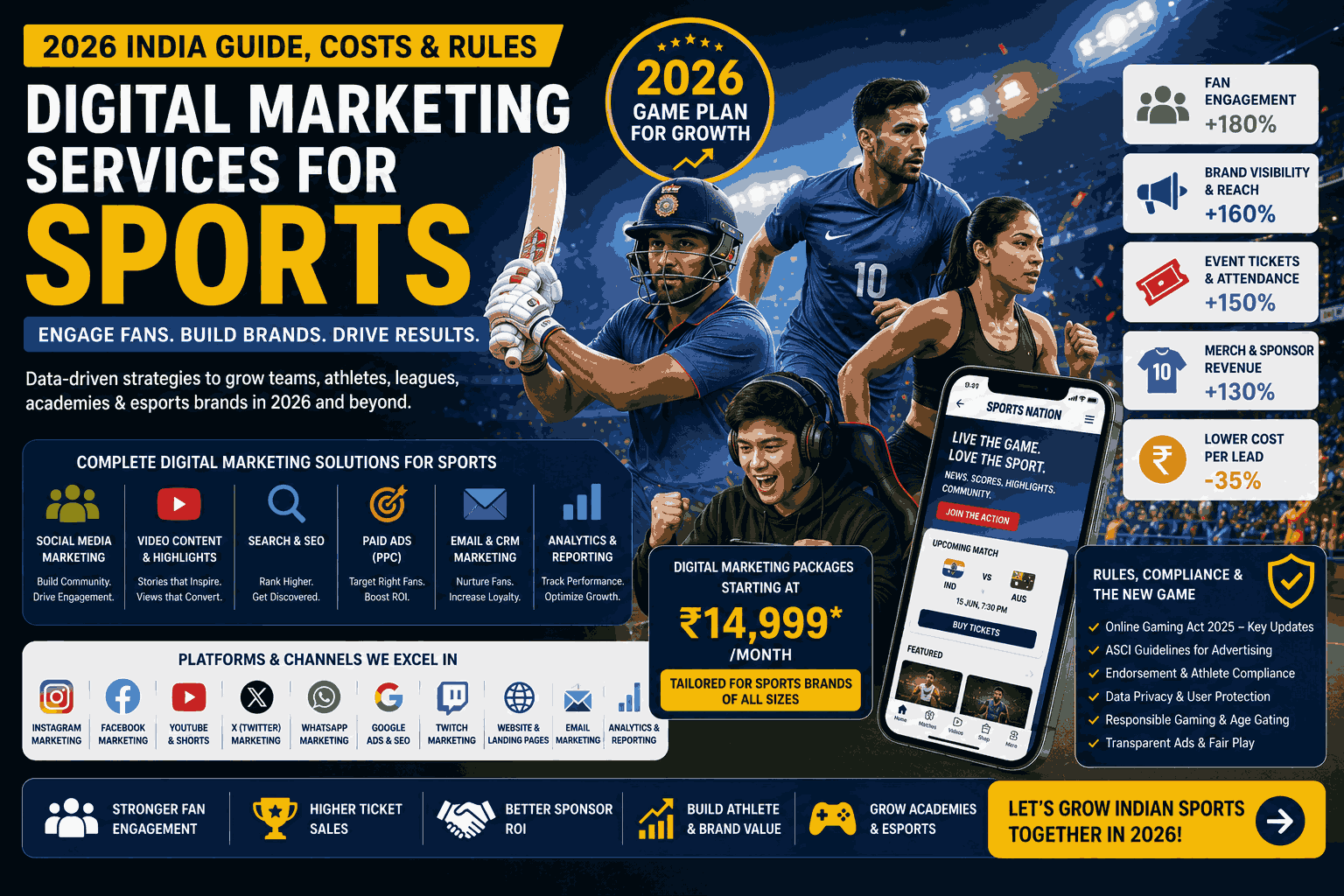
Few things command attention like sport. It’s passionate, tribal, and emotional — fans don’t just watch, they belong. But where that passion lives has changed completely. Today a fan might discover an athlete on Instagram, watch highlights on YouTube, argue about a match in a WhatsApp group, and follow training clips between games — often on a second screen while the live broadcast plays. For everyone from an IPL franchise to a neighbourhood cricket academy, that shift is why digital marketing services for sports have become essential.
Sport in 2026 is a year-round, always-on ecosystem. The game is the centrepiece, but the real value increasingly sits in the highlights, the behind-the-scenes content, the fan communities, and the merchandise and memberships that surround it. At the same time, the business of Indian sports has been jolted by a major regulatory change — the new law on online gaming — that reshaped who sponsors sport and how it’s marketed.
This guide is written for Indian sports organisations and professionals — leagues, teams and clubs, individual athletes, academies and coaching centres, and sports brands — who want a clear, practical picture of what works now, the channels that perform, honest pricing, and the rules you must follow. As you’ll see, the winners aren’t simply chasing reach; they’re building loyalty, owning their fan relationships, and turning attention into durable revenue.
What Are Digital Marketing Services for Sports?
Digital marketing services for sports are the strategy and execution that grow a sports entity’s fan base, deepen engagement, and convert that attention into revenue — whether the entity is a league, a club, an individual athlete, an academy, or a sports brand. The emphasis has moved from one-off campaigns to continuous, fan-first relationships across every screen a fan uses.
Who it’s for
“Sports” is a wide field, and each type of organisation markets differently. Here’s how the main players line up.
| Sports Entity | Primary Goal | Lead Channels |
|---|---|---|
| Leagues & tournaments | Viewership, sponsors, fan growth | Social, video, OTT, PR, paid |
| Teams & clubs | Fans, memberships, tickets, merch | Social, owned app/community, video |
| Individual athletes | Personal brand, fans, endorsements | Instagram, YouTube, short video |
| Academies & coaching centres | Student enquiries and admissions | Local SEO, GBP, WhatsApp, reviews |
| Sports brands & apparel | Product sales and brand love | Social commerce, D2C, creators, ads |
| Esports & gaming orgs | Audience, streams, sponsors | YouTube, Twitch, Discord, social |
The core components
Across these, a serious programme usually combines: social media and short-form video; fan-community and owned-platform building; content and SEO; athlete and influencer partnerships; paid advertising around key moments; sponsorship activation; merchandise, ticketing, and membership promotion; first-party data capture; and analytics tied to real outcomes. For academies and local sports businesses, local SEO and a strong Google Business Profile do much of the heavy lifting.
Why Sports Is a Unique (and Powerful) Marketing Category
Sport has something most categories would kill for: built-in, passionate, repeat attention. Fans identify with teams and athletes so deeply they call themselves “nations,” and that loyalty spans generations. But attention is also harder to hold than ever — the average attention span hovers around eight seconds, and roughly 80% of fans use a second screen while watching, so a short highlight clip often travels further than the match itself.
Several forces make 2026 a pivotal year. Streaming has become the default for younger fans, with around half of those aged 18–34 saying online streaming is their main way to consume sport. The creator economy has exploded — the influencer market has grown from under USD 2 billion a decade ago to tens of billions — and athletes are now creators in their own right, with direct, trusted relationships with fans. Women’s sports are growing rapidly, opening new audiences and sponsorships. The catch is that organic reach is declining and attention is fragmented across many platforms at once, so a smart, multi-channel, fan-first strategy matters more than raw spend.
What’s Included in Professional Digital Marketing Services for Sports
Here’s a clear breakdown of what a strong provider should deliver, so you can read any proposal with confidence.
| Service | What It Covers | Why It Matters |
|---|---|---|
| Social media & video | Content calendar, reels, highlights, live moments | Where fans discover and engage daily |
| Fan community & owned platforms | Apps, groups, email, memberships | Loyalty and first-party data you own |
| Content & SEO | Website, stories, search visibility, AEO | Discovery and durable organic reach |
| Athlete & influencer partnerships | Creator collaborations, athlete content | Authentic reach and trust |
| Paid advertising | Social and video ads around key moments | Fast reach and conversions |
| Sponsorship activation | Bringing sponsor deals to life digitally | Measurable value for partners |
| Merch, tickets & memberships | Promotion, drops, D2C, conversions | Direct revenue from fandom |
| Analytics & first-party data | Engagement, conversion, fan data | Turns attention into business outcomes |
The Big 2026 Shifts in Sports Marketing
Sports marketing is changing fast this year. Here’s what matters most.
1. Fandom as belonging — and owned fan platforms
Fans increasingly want connection and community, not just content. The leading approach in 2026 treats social platforms as an acquisition layer while delivering the core experience through owned channels — an app, a members’ area, an email list, or a fan hub — where the organisation controls the relationship and, crucially, collects first-party data. Top clubs run their own apps with live match chats, exclusive video, and member-only content for exactly this reason.
2. The athlete creator economy
Athletes have become trusted creators with direct lines to fans, and partnerships built around them now outperform plain logo placements. Fans quickly see through money-driven endorsements, so authenticity wins — “behind-the-scenes” content, real reactions, and genuine brand fit matter more than polish. Notably, smaller creators often drive more trust than mega-influencers, and a large majority of marketers plan to increase creator investment this year.
3. Short-form video and the highlight economy
A clip of a buzzer-beater or a stunning goal can live far longer than the broadcast it came from. Short, real-time video built around live moments — upsets, celebrations, fan reactions — delivers engagement that evergreen brand ads simply can’t match. For most sports entities, a disciplined short-form video engine is now the single most important content investment.
4. From “likes” to “loyalty”
Sponsors and teams are shifting from chasing reach to measuring engagement and loyalty. Multi-year partnerships with athletes who own their audiences, first-party data to prove real-world ROI, and community impact are replacing one-off, impressions-led deals. The question is no longer how many people watched, but how often fans return and whether that attention compounds into revenue.
5. AI, personalisation, and streaming
AI is being used to interpret fan behaviour and personalise the timing, tone, and format of content, while streaming and direct-to-fan models open new revenue lines — subscriptions, pay-per-view, premium access, and exclusive digital content. For sports brands, this means owning the data and experience rather than renting both from platforms.
6. Esports and new formats
Competitive, skill-based esports continues to grow fast and now sits within a recognised legal framework in India under the National Sports Governance Act, 2025. It reaches a young, highly engaged audience and supports sponsorship, streaming, and content revenue — making it one of the most promising compliant opportunities in Indian sports marketing, provided formats avoid any real-money wagering.
The Big Regulatory Shift: India’s Online Gaming Act and Sports Marketing
No discussion of sports marketing in India in 2026 is complete without this. A single law has reshaped how Indian sport is funded and promoted, and every sports marketer needs to understand it.
| Important: Real-money online gaming, real-money fantasy sports, and betting cannot be operated, funded, or advertised in India. This section explains the rules so you can stay compliant — it is not encouragement to market these products, which is prohibited and carries serious penalties. |
What changed
The Promotion and Regulation of Online Gaming Act, 2025 — passed in August 2025 and in effect from May 2026, administered by a new Online Gaming Authority — bans real-money online games, including real-money fantasy sports and betting, along with their advertising and even celebrity endorsement, and bars banks from processing related payments. Because fantasy gaming had become the single largest advertiser category in Indian sports — funding a large share, by some estimates close to 40%, of cricket’s broadcast advertising and investing thousands of crores a year — that money disappeared almost overnight. Dominant platforms shut or suspended their real-money operations, and high-profile sponsorships ended, with new sponsors from other sectors stepping in to fill the gap.
What’s still allowed
The law draws a clear line. Real-money games are banned, but two categories remain permitted: social games offered purely for entertainment or skill-building without any wagering (which may charge subscription or access fees), and esports — organised, skill-based competition with no betting. Legitimate sponsorship of teams and leagues by mainstream brands, fan engagement, merchandise, ticketing, and content all continue normally. In fact, the exit of gaming money has opened sponsorship space for non-gaming categories.
The hard line on betting and surrogate ads
Offshore betting apps are illegal for Indian users, and so are their surrogate advertisements — the “news” or “sports” lookalikes that try to slip past the rules — under earlier advisories and advertising-standards guidance. Major ad platforms have also barred promotions for rummy and daily fantasy sports targeting India, and enforcement has been heavy, with authorities freezing large sums linked to illegal operators. The takeaway for any sports marketer is simple: never touch real-money gaming, betting, or surrogate promotion. Build on legitimate sponsors, owned fan channels, and compliant formats instead.
The Economics: Turning Fans into Revenue
Most sports-marketing advice stops at engagement. Let’s go further, because attention only matters if it becomes revenue. The modern sports business turns fan attention into money through several streams, and digital marketing strengthens each one.
| Revenue Stream | How Digital Helps | Note |
|---|---|---|
| Sponsorship | Proves engagement and ROI to partners | Now favours measurable, multi-year deals |
| Media & streaming | Direct-to-fan content, subscriptions, PPV | New income beyond broadcast rights |
| Merchandise | Social commerce, drops, D2C stores | High-margin, fandom-driven sales |
| Tickets & events | Targeted local and fan campaigns | Fills seats and venues |
| Memberships & community | Owned platforms, premium access | Recurring, loyal revenue |
| Academies & coaching | Local SEO, enquiries, admissions | Steady fees from students |
The gaming-law shock made one lesson unmistakable: don’t let a single sponsor category or platform control your fortunes. When fantasy money vanished, organisations that had built direct fan relationships, diverse revenue, and their own data weathered it far better than those dependent on one funding source. That’s the strategic heart of modern sports marketing — own the fan relationship and the first-party data, then diversify how you earn from it.
Practically, that means treating fan acquisition as an investment you recover over time. A fan won through a viral clip or a paid campaign is worth little as a one-off, but a lot if they join your community, buy merchandise, renew a membership, attend matches, and bring friends. Track the numbers that prove it: fan growth and engagement rate, first-party sign-ups, conversion to tickets, merchandise, and memberships, and the lifetime value of an engaged fan.
How Much Do Digital Marketing Services for Sports Cost in India in 2026?
Let’s be direct. Pricing depends on the scale of the entity, how much video and content you need, and your ambitions. Here are realistic 2026 ranges for the Indian market.
| Tier | Monthly Fee | What You Get | Best For |
|---|---|---|---|
| Starter | ₹15,000–35,000 | Social, basic content, local SEO, reporting | Athletes, academies, small clubs |
| Growth | ₹35,000–80,000 | Video, community, ads, sponsorship support | Teams, clubs, growing brands |
| Full-service | ₹80,000–2,50,000+ | All channels, pro video, data, strategy | Leagues and sports brands |
| Enterprise / event | ₹2,50,000+ | Large campaigns, multi-platform, activations | Major properties and events |
Management fee vs production and media spend — and GST
The management fee is not the whole bill. In sports, two costs are almost always separate: professional content and video production (the engine of fan engagement), and paid media or sponsorship-activation spend. A quote that bundles everything into one number is hiding something. Remember too that 18% GST applies to Indian agency fees, so a ₹50,000 retainer really costs ₹59,000.
A simple budgeting rule
Sports demand is event-driven, so spend should be too. Concentrate budget and your best content around your key moments — a tournament, a season launch, an admission window for an academy, a product drop for a brand — when fan attention peaks, and keep a steady, lower-cost content drip the rest of the year to maintain the relationship. For academies and local sports businesses, weight spend toward admission seasons and local targeting.
Where Should a Sports Brand Invest? Social vs Content vs Paid vs Owned
These work together, not in isolation. Here’s how they compare for a sports entity.
| Factor | Social | Content / Video | Paid + Owned |
|---|---|---|---|
| Main job | Reach and engage fans | Build story and discovery | Acquire fast & retain |
| Speed | Fast | Builds over months | Ads fast; owned compounds |
| Cost model | Content + light spend | Production-led | Ad spend + owned tools |
| Strength | Daily engagement | Durable, searchable, AI-friendly | Scale plus loyalty & data |
| Best for | Fans, athletes, moments | Academies, brands, authority | Growth and revenue |
The verdict: use social and short-form video to reach and engage fans, invest in content and SEO for durable discovery (especially academies and brands), run paid ads to scale around key moments, and — most importantly — funnel everything into owned channels and first-party data so you keep the relationship. No single channel wins alone; the mix compounds into loyalty and revenue.
Advantages and Disadvantages of Digital Marketing Services for Sports
Every agency lists the upsides. Here’s an honest look at both sides.
Advantages
- Passionate, repeat attention — sport has built-in, emotional, loyal audiences.
- Multiple revenue streams — sponsorship, merch, tickets, memberships, and content.
- Authentic reach via athletes — creators and players build trust money can’t buy.
- Own your fans and data — owned channels reduce dependence on any one platform or sponsor.
- Highlights compound — short clips keep working long after the final whistle.
- Great for local sports businesses — academies and clubs win students through local SEO.
Disadvantages
- A real regulatory minefield — gaming, betting, and surrogate ads are strictly off-limits in India.
- Attention is hard to hold — short spans and fragmented platforms demand constant, quality content.
- Content-heavy and ongoing — sports marketing needs a steady production engine, not one-off posts.
- Sponsorship can be volatile — over-reliance on one category is risky, as 2026 showed.
- Production and media costs are extra — the management fee is rarely the full bill.
- No legitimate guarantees — credible partners don’t promise virality or fixed numbers.
Security, Compliance, and Trust in Sports Marketing
Beyond the gaming law, a few rules protect fans, athletes, and your brand. A good partner builds these in from the start.
No gaming, betting, or surrogate promotion
As covered above, real-money gaming, fantasy, and betting — and the surrogate ads that disguise them — are prohibited in India, with penalties extending to advertisers and endorsers. This is the single biggest compliance line in Indian sports marketing. Stay entirely clear of it and build on legitimate sponsors and compliant formats.
Honest advertising and influencer disclosure
Advertising must be truthful under ASCI norms, and any paid athlete or influencer partnership must be disclosed clearly with labels like #Ad. Fans are quick to spot inauthentic endorsements, so genuine, well-matched partnerships aren’t just compliant — they perform better.
Image rights, personality rights, and ambush marketing
Using an athlete’s name, image, or likeness requires proper rights and agreements — personality rights are increasingly protected. During major events, be careful to avoid “ambush marketing” that implies an official association you don’t have, which can invite legal trouble. Always secure the rights you’re using.
Fan data, minors, and the DPDP Act
The fan data you collect — sign-ups, app users, communication preferences — is personal data under India’s Digital Personal Data Protection Act, 2023, requiring clear consent, purpose limitation, and secure storage. Sports audiences skew young, so be especially careful with minors, including age-appropriate content and any required parental consent. As always, your accounts, website, fan database, and content should belong to your organisation, not your agency.
How to Choose a Sports Marketing Agency
Use this as a filter when evaluating providers.
Green flags
- They clearly understand the gaming law and keep you well clear of betting and surrogate ads.
- They have real sports content and short-form video capability.
- They focus on owned fans and first-party data, not just follower counts.
- They separate management fees, production, and media spend transparently.
- They report on engagement, conversions, and revenue — not just impressions.
Red flags
- They suggest any real-money gaming, betting, or surrogate promotion.
- They promise virality or guaranteed follower or sponsor numbers.
- “All-inclusive” pricing that hides production and ad costs.
- They want to own your accounts, fan data, or content.
- No real sports experience or understanding of fan behaviour.
Questions worth asking before you sign
- How do you keep our marketing compliant with the gaming law, ASCI, and the DPDP Act?
- How will you help us own our fan relationships and first-party data?
- Is production and media spend separate, and what do you recommend for our moments?
- Who owns our accounts, content, and fan database?
- How do you turn engagement into tickets, merchandise, or memberships?
- For an academy: how will you generate and follow up local enquiries?
Measuring ROI — Metrics That Matter in Sports Marketing
Followers and views feel good but don’t pay the bills. Track what ties to loyalty and revenue, and judge each effort on its own timeline.
- Engagement rate and fan growth — are you building an active, growing audience?
- Video views and retention — is your short-form content holding attention?
- First-party sign-ups — app users, members, and email subscribers you own.
- Conversions — tickets, merchandise, memberships, or academy enquiries.
- Sponsorship value delivered — measurable engagement and ROI for partners.
- Fan lifetime value — total value of an engaged fan over time, not a single sale.
| Timeframe | What to Expect |
|---|---|
| Week 1–4 | Channels and content set up; first campaigns drive reach, enquiries, or sales around a moment. |
| Month 2–3 | Engagement and community grow; short-form video and SEO start compounding. |
| Month 4–6+ | Owned audience and first-party data build; conversions and loyalty strengthen revenue. |
Expert Insights — What Works in Sports Marketing in 2026
A few hard-won principles from sports organisations winning this year:
- Own the fan, not just the post. Use social to reach, but build the relationship and data on channels you control.
- Make short-form video your engine. Highlights and behind-the-scenes clips drive the most engagement.
- Be authentic with athletes. Genuine, well-matched partnerships beat money-driven endorsements every time.
- Diversify revenue. Sponsorship, merch, tickets, and memberships together are safer than any single source.
- Plan around moments. Concentrate budget and content on tournaments, launches, and admission windows.
- Stay strictly clear of gaming and betting. It’s the biggest compliance line in Indian sport — don’t cross it.
- For academies, win local. A strong Google Business Profile and reviews turn searches into students.
Frequently Asked Questions
What are digital marketing services for sports?
Digital marketing services for sports are the strategy and execution that help any sports entity — a league, team, club, individual athlete, academy, or sports brand — grow its fan base, deepen engagement, and turn that attention into revenue. They include social media and short-form video, fan-community and owned-platform building, content and SEO, influencer and athlete partnerships, paid advertising, sponsorship activation, merchandise and ticketing promotion, and increasingly esports and AI-driven personalisation, all measured against real business outcomes rather than vanity metrics.
How much do digital marketing services for sports cost in India in 2026?
In 2026, an athlete or a sports academy in India can start around ₹15,000–35,000 per month for social media, content, and local promotion. Club and team packages with video, community building, and ads run ₹35,000–80,000, while full-service work for leagues and sports brands typically ranges from ₹80,000 to ₹2,50,000+ per month. Video and content production and paid ad or sponsorship spend are usually separate, and 18% GST applies to Indian agency fees.
How has India’s Online Gaming Act 2025 affected sports marketing?
Significantly. The Promotion and Regulation of Online Gaming Act, 2025, effective from May 2026, banned real-money online games — including real-money fantasy sports and betting — along with their advertising and even celebrity endorsements. Because fantasy gaming had funded a large share of cricket’s broadcast advertising, that money vanished, and sponsors like Dream11 exited, replaced by brands from other sectors. Sports marketing in India has shifted toward non-gaming sponsors, owned fan channels, and compliant formats like esports.
Can sports brands still advertise fantasy sports or betting in India?
No. Real-money online gaming, real-money fantasy sports, and betting cannot be operated, funded, or advertised in India under the 2025 Online Gaming Act, and offshore betting apps and their surrogate ads are illegal. Google has also barred ads for rummy and daily fantasy sports targeting India. Promoting these can bring serious penalties, including for advertisers and endorsers. Sports marketing should focus on legitimate sponsors, fan engagement, merchandise, ticketing, and compliant formats such as esports and free-to-play games.
What is the best digital marketing strategy for a sports team or athlete?
Use social platforms to reach and grow fans, but build the core relationship on channels you control — an app, community, email, or fan hub — so you own the audience and the data. Lead with authentic, behind-the-scenes content and short-form video, post consistently around live moments, and turn engagement into revenue through memberships, merchandise, tickets, and genuine sponsor partnerships. For athletes, a consistent personal brand and real fan interaction matter more than follower count alone.
How can a sports academy or coaching centre get more students through digital marketing?
Start with a strong Google Business Profile and local SEO so parents searching for a ‘[sport] academy near me’ find you, then add a clear website with easy enquiry and trial-booking, genuine reviews, and steady social content showing training, results, and student progress. Short videos of drills and success stories build trust, and targeted local ads around admission seasons drive enquiries. WhatsApp is excellent for following up with interested parents and running batches.
Which digital channels work best for sports marketing?
Instagram, YouTube, and short-form video lead for fan engagement and athlete content, while a strong website and SEO anchor discovery for academies and brands. WhatsApp is powerful for community and conversions in India, owned apps and email build loyalty and first-party data, and paid social extends reach around key moments. The right mix depends on whether you’re marketing a league, a team, an athlete, an academy, or a sports product.
Is esports marketing legal and worth it in India?
Yes. Esports — competitive, skill-based gaming without wagering — is recognised under India’s National Sports Governance Act, 2025 and sits in the permitted category under the online gaming framework, unlike banned real-money games. It reaches a large, young, highly engaged audience, supports sponsorship, streaming, and content revenue, and is one of the fastest-growing compliant opportunities in Indian sports marketing. As always, formats must avoid any real-money wagering to stay on the right side of the law.
How do athletes build a personal brand online?
By being consistent and authentic. Share a steady stream of genuine content — training, behind-the-scenes moments, wins and setbacks, and personal interests — so fans feel a real connection, not just a highlight reel. Engage directly, pick brand partnerships that genuinely fit your values, and build presence on channels you can control, such as a community or email list. Authenticity and regular interaction build the trust that makes an athlete’s recommendations and partnerships valuable.
Final Verdict
Digital marketing services for sports in 2026 are about turning passion into lasting loyalty and revenue — reaching fans where they actually are, engaging them with authentic content and short-form video, and building owned relationships and first-party data that no single platform or sponsor can take away. For Indian sport especially, the year brought a hard lesson: the organisations that owned their fans and diversified their income absorbed the shock of the gaming-law upheaval, while those dependent on one funding source struggled.
If you’re investing here, go in with clear eyes. Build a short-form video engine, own your fan community and data, partner authentically with athletes and creators, diversify revenue across sponsorship, merchandise, tickets, and memberships, and stay strictly clear of gaming, betting, and surrogate ads. Demand transparent pricing that separates fees, production, and media, and judge results by engagement, conversions, and loyalty rather than vanity metrics. Do that, and digital marketing becomes the most dependable way to grow your team, your brand, or your academy — and to keep your fans coming back.