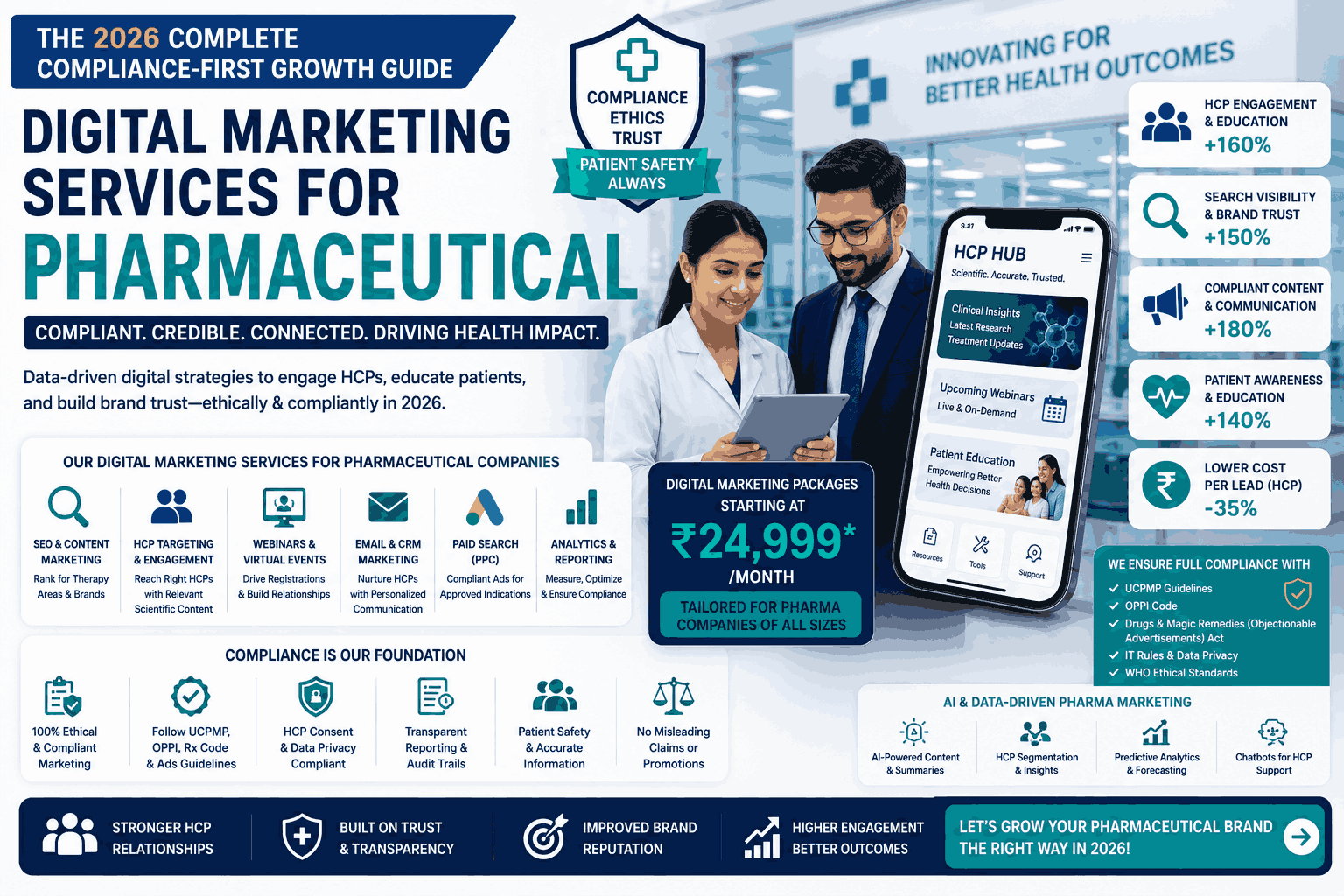
Pharmaceutical marketing has always operated at the intersection of science, regulation, and human need. That intersection has not changed — but the channels through which pharmaceutical companies must navigate it have transformed completely. A 2025 Deloitte Global Pharma Report found that 76% of Healthcare Professionals (HCPs) in India now prefer digital channels — email, medical portals, webinars, and social platforms — as their primary source of pharmaceutical information, over traditional medical representative visits. Among patients, 91% search online before asking a doctor about a medication or treatment option they have heard about.
For pharmaceutical companies — whether global MNCs, Indian generics manufacturers, specialty drug companies, or nutraceutical brands — this shift has made digital marketing services for pharmaceutical not optional but operationally essential. Yet pharma digital marketing is uniquely complex: it operates under some of the most stringent regulatory frameworks in any industry, addresses audiences with vastly different information needs (HCPs versus patients), and carries profound ethical responsibilities because the stakes — patient health outcomes — could not be higher.
This is the definitive 2026 guide to digital marketing services for pharmaceutical companies — covering every relevant channel and service, the regulatory frameworks that govern pharmaceutical digital marketing in India and globally, what each investment realistically delivers, and how to build a strategy that drives genuine business growth without compromising clinical integrity or regulatory compliance.
The Digital Imperative for Pharmaceutical Companies in 2026
HCPs Have Moved Permanently to Digital Channels
The shift in how doctors, pharmacists, and other healthcare professionals engage with pharmaceutical information has been decisive and permanent. Medical representative (MR) visits — long the backbone of pharmaceutical promotion — have declined in effectiveness and accessibility. HCPs report access fatigue with MR interactions and increasingly prefer to consume product information, clinical data, and CME content on their own schedule through digital channels.
India’s pharmaceutical market, valued at over ₹2.1 lakh crore in 2025 and consistently among the world’s top five by volume, has seen this transition accelerate through 2025 into 2026. Digital detailing platforms, HCP email programmes, medical webinar series, and peer-reviewed content partnerships have become primary HCP engagement channels for leading pharma companies. Companies that have not built these capabilities are reaching fewer HCPs more expensively than competitors who have.
Patients Are Active Pharmaceutical Information Seekers
The informed patient of 2026 does not passively receive treatment decisions from their physician — they actively research conditions, treatment options, drug mechanisms, side effects, and alternatives before and after medical consultations. This behavioural shift has two significant implications for pharmaceutical marketing:
- Patient education content from pharmaceutical companies can directly influence therapy adherence, brand awareness, and informed treatment conversations between patients and their physicians
- Inaccurate, misleading, or irresponsible pharmaceutical content online — including from competitor-adjacent misinformation — creates patient confusion that pharmaceutical brands with authoritative digital presence can counteract
The challenge for pharmaceutical marketers is engaging this active patient audience within strict direct-to-consumer (DTC) advertising regulations that in India prohibit prescription drug promotion directly to the public. This creates a content strategy imperative: pharma brands must educate patients about conditions, disease awareness, and treatment categories without making direct prescription drug claims to non-medical audiences.
The Generics, OTC, and Nutraceuticals Opportunity
While prescription drug DTC advertising faces regulatory constraints, a large segment of the pharmaceutical market — over-the-counter (OTC) products, nutraceuticals, dietary supplements, and health products — operates with significantly more digital marketing flexibility. This segment represents a genuine mass-market digital opportunity for pharma companies with appropriate product portfolios, requiring strategies similar to consumer brand digital marketing but with the added credibility demands of scientific substantiation.
Complete Overview: Digital Marketing Services for Pharmaceutical Companies
1. Pharmaceutical SEO — Scientific Authority in Search
Pharmaceutical Search Engine Optimization is the practice of ensuring that when HCPs, patients, caregivers, or healthcare students search for medical conditions, treatment approaches, drug mechanisms, or healthcare topics, your company’s content appears prominently in organic results. In an information environment saturated with medical content of varying quality, pharmaceutical brands that produce genuinely expert, rigorously accurate content earn both search visibility and the scientific credibility that influences HCP and patient trust.
Pharma SEO in 2026 encompasses:
- Condition and disease awareness pages: Clinically accurate, expert-authored content about the conditions your therapeutic areas address — written to serve both HCP information needs and patient health literacy
- Drug mechanism and pharmacology content: Technical educational content about drug classes, mechanisms of action, pharmacokinetics, and clinical evidence — particularly valuable for HCP audiences seeking depth beyond product promotional materials
- Research and clinical trial SEO: Ensuring your company’s published research, trial results, and pipeline developments are visible and accurately represented in organic search
- Technical SEO for pharmaceutical websites: Healthcare schema markup (MedicalOrganization, Drug schema types), Core Web Vitals compliance, HTTPS security, and mobile-first design — all directly affecting pharmaceutical content rankings
- AI search optimization (GEO): Structuring pharmaceutical content to be cited in Google AI Overviews, ChatGPT, and Perplexity responses to health and medical queries — a significant emerging opportunity for authoritative pharma content
Google’s E-E-A-T (Experience, Expertise, Authoritativeness, Trustworthiness) framework applies with particular rigour to pharmaceutical content. Pages authored by named medical professionals or pharmacologists, citing peer-reviewed sources, including dosing information reviewed by clinical teams, and updated to reflect current regulatory approvals consistently outrank anonymously authored pharmaceutical content — and are treated with appropriate scepticism by quality-conscious HCP readers when attribution is absent.
2. HCP Digital Engagement Platforms and Medical Detailing
The transformation of pharmaceutical sales force engagement from in-person to digital has created a category of digital marketing unique to the pharmaceutical sector: digital HCP engagement. This encompasses the full range of tools and platforms used to reach, educate, and build relationships with physicians, pharmacists, nurses, and other healthcare professionals through digital channels.
HCP digital engagement services for pharmaceutical companies include:
- Digital detailing: Interactive, multimedia product information presentations delivered via HCP-authenticated platforms, email, or direct rep-facilitated tablet presentations — replacing or supplementing traditional in-person MR visits
- Medical education webinars and virtual symposia: Live and on-demand expert-led educational programmes on therapeutic areas, clinical evidence, and treatment guidelines — among the highest-engagement HCP digital formats
- HCP portal development: Dedicated authenticated platforms where registered healthcare professionals access brand-specific educational content, clinical data, sampling programmes, and CME materials
- Email marketing for HCPs: Compliant, peer-reviewed-sourced educational newsletters, clinical update communications, and conference highlight summaries delivered to opted-in HCP databases
- Medical social media engagement: Pharma-compliance-reviewed content on platforms like Twitter/X, LinkedIn, and Doceree (India’s HCP-specific digital platform) — reaching HCPs in professional networking contexts
India-specific HCP digital platforms have matured significantly. Doceree (India’s dedicated HCP programmatic advertising platform), Medscape India, and Practo for Doctors offer pharmaceutical companies verified HCP audience access for compliant promotional and educational content. These platforms verify medical credentials before granting access, ensuring promotional pharmaceutical content reaches only qualified healthcare professionals — a regulatory requirement for prescription drug promotion in India.
3. Paid Digital Advertising for Pharmaceutical Brands
Pharmaceutical paid advertising requires careful channel and format selection based on the regulatory distinction between prescription (Rx) drugs, over-the-counter (OTC) products, and nutraceuticals — each with different promotional rules.
Compliant pharmaceutical paid digital advertising includes:
- Google Ads for OTC and nutraceutical brands: Search and display advertising for products that do not require prescription, targeting consumers with health-intent queries — subject to Google’s healthcare advertising policies including category-specific certification requirements
- Programmatic advertising on verified HCP platforms: Doceree, Epocrates, and medical portal programmatic networks offering prescription drug promotional advertising to verified HCP audiences — compliant with regulatory requirements restricting Rx drug promotion to medical professionals
- LinkedIn advertising for pharmaceutical B2B: Targeting healthcare decision-makers, hospital procurement professionals, and medical institution leadership for pharmaceutical B2B purposes — including bulk procurement discussions, formulary inclusion campaigns, and institutional partnerships
- YouTube advertising for disease awareness: Non-promotional, condition-awareness video campaigns that educate the public about symptoms, diagnosis importance, and treatment category availability — without making specific prescription drug claims to the general public
The distinction between promotional content (which must reach only HCPs for prescription drugs) and educational/awareness content (which can reach the general public) is the foundational compliance decision in every pharmaceutical paid advertising campaign. This distinction must be built into campaign targeting, creative content, and landing page strategy before any campaign goes live.
4. Pharmaceutical Content Marketing — Science Meets Storytelling
Content marketing for pharmaceutical companies serves multiple audiences with fundamentally different information needs — and the content strategy must reflect this complexity. HCP-facing content must meet the scientific rigour that medical professionals demand: precise, evidence-referenced, clinically nuanced. Patient-facing content must be accurate but accessible — reducing health anxiety, improving disease understanding, and empowering informed conversations with prescribing physicians.
High-performing pharmaceutical content categories:
- Clinical evidence summaries: Accessible summaries of key trial data, published in formats that HCPs can quickly review and share with colleagues — including infographics, data visualisations, and interactive data explorers
- Disease awareness content: Patient-accessible guides to conditions in your therapeutic areas — symptoms, diagnosis pathways, lifestyle management, and why seeking medical care matters — without direct prescription drug promotion
- Pharmacovigilance and safety transparency content: Clear, accurate safety information that demonstrates your company’s commitment to patient safety communication
- Therapy area thought leadership: White papers, conference presentations, and expert opinion pieces authored by or developed in collaboration with Key Opinion Leaders (KOLs) in your therapeutic areas
- Patient journey narratives: Carefully constructed (and legally reviewed) stories illustrating disease impact and treatment pathways — without making efficacy or safety claims that violate promotional guidelines
- Pipeline and R&D transparency content: Non-promotional communications about your company’s research programme that build scientific credibility and investor/stakeholder confidence
All pharmaceutical content must pass medical, legal, and regulatory (MLR) review before publication — a formal internal approval process that pharmaceutical companies maintain to ensure promotional and educational content meets regulatory standards. Digital marketing agencies working with pharmaceutical clients must understand and operate within MLR review timelines, which significantly affect campaign planning and content production schedules.
5. Social Media Marketing for Pharmaceutical Companies
Pharmaceutical social media marketing requires a more carefully structured approach than most industries, but the opportunity for genuine brand building, disease awareness, and HCP engagement through social channels is real and growing.
Compliant pharma social media strategies:
- Disease awareness campaigns on Facebook and Instagram: Non-branded or appropriately qualified campaigns raising awareness of under-diagnosed conditions, encouraging symptomatic patients to seek medical advice — without promoting specific prescription products
- LinkedIn for pharmaceutical professional engagement: Company brand building, thought leadership content, R&D transparency, talent attraction, and HCP professional community engagement
- YouTube for medical education: Expert-led educational video series on therapeutic areas, disease mechanisms, diagnostic approaches, and patient management strategies — among the most effective long-form HCP digital engagement formats
- Twitter/X for scientific and conference engagement: Real-time sharing of clinical trial results, regulatory approvals, conference presentations, and peer-reviewed publications — engaging the global HCP and scientific community
Every pharmaceutical social media post must be reviewed for adverse event reporting implications — any mention of a product name alongside a medical condition or symptom could trigger pharmacovigilance reporting obligations. Pharmaceutical companies must have social media monitoring systems that identify and escalate potential adverse event mentions for evaluation by qualified safety teams.
6. Pharmaceutical Website Design and Digital Brand Architecture
A pharmaceutical company’s digital presence typically spans multiple audiences and multiple regulatory contexts simultaneously — requiring a deliberate information architecture that serves each audience appropriately:
- Public corporate website: Company information, therapeutic area overview, pipeline, sustainability, investor relations, and disease awareness content — accessible to general audiences and compliant with non-promotional requirements
- HCP portal (authenticated): Detailed product information, prescribing information, clinical data, educational resources, sampling, and promotional content — accessible only to verified healthcare professionals
- Patient support programme platforms: Disease management tools, therapy adherence support, patient assistance programme information, and disease education resources — accessible to patients and caregivers without containing promotional prescription drug content
- Investor and stakeholder communications: Financial reporting, pipeline updates, corporate governance, and ESG information — subject to financial communication regulatory requirements
Website technical requirements for pharmaceutical companies include robust age and professional verification systems for HCP portals, privacy-compliant cookie and tracking technology, accessible design for patient audiences with health conditions, and security infrastructure appropriate for healthcare data. Pharmaceutical websites handling clinical trial recruitment data or patient programme enrolments must meet clinical data security standards in addition to general website security requirements.
7. Email Marketing for Pharmaceutical HCP and Stakeholder Communication
Email remains among the highest-ROI digital channels for pharmaceutical HCP engagement — when executed with appropriate compliance controls and genuine educational value.
Pharmaceutical email programmes include:
- HCP educational newsletters: Peer-reviewed content summaries, therapeutic area updates, and clinical guideline developments delivered to opted-in physician and pharmacist databases
- Conference and publication alerts: Timely communications highlighting relevant trial publications, conference presentation summaries, and regulatory decisions in key therapeutic areas
- Product update communications: Formulary additions, new indication approvals, safety updates, and prescribing information changes communicated to relevant HCP audiences
- Medical education event invitations: Webinar, virtual symposium, and CME programme invitations for relevant therapeutic area specialists
- Patient support programme communications: Non-promotional health management guidance, therapy adherence support, and care coordination information for enrolled patients
Pharmaceutical email programmes must operate within explicit consent management frameworks under India’s DPDPA 2023 and applicable international data protection regulations for companies with global HCP databases. Email lists must consist of verified, opted-in recipients, and unsubscribe mechanisms must be functional and honoured promptly. Healthcare professional data used for marketing communication must be collected and maintained within data protection law requirements.
8. Medical SEO and Pharmaceutical Reputation Management
Pharmaceutical companies face a unique reputation management challenge: their brands, products, and executives are subject to intense public, media, and regulatory scrutiny — and negative search results, adverse media coverage, or patient community criticism can significantly affect prescriber confidence, patient adherence, and institutional relationships
Pharmaceutical online reputation management includes:
- Brand search landscape management: Ensuring the first page of search results for your company and product names reflects accurate, current, and appropriately positive information
- Scientific communication around adverse events: Ensuring publicly visible information about product safety issues is accurate, contextualised, and reflects current regulatory determinations
- KOL and Medical Affairs digital presence: Managing the searchable professional profiles of Key Opinion Leaders who represent your therapeutic areas — ensuring their credentials and publications are accurately and prominently represented
- Generic competitive defence: Managing digital presence against generic market entry through differentiated value communication, patient education content, and brand authority building
Digital Marketing Channel Comparison for Pharmaceutical Companies
How each channel performs across the dimensions most relevant to pharmaceutical marketing objectives:
| Channel | Primary Audience | Primary Purpose | Compliance Complexity | Speed | ROI Potential |
|---|---|---|---|---|---|
| Pharmaceutical SEO | HCPs + Patients | Organic authority + discovery | Medium | 4–8 months | Excellent |
| HCP Programmatic (Doceree) | HCPs only (verified) | Rx drug promotion + education | High | Immediate | Very Good |
| Google Ads (OTC/Nutri) | Consumers | OTC + nutraceutical acquisition | Medium | Days | Good–Very Good |
| LinkedIn Ads | HCPs + B2B | Professional engagement + B2B | Medium | Days | Good |
| YouTube (Medical Ed) | HCPs + Patients | Disease awareness + authority | Medium | 2–5 months | Very Good |
| Medical Email (HCPs) | HCPs only (opted-in) | Education + relationship management | High | Immediate | Excellent |
| Content Marketing | HCPs + Patients | Authority + SEO + education | High | 4–9 months | Excellent |
| Social Media (Branded) | HCPs + Public | Brand equity + awareness | Very High | 2–4 months | Good |
| ORM | All stakeholders | Brand trust + credibility defence | Medium | Ongoing | Very High |
Recommended Digital Marketing Strategy by Pharmaceutical Company Type
| Company Type | Priority Channels | Key Message Focus | Approx. Monthly Budget |
|---|---|---|---|
| Indian Generic Manufacturer | SEO, LinkedIn, HCP email, YouTube, Trade portals | Quality, cost, availability, ANDA/regulatory approvals | ₹50,000 – ₹2 lakh |
| Specialty Rx Pharma (India) | HCP portals, Doceree, Medical email, Webinars, SEO | Clinical evidence, therapeutic differentiation, HCP support | ₹1.5 lakh – ₹6 lakh |
| MNC Pharmaceutical (India ops) | Full funnel: SEO + HCP platforms + Social + PR + Email | Global evidence base, patient support, scientific leadership | ₹5 lakh – ₹25 lakh+ |
| OTC / Consumer Health Brand | Google Ads, Meta Ads, YouTube, SEO, Influencer | Efficacy, safety, convenience, brand trust | ₹1 lakh – ₹10 lakh+ |
| Nutraceutical / Supplement Brand | SEO, Google Ads, Meta Ads, Instagram, Content, Reviews | Science-backed, natural, specific health benefits | ₹50,000 – ₹5 lakh |
| Contract Research / CDMO | LinkedIn, SEO, Content, Email, Trade Shows (digital) | Capability, quality systems, regulatory experience, speed | ₹75,000 – ₹3 lakh |
2026 Updates: What Has Changed in Pharmaceutical Digital Marketing
AI Search Has Created New Pharmaceutical Content Stakes
Google’s AI Overviews now answer a significant proportion of medical and drug-related queries directly in search results. When patients or HCPs ask AI systems about drug mechanisms, treatment guidelines, or side effect profiles, the AI draws from indexed web content and generates synthesised answers. Pharmaceutical companies whose medically accurate, properly attributed, and well-structured content is indexed by these AI systems gain citation within AI-generated health answers — significant brand exposure and scientific authority signals reaching millions of queries daily.
Conversely, pharmaceutical companies with thin, poorly structured, or unverified digital content may find that AI systems cite competitor content or, worse, inaccurate third-party sources for queries about their own therapeutic areas. Investing in authoritative, structured pharmaceutical content is now partly a strategy for managing AI search representation, not just traditional search rankings.
CDSCO’s Evolving Digital Advertising Framework
India’s Central Drugs Standard Control Organisation (CDSCO) has been developing more explicit guidelines for digital pharmaceutical advertising throughout 2025 into 2026. While the Drugs and Magic Remedies (Objectionable Advertisements) Act 1954 and the Drugs and Cosmetics Act 1940 remain the primary legislative frameworks for pharmaceutical advertising, CDSCO has issued advisory circulars specifically addressing social media promotion, influencer marketing for health products, and digital direct-to-consumer pharmaceutical advertising. Pharmaceutical companies should have their digital marketing practices reviewed against current CDSCO guidance by regulatory counsel.
DPDPA 2023 Impact on Pharmaceutical Data Marketing
India’s Digital Personal Data Protection Act 2023 has significant and specific implications for pharmaceutical digital marketing. Patient support programme data, HCP database management, clinical trial participant information, and adverse event reporter contact data all involve personal data processing subject to DPDPA requirements. Pharmaceutical companies must obtain explicit, purpose-specific consent for all digital marketing uses of personal data — including HCP email marketing, patient programme enrolment, and digital retargeting campaigns that use CRM data. International pharmaceutical companies operating both Indian and global digital marketing programmes must ensure their data practices satisfy both DPDPA and applicable international frameworks (GDPR where relevant) simultaneously.
Doceree and HCP Programmatic Advertising Maturation
India’s HCP programmatic advertising ecosystem has matured significantly by 2026. Doceree’s verified HCP audience platform — which cross-references India’s medical council registry to verify physician credentials before serving pharmaceutical promotional content — has grown its verified HCP reach to over 1.2 million registered physicians. Pharma companies that have not yet integrated verified HCP programmatic into their digital marketing mix are missing the most precisely targeted HCP digital advertising channel available in the Indian market.
Pharma Influencer Marketing — Regulatory Lines Have Clarified
The use of healthcare professionals and patient advocates as influencers in pharmaceutical content has grown, but regulatory lines have clarified. ASCI’s Influencer Advertising Guidelines 2021 (updated in practice through 2025) and CDSCO advisory circulars have established that HCP influencer content that promotes specific prescription drugs to consumer audiences — without verified HCP audience targeting — violates pharmaceutical advertising restrictions. Compliant pharma influencer programmes must either (a) restrict HCP influencer content to verified professional audiences, or (b) limit influencer content strictly to disease awareness, lifestyle, or OTC product categories where DTC promotion is permitted.
Pharmacovigilance and Social Media Monitoring — Mandatory in Practice
Regulatory guidance from both CDSCO and the European Medicines Agency has reinforced that pharmaceutical companies have obligations to monitor social media for potential adverse event (AE) mentions relating to their products. In 2026, pharmaceutical companies without automated social media AE monitoring systems face both regulatory exposure and the practical risk of missing safety signals in digital channels. This monitoring obligation applies to branded social media channels, online communities where patients discuss treatments, and user-generated content on third-party platforms mentioning product names.
Honest Pros and Cons of Digital Marketing Services for Pharmaceutical Companies
Advantages
- HCP reach at scale with declining MR access: Digital channels reach physicians and pharmacists who restrict or limit MR access — expanding the effective HCP reach of pharma sales organisations beyond what field forces can achieve
- Verified audience targeting for prescription content: Platforms like Doceree enable pharmaceutical companies to serve promotional content exclusively to verified HCPs, satisfying regulatory requirements for Rx drug promotion while reaching target prescribers efficiently
- Measurable HCP engagement: Unlike traditional MR-delivered detailing where outcome measurement was limited, digital HCP engagement programmes provide detailed interaction data — content views, webinar attendance, content downloads, email opens — that enables evidence-based optimisation of HCP communication strategies
- 24/7 HCP information access: Digital educational resources allow HCPs to access product information, clinical data, and educational content at times convenient to their practice schedules — significantly more accessible than appointment-dependent MR interactions
- Patient adherence and support programme scale: Digital patient support programmes can reach and serve far larger patient populations than traditional phone-based programmes, at lower per-patient cost, with measurable adherence and outcome data
- OTC and nutraceutical brand building: For non-prescription product portfolios, digital marketing enables sophisticated consumer brand building, targeted acquisition, and loyalty programme management comparable to FMCG brand marketing
- Scientific authority building at global scale: Digital content platforms enable pharmaceutical companies to distribute high-quality scientific and educational content globally, building therapeutic area authority that influences HCP prescribing preferences across geographies
Disadvantages
- MLR review timelines slow content production: The medical, legal, and regulatory review process required for pharmaceutical marketing content adds 2–6 week timelines to content production cycles, making rapid-response digital marketing significantly more challenging than in unregulated industries
- Regulatory compliance complexity is genuinely high: Pharmaceutical digital marketing must navigate CDSCO guidelines, the Drugs and Cosmetics Act, the Drugs and Magic Remedies Act, ASCI guidelines, DPDPA 2023, international equivalents where applicable, and platform-specific policies — requiring either substantial internal compliance expertise or specialist agency support
- DTC prescription drug advertising restrictions limit audience reach: Regulatory prohibition on direct-to-consumer prescription drug promotion limits the audiences pharmaceutical companies can address with promotional content — requiring the discipline of separating compliant patient education from promotional objectives
- Adverse event monitoring creates operational overhead: Social media and digital channel monitoring for potential adverse event mentions is a regulatory obligation that requires specialised systems and trained pharmacovigilance personnel to manage effectively
- Platform advertising restrictions create targeting limitations: Google and Meta have specific healthcare and pharmaceutical advertising policies — including category-specific certification requirements and targeting restrictions for sensitive health conditions — limiting some advertising approaches available to non-pharma advertisers
- Audience verification requirements add cost and complexity: For prescription drug digital promotion, verifying that targeted audiences consist exclusively of qualified healthcare professionals requires platform partnerships, credential verification systems, or HCP-gated portal architectures — representing genuine infrastructure investment
- Generic competition continuously erodes branded digital ROI: For branded pharmaceutical products facing generic entry, digital marketing investment faces the challenge of communicating product differentiation in a market where efficacy equivalence is assumed and price is the primary decision driver
Regulatory Framework: Compliance Standards for Pharmaceutical Digital Marketing in India
Drugs and Magic Remedies (Objectionable Advertisements) Act 1954
This foundational legislation prohibits advertisements for drugs claiming to cure or prevent specified diseases and conditions, making misleading claims about drug efficacy, or advertising prescription drugs to the general public. All pharmaceutical digital marketing in India must be reviewed against the schedule of prohibited claims under this Act. Digital channels — websites, social media, paid search ads, email — are not exempt from these provisions. CDSCO and state drug controllers have authority to take action against non-compliant digital pharmaceutical advertising.
Drugs and Cosmetics Act 1940 and Rules
The Drugs and Cosmetics Act and its Rules govern how pharmaceutical products may be labelled, promoted, and communicated. Schedule H drugs (which require prescription) may not be advertised to the general public. Digital marketing content for pharmaceutical products must reflect approved indications only, may not make claims beyond regulatory approval, and must include required statutory labelling statements where applicable.
ASCI Healthcare Advertising Guidelines
The Advertising Standards Council of India guidelines for healthcare and pharmaceutical advertising require that product claims be clinically substantiated, that safety information be appropriately communicated alongside efficacy claims, and that advertising not mislead consumers about drug risks or benefits. ASCI now monitors digital advertising including social media and influencer content — making ASCI compliance a consideration for pharma social media and content programmes, not just traditional media.
Medical Council of India / National Medical Commission Ethical Guidelines
The NMC Code of Medical Ethics has provisions relevant to pharmaceutical industry interactions with physicians — including prohibitions on gifts, hospitality, and inducements that could influence prescribing. Digital sponsorship, HCP webinar programmes, CME funding, and KOL relationships must be structured in compliance with these ethical provisions. Transparency in pharmaceutical-HCP digital engagement — clear disclosure of sponsorship, independent content, and the commercial relationship between content producers and pharmaceutical companies — is both an ethical requirement and an emerging industry standard.
DPDPA 2023 for Pharmaceutical Data Processing
Personal data processed in pharmaceutical digital marketing — including HCP contact databases, patient support programme enrolments, clinical trial participant records, and adverse event reporter information — attracts DPDPA 2023 obligations. Pharmaceutical companies must maintain documented consent for each data use purpose, implement appropriate data security measures, honour data subject rights including deletion and access requests, and ensure third-party platforms (CRM systems, email service providers, HCP marketing platforms) meet equivalent data protection standards through contractual data processing agreements.
Digital Marketing Cost Benchmarks for Pharmaceutical Companies — India 2026
| Service | Agency Fee (Monthly) | Platform/Ad Spend (Separate) | Expected Outcome |
|---|---|---|---|
| Pharmaceutical SEO + Content | ₹30,000 – ₹1 lakh | None | Therapeutic area authority; organic HCP/patient traffic in 4–8 months |
| HCP Programmatic (Doceree/portals) | ₹20,000 – ₹60,000 | ₹50,000 – ₹3 lakh+ | Verified HCP reach; Rx promotional content delivery; detail views |
| Google Ads (OTC/Nutraceuticals) | ₹15,000 – ₹45,000 | ₹25,000 – ₹2 lakh+ | Consumer acquisition; OTC product brand visibility; leads |
| LinkedIn Ads (B2B/HCP) | ₹12,000 – ₹35,000 | ₹20,000 – ₹80,000 | HCP/pharma B2B professional engagement; partner development |
| Medical Email (HCP database) | ₹15,000 – ₹40,000 | ₹5,000 – ₹20,000 | HCP educational engagement; prescriber relationship maintenance |
| Medical Webinar Programme | ₹30,000 – ₹1.5 lakh | ₹30,000 – ₹2 lakh+ | Deep HCP engagement; CME credit delivery; KOL association |
| YouTube / Video Production | ₹30,000 – ₹2 lakh+ | None (production cost) | Medical education authority; long-term HCP/patient discovery |
| ORM / Brand Reputation | ₹15,000 – ₹40,000 | None | Search landscape management; scientific credibility maintenance |
| Full-Service Pharma Digital | ₹1 lakh – ₹10 lakh+ | ₹50,000 – ₹5 lakh+ | Integrated HCP engagement + patient education + brand building |
Note: Platform ad spend and agency management fees are separate components. Pharmaceutical digital marketing budgets vary enormously by company size, therapeutic area, competitive landscape, and regulatory environment. Budgets shown are indicative for mid-sized Indian pharmaceutical operations. Multinational pharma companies and major branded Rx launches typically invest multiples of these figures.
Frequently Asked Questions — Digital Marketing Services for Pharmaceutical
No. Under the Drugs and Magic Remedies (Objectionable Advertisements) Act 1954 and the Drugs and Cosmetics Act 1940, direct-to-consumer advertising of prescription (Schedule H) drugs is not permitted in India. Pharmaceutical digital marketing for Rx products must target verified healthcare professionals only. Disease awareness content that educates the public about conditions — without promoting specific prescription products — is generally permissible, but any borderline content should be reviewed by regulatory counsel. OTC products and nutraceuticals are not subject to the same restrictions.
HCP (Healthcare Professional) programmatic advertising is digital advertising that targets verified, credentialed healthcare providers through platforms that authenticate professional credentials against medical council registries before serving content. In India, Doceree is the primary dedicated HCP programmatic platform, cross-referencing the National Medical Commission registry to verify physician credentials. Pharmaceutical companies can serve promotional content — including product information, clinical data, and prescribing guidance — to these verified HCP audiences, satisfying the regulatory requirement that prescription drug promotion reach only qualified healthcare professionals. This makes HCP programmatic the most efficient compliant digital channel for Rx drug promotion.
DPDPA 2023 requires pharmaceutical companies to obtain explicit, purpose-specific consent before collecting or using personal data for digital marketing. This applies to HCP email database marketing, patient support programme enrolments, adverse event reporter contact management, and any digital retargeting campaigns using CRM data. Health data — including patient disease and treatment information — attracts heightened protection requirements. Pharmaceutical companies must maintain consent records, enable data subject rights (access, deletion), and ensure third-party marketing platforms meet equivalent data protection standards through contractual agreements. Legal review by counsel with pharmaceutical data expertise is strongly advisable.
Pharmaceutical companies can publish disease awareness content, health education articles, lifestyle and wellness content, and therapeutic area information for general public audiences — provided this content does not amount to prescription drug promotion. Appropriate content includes: symptom awareness information encouraging people to consult a physician, disease management and lifestyle advice, information about treatment categories (without naming specific prescription products), company pipeline and R&D updates, and patient support programme information. All public-facing pharmaceutical content should be reviewed by regulatory and legal teams before publication.
Any mention of a company’s pharmaceutical product alongside a medical condition, symptom, or adverse outcome on social media could constitute a reportable adverse event under pharmacovigilance regulations. Pharmaceutical companies must have social media monitoring systems — either manual or automated — that identify potential AE mentions across brand channels and third-party platforms. Identified potential AEs must be escalated to qualified pharmacovigilance personnel for assessment. Companies must also train all social media team members to recognise and properly escalate potential AE reports rather than attempting to respond to safety-related content without pharmacovigilance expertise.
Generic pharma manufacturers have significant flexibility compared to branded Rx companies. B2B digital marketing targeting hospital procurement, pharmacy chains, and institutional customers through LinkedIn and trade portal advertising is effective for domestic market development. Export market development benefits from international SEO, industry portal presence, and quality certification digital communications. For generic manufacturers in the OTC space, consumer digital marketing including Google Ads, Meta advertising, and social content marketing can be employed with the same flexibility as consumer brands. SEO and content marketing building domain authority in therapeutic areas where the company manufactures generics supports both HCP awareness and trade partner confidence.
Medical, Legal, and Regulatory (MLR) review is the formal internal approval process that pharmaceutical companies use to ensure promotional and educational content meets regulatory standards before publication. In digital marketing, MLR review must be built into content production workflows — typically adding 2–6 weeks to production timelines. Content calendars should account for MLR timelines, and rapid-response digital content should have pre-approved templates and modular content libraries available to minimise cycle time. Digital marketing agencies working with pharmaceutical clients should have clear handoff protocols for submitting content for MLR review and receiving approved materials within campaign timelines.
LinkedIn is the most broadly effective social platform for pharmaceutical HCP professional engagement — allowing precise targeting by medical specialty, job title, and institution, and providing a professional context appropriate for clinical evidence sharing. Twitter/X remains valuable for real-time scientific engagement — publication alerts, conference discussions, and regulatory news — among the globally connected HCP and pharma professional community. YouTube is the most effective long-form HCP educational content platform. India-specific platforms including Doceree’s social features and Practo for Doctors provide HCP-verified environments for pharmaceutical promotional content. Facebook and Instagram are primarily appropriate for disease awareness and OTC/consumer health content, not prescription product promotion.
KOLs — respected physician specialists whose clinical expertise and peer influence shapes prescribing patterns in their therapeutic areas — play a significant role in pharmaceutical digital marketing as educational content contributors, webinar faculty, scientific advisory board members, and peer-to-peer influence channels. Digital KOL engagement includes co-authored educational content, webinar presentations, conference symposium participation streamed online, and social media scientific commentary. All KOL engagements must be structured transparently with clear disclosure of the pharmaceutical company’s sponsorship or commercial relationship, compliant with NMC ethical guidelines governing pharma-HCP relationships and ASCI influencer disclosure requirements.
Nutraceutical and dietary supplement brands operate outside the prescription drug advertising restrictions of the Drugs and Cosmetics Act, giving them significantly more digital marketing flexibility. Consumer-facing Google Ads, Meta advertising, Instagram influencer marketing, YouTube product content, SEO, and review-based ecommerce marketing are all available to nutraceutical brands. The primary regulatory constraint for nutraceutical digital marketing is the requirement that health claims be scientifically substantiated — FSSAI (Food Safety and Standards Authority of India) governs claims for food supplement products, and ASCI guidelines apply to advertising claim standards. Nutraceutical brands should have their digital marketing claims reviewed against current FSSAI and ASCI standards.