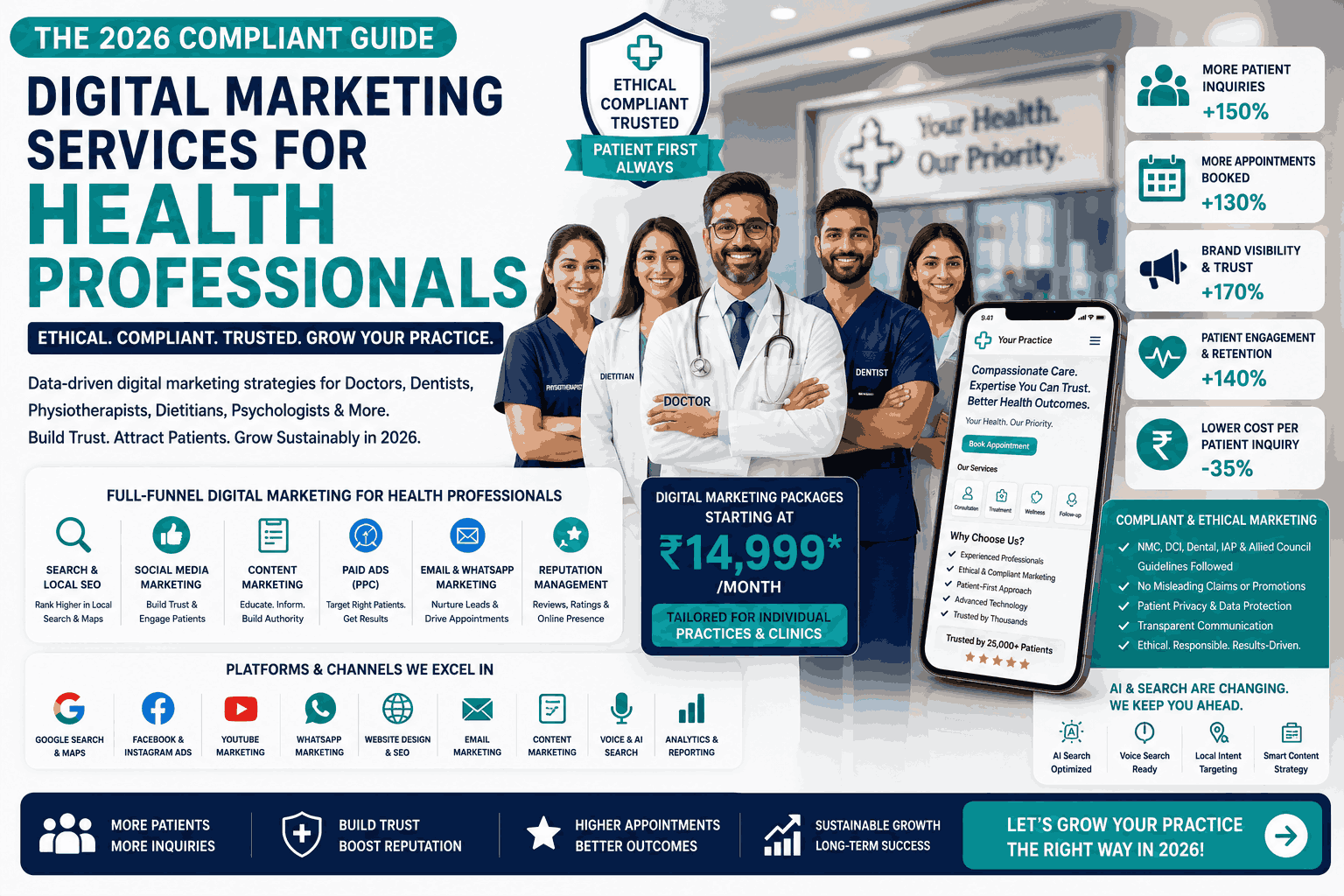
Whether someone needs a cardiologist, a physiotherapist for a bad back, a dietitian to manage diabetes, or a therapist to talk to, the journey now starts the same way: a search on a phone, a glance at reviews, a look at a website, and increasingly a question put to an AI assistant. For every kind of practitioner, that shift is why digital marketing services for health professionals have moved from optional to essential.
But here’s what makes marketing in this field genuinely different from marketing a shop or a restaurant: health is a profession bound by ethics, and — importantly — the rules are not the same for everyone. What a wellness coach can say online is not what a registered doctor can say. Get this wrong and you risk your reputation or your registration; get it right and you build the kind of trust that quietly fills your appointment book.
This guide is written for the full spectrum of Indian health professionals — doctors, dentists, physiotherapists, dietitians, psychologists, AYUSH practitioners, and wellness specialists — who want to grow ethically and compliantly. We’ll cover what’s actually allowed for your profession, the strategies that work in 2026, honest pricing, and how to choose a partner who understands healthcare rather than just clicks. Reassuringly, as you’ll see, ethical marketing and effective marketing now point in the same direction.
What Are Digital Marketing Services for Health Professionals?
Digital marketing services for health professionals are the strategy and execution that help a practitioner be found, trusted, and reached by the right patients or clients online — within the boundaries of their profession’s ethics. The emphasis matters: it’s about informing and helping people, not soliciting them. Done well, it lets a genuinely capable professional show up where patients are already looking.
Who counts as a health professional?
“Health professional” is a wide umbrella, and each type markets a little differently. Here’s how the main groups line up.
| Health Professional | Typical Goal | Best-fit Channels |
|---|---|---|
| Doctors & dentists | New patients, specialty awareness | Local SEO, GBP, education content, reviews |
| Physios, chiropractors, OTs | Local clients, condition recovery | Local SEO, GBP, video, reviews |
| Dietitians & nutritionists | Programmes and online clients | Content, social, email, telehealth |
| Psychologists & therapists | Confidential client enquiries | Discreet content, SEO, directories |
| AYUSH practitioners | Local patients, awareness | Local SEO, GBP, compliant education |
| Wellness & fitness coaches | Programmes, community, online sales | Social, video, email, D2C |
The core components
Across disciplines, a serious programme usually combines: a fast, mobile-friendly website with online booking; local SEO and an optimised Google Business Profile; patient-education content with your name and credentials; online reputation and review management; compliant social media and short video; telehealth enablement where relevant; answer engine optimisation so AI assistants describe you accurately; and analytics tied to real enquiries and bookings.
Why Every Health Professional Needs an Online Presence in 2026
Patient behaviour has changed permanently. Most people research online before booking any kind of practitioner, and in India around three-quarters do so. Searches for a professional “near me” have grown dramatically over the past few years, and younger patients are far more likely to choose based on online presence than on a personal referral. Most read reviews first, and a growing share won’t consider a provider below a strong rating.
There’s a fairness problem hidden in this. A skilled physiotherapist or an experienced dietitian with a weak digital footprint can lose clients to a less experienced but more visible peer. That isn’t right, but it’s how decisions are made now. Ethical digital marketing simply lets your real-world competence show up where patients are actually looking — and increasingly, that includes AI assistants summarising who to trust.
Know Your Rules First — Advertising Norms Vary by Profession
This is the section most marketing pages skip, and it’s the one that matters most. Unlike other industries, health professionals in India are governed by professional codes — but by different bodies, with different rules. Before any tactics, find where you sit.
The regulatory map
| Profession | Governing Body | Advertising Stance |
|---|---|---|
| Doctors (allopathic) | National Medical Commission (NMC) | No soliciting/advertising; factual information only |
| Dentists | Dental Council of India (DCI) | Restricts advertising and soliciting; factual announcements only |
| AYUSH (Ayurveda, Homeopathy, etc.) | NCISM / NCH + Drugs & Magic Remedies Act | No cure or ‘magic remedy’ claims; restricted advertising |
| Physios, dietitians, optometrists | National Commission for Allied & Healthcare Professions (NCAHP) | Draft 2026 code bars soliciting, endorsements, buying followers |
| Clinical psychologists / mental health | Rehabilitation Council of India (RCI) + Mental Healthcare Act, 2017 | Strict confidentiality; cautious, non-soliciting promotion |
| Nurses | Indian Nursing Council (INC) | Professional code; no soliciting |
| Wellness / fitness / nutrition coaches | Not professionally registered | ASCI, consumer-protection & anti-cure rules apply |
A genuinely important 2026 development sits in that table. Allied professionals — physiotherapists, optometrists, dietitians, and others — were until recently largely unregulated on advertising. The NCAHP, set up in 2021 and operational from 2024, has now released a draft Professional Conduct and Ethics code (out for consultation in 2026) that, much like the doctors’ code, bars soliciting patients directly or indirectly, prohibits endorsements and buying social-media followers, and mandates upfront fee disclosure. In short, the freedom many allied professionals assumed they had is narrowing fast, so it pays to market conservatively now.
The universal red lines
Whatever your profession, a few rules apply to everyone:
- No guaranteed cures, outcomes, or exaggerated claims.
- No fabricated or purchased reviews, followers, or ratings.
- No misleading before-and-after content or patient images without clear consent — and for most registered professionals, not at all.
- No claims to treat or cure serious diseases (the Drugs and Magic Remedies Act applies broadly).
- Always present accurate, verifiable credentials and qualifications.
The safe, scalable strategy for almost everyone is the same: promote education and your verifiable expertise, not self-glorification. Encouragingly, that’s exactly what modern search rewards — so compliance and good SEO have become the same project.
What’s Included in Professional Digital Marketing for Health Professionals
Here’s a clear breakdown of what a healthcare-savvy provider should deliver, framed for compliance, so you can read any proposal with confidence.
| Service | What It Covers | Why It Matters |
|---|---|---|
| Website & online booking | Mobile-fast site, services, credentials, scheduling | Your digital front door and conversion point |
| Local SEO & Google Profile | Profile optimisation, accurate details, photos | Wins “near me” discovery — highest ROI |
| Education content | Condition guides and FAQs with named authorship | Builds trust and ranks in search and AI |
| Reputation management | Genuine review generation and professional responses | Drives confidence and local ranking |
| Compliant social & video | Factual, educational posts and short videos | Authority without self-promotion |
| Telehealth enablement | Online-consult info and booking flows | Extends reach within the rules |
| AEO / structured data | Schema and direct answers for AI assistants | Accurate visibility in AI answers |
| Analytics & tracking | Enquiries, bookings, cost per patient | Separates real growth from vanity metrics |
The Big 2026 Shifts Health Professionals Should Know
Healthcare marketing is changing fast this year. Here’s what matters most for practitioners.
1. AI search and answer engines
Patients increasingly begin with AI — asking ChatGPT, Google’s AI Overviews, Gemini, or Perplexity about symptoms and which kind of professional to see. Many searches now end without a click, with the answer delivered directly. This makes Answer Engine Optimisation important: accurate, structured, machine-readable information about your services and expertise so AI systems can describe and recommend you correctly. Being cited by an AI assistant for your specialty is among the highest-leverage outcomes of 2026.
2. E-E-A-T and named professional authorship
Health content sits in Google’s “Your Money or Your Life” category, where trust is decisive. Content that clearly identifies a qualified author or reviewer consistently outperforms anonymous content in both rankings and engagement. Showcasing real credentials, citing reputable sources, and keeping information current is both an ethics signal and a ranking advantage — a rare case where the careful path and the high-performance path are identical.
3. Google Business Profile and reviews
For local discovery, your Google Business Profile is the battleground. It powers the map results that appear for nearly every “near me” search, and review signals strongly influence both ranking and patient choice. A complete, accurate profile with correct details and a steady stream of genuine, unsolicited reviews — answered professionally — is the single highest-ROI asset most practitioners have.
4. Video and short-form education
Video is where trust forms quickly — patients search it for condition overviews and to get a feel for a practitioner before booking. Short, authentic educational clips now outperform glossy productions; people trust clarity and honesty over studio polish. Video also lifts engagement and gives AI systems richer material to draw on.
5. Telehealth and online consultations
Online consultations have become mainstream across many disciplines, from dietetics and therapy to follow-up medical care. For doctors, the Telemedicine Practice Guidelines, 2020 set the framework, and comparable professional standards apply elsewhere. You can factually let patients know you offer online consultations and make booking easy — while keeping clinical advice off public social media.
6. Privacy-first marketing and the DPDP Act
As personalisation grows, so does scrutiny of patient data. Anything you collect — enquiry forms, appointment details, communication preferences — falls under India’s Digital Personal Data Protection Act, 2023, requiring clear consent, purpose limitation, and secure storage. Building privacy in from the start, and keeping education separate from anything promotional, is now best practice and a genuine trust differentiator.
How Much Do Digital Marketing Services for Health Professionals Cost in India in 2026?
Let’s be direct. Pricing depends on your field’s competitiveness, your city, and how many channels you run. Here are realistic 2026 ranges for the Indian market.
| Tier | Monthly Fee | What You Get | Best For |
|---|---|---|---|
| Starter | ₹10,000–25,000 | Google Profile, basic local SEO, light content | Solo practitioners, new practices |
| Growth | ₹25,000–50,000 | Local SEO, content, reviews, compliant ads, social | Established single/multi-practitioner clinics |
| Full-service | ₹50,000–1,00,000+ | All channels, advanced SEO, video, reputation, reporting | Multi-practitioner clinics in competitive metros |
| Specialist / group | ₹1,00,000+ | Multi-location SEO, paid media, content, AEO | Specialist centres and professional groups |
Management fee vs ad spend — and GST
Your management fee and your ad spend are two different things. The fee pays the team that plans, builds, and reports; the ad spend goes directly to Google or Meta to run compliant, practice-level campaigns. A quote that bundles both into one “all-inclusive” number is hiding something. Remember too that 18% GST applies to Indian agency fees, so a ₹30,000 retainer really costs ₹35,400.
The economics of a single patient or client
Here’s where the numbers get interesting for a practice. Paid ads can bring enquiries within the first week but stop the moment you stop paying. Local SEO and content take three to six months to build, then deliver patients at a far lower long-term cost. The clincher is lifetime value: a single ongoing patient — a therapy client over many months, a chronic-care patient, a recurring nutrition programme, or a high-value procedure — can be worth far more than the first appointment, meaning even a full month’s marketing is often recovered from one or two patients.
A simple budgeting rule
Don’t guess. A practical guideline across Indian healthcare is to allocate roughly 5–15% of revenue to marketing, scaled to your growth ambition and competition. Then work backwards: estimate your target number of new patients, your realistic cost per patient, and the channel mix to get there. Spending too little to sustain consistent content and a managed profile usually produces little — at the bottom end, doing the basics well yourself beats paying for half-hearted execution.
SEO vs Paid Ads vs Reputation for Health Professionals
These channels are complementary, not competing. Here’s how they compare for a practice.
| Factor | Local SEO + GBP | Paid Ads | Reputation / Reviews |
|---|---|---|---|
| Speed to results | 3–6 months | Days to 2 weeks | Builds gradually |
| Cost model | Monthly retainer | Ad spend + management | Mostly time and process |
| Longevity | Compounds; durable | Stops when budget stops | Compounds with each review |
| Compliance fit | Excellent (factual/educational) | Good (promote practice, not self) | Sensitive — never solicit/fabricate |
| Best for | Steady “near me” discovery | Faster enquiries, new services | Trust and local ranking |
The verdict: start with the foundation — a complete Google Business Profile and local SEO — because that’s where most patients discover you and it’s fully compliant. Layer on educational content with named authorship to build authority and AI visibility, use compliant paid ads to accelerate when you need enquiries faster, and nurture genuine reviews over time. No single channel wins alone; the mix fills your practice sustainably.
Advantages and Disadvantages of Digital Marketing for Health Professionals
Every agency lists the upsides. Here’s an honest look at both sides.
Advantages
- Visibility where patients search — you show up for “near me” queries and in AI answers.
- Trust before the first visit — credible content and reviews build confidence in advance.
- Strong, measurable ROI — a single ongoing patient can repay months of marketing.
- Compounding, lower-cost growth — SEO and content keep working long after publication.
- Better patient experience — easy information and online booking reduce friction.
- Compliance-friendly when done right — educational marketing aligns with both ethics and SEO.
Disadvantages
- Rules differ and are tightening — what’s allowed depends on your profession and is evolving.
- It rewards patience — SEO and reputation take months, not days.
- Compliance risk if mishandled — testimonials, guarantees, or soliciting can damage your standing.
- Quality varies enormously — generalist agencies often don’t understand professional codes.
- Ad spend and content are extra — the management fee is rarely the whole bill.
- No legitimate guarantees — credible providers never promise a fixed number of patients.
Security, Compliance, and Trust (Beyond Advertising Rules)
Beyond professional advertising codes, a few laws apply across the board. A healthcare-aware partner builds these in from the start.
Patient data and confidentiality
The moment you collect patient details — enquiry forms, phone numbers, appointment data — you’re handling personal data under India’s Digital Personal Data Protection Act, 2023, which requires clear consent, purpose limitation, and secure storage. Layered on top is your professional duty of confidentiality, which for mental health professionals is reinforced by the Mental Healthcare Act, 2017. Patient information and images must never become marketing material without explicit, documented permission — and for most clinicians, caution is warranted even then.
The Drugs and Magic Remedies Act
The Drugs and Magic Remedies (Objectionable Advertisements) Act, 1954 prohibits advertisements claiming to diagnose, cure, or prevent certain listed conditions. This applies broadly — to clinicians, AYUSH practitioners, and wellness coaches alike. Any marketing implying a guaranteed cure for these conditions is illegal, regardless of professional ethics. Keep claims factual, evidence-based, and free of “miracle cure” language.
Advertising standards and ad platforms
Advertising-standards and consumer-protection rules prohibit misleading health claims, and any influencer or content collaboration must clearly disclose paid arrangements. On the platforms, Google’s healthcare advertising policies require special certification (such as LegitScript) for sensitive categories like addiction treatment and online pharmacies. Keep messaging accurate, and promote your practice and education rather than guaranteeing outcomes.
Own your assets
Finally, ownership is a form of security. Your website, domain, Google Business Profile, social accounts, and patient database should belong to you — with any agency given access, never the other way around. If you ever change partners, you keep your data, reviews history, and visibility intact.
| A reminder: Advertising and data rules for health professionals in India are detailed, differ by profession, and are evolving (the NCAHP allied-health ethics code is still in draft, and the NMC’s 2023 rules are in abeyance). Nothing here is legal advice. Before launching campaigns, confirm your own council’s current position and consult a medico-legal expert. When in doubt, choose the more conservative, patient-first option. |
How to Choose a Healthcare Marketing Agency (as a Health Professional)
Use this as a filter — and weight healthcare experience heavily.
Green flags
- They understand the rules of your specific profession and lead with compliance.
- They focus on education, local SEO, and practice-level promotion.
- They separate management fees from ad spend transparently.
- They report on patients, calls, and bookings — not just impressions.
- They handle data responsibly and mention the DPDP Act without prompting.
Red flags
- They promise a guaranteed number of patients or top rankings.
- They suggest testimonials, before-and-after posts, or buying reviews and followers.
- “All-inclusive” pricing that hides ad spend.
- They want to own your Google Profile, website, or patient data.
- No healthcare experience and no awareness of professional codes.
Questions worth asking before you sign
- How do you keep our marketing compliant with my council’s rules and the DPDP Act?
- Will you promote the practice and education rather than soliciting for me personally?
- Is ad spend separate, and what do you recommend for my field and city?
- Who owns our website, Google Profile, and patient data?
- How do you generate reviews ethically and handle negative ones?
- How will you report results in terms of actual patient enquiries?
Measuring ROI — Metrics That Matter for a Practice
Followers and impressions feel good but don’t fill your schedule. Track what ties to patients, and judge each channel on its own timeline.
- New patient enquiries — calls, form fills, and booking requests.
- Cost per patient (acquisition cost) — what it takes to win one new patient.
- Patient/client lifetime value — total value over time, not just the first visit.
- Google Business Profile actions — calls, direction requests, and website clicks.
- Review rating and volume — your most public, trust-moving metric.
- AI and search visibility — whether you’re cited for your field and rank for “near me” terms.
| Timeframe | What to Expect |
|---|---|
| Week 1–2 | Compliant ads and an optimised Google Profile can produce enquiries; foundations cleaned up. |
| Month 2–3 | Local SEO and reviews lift discovery; content begins ranking and feeding AI answers. |
| Month 4–6+ | Organic patient flow and reputation compound; cost per patient falls and visibility strengthens. |
Expert Insights — What Works for Health Professionals in 2026
A few hard-won principles from practitioners growing the right way:
- Educate, don’t advertise. Answer real patient questions clearly; helpful content builds trust, ranks, and stays compliant.
- Put your name and credentials on your content. Named authorship is both an ethics signal and a ranking advantage.
- Win local discovery first. A complete, active Google Business Profile is the highest-ROI move most practitioners can make.
- Earn reviews, don’t buy them. Encourage genuine feedback and respond professionally within privacy limits.
- Use authentic video. A clear, honest explainer beats studio polish and works across search, social, and AI.
- Know your council’s rules. What a wellness coach can post is not what a doctor or dentist can — market to your own code.
- Promote the practice, not the persona. When in doubt, lead with education and verifiable expertise.
Frequently Asked Questions
Digital marketing services for health professionals are the strategy and execution that help any practitioner — a doctor, dentist, physiotherapist, dietitian, psychologist, AYUSH practitioner, or wellness coach — be found, trusted, and reached by the right patients or clients online, within the rules of their profession. They include a professional website, local SEO and Google Business Profile, patient-education content, reviews and reputation management, compliant social media, telehealth enablement, and answer engine optimisation for AI search.
It depends on the profession. Registered clinicians such as doctors and dentists face strict limits on advertising and soliciting and may share only factual information. Allied professionals like physiotherapists and dietitians are coming under similar restrictions through the NCAHP’s draft 2026 ethics code, which bars soliciting and buying followers. Non-registered wellness coaches have more latitude but must still follow advertising-standards, consumer-protection, and anti-magic-remedy rules. When unsure, market education and verifiable credentials, not self-promotion.
In 2026, a solo health professional in India can start around ₹10,000–25,000 per month for Google Business Profile optimisation and basic local marketing. Growth packages with local SEO, content, and ads run ₹25,000–50,000, while full-service marketing for multi-practitioner clinics typically ranges from ₹50,000 to ₹1,00,000+ per month. Ad spend is separate, content production is often extra, and 18% GST applies to Indian agency fees.
The highest-ROI foundation is a complete Google Business Profile plus local SEO, since most patients search for a ‘[profession] near me.’ Add a clear, mobile-friendly website with online booking, genuinely helpful educational content carrying your name and credentials, and a steady flow of authentic reviews. Short educational videos and, where appropriate, telehealth can extend your reach. Keep everything factual and compliant with your council’s rules.
Yes, significantly. Doctors are governed by the NMC, dentists by the Dental Council of India, clinical psychologists by the RCI, and allied professionals like physiotherapists and dietitians by the NCAHP, while AYUSH practitioners also fall under the Drugs and Magic Remedies Act. Registered professionals generally cannot solicit patients or make outcome claims, whereas non-registered wellness coaches have more freedom but still cannot make disease-cure claims. Always follow the specific code that applies to you.
For most registered professionals, publishing patient testimonials or before-and-after content on your own website or social media is treated as self-promotion and should be avoided. Organic reviews left by patients on third-party platforms like Google exist in a separate, grey area — you should not buy, fabricate, or solicit them, but you may respond professionally within privacy limits. Wellness coaches have more latitude but must keep any testimonials genuine and non-misleading.
It varies by channel. A well-run Google Business Profile and compliant paid ads can produce enquiries within the first week or two. Local SEO and content marketing usually show meaningful results in three to six months, then compound, while reputation builds gradually as genuine reviews accumulate. Anyone promising a flood of guaranteed patients overnight is overselling — and likely cutting ethical corners.
Yes, within the applicable rules. For doctors, the Telemedicine Practice Guidelines, 2020 govern online consultations, and similar professional standards and confidentiality duties apply to other practitioners. You can factually inform patients that you offer online consultations and guide enquirers toward a proper booking, but you should keep clinical advice off public social media and protect patient data under the Digital Personal Data Protection Act, 2023.
Lead with information, not promotion: share factual credentials, clinic details, and patient education, and avoid testimonials, before-and-after content, guaranteed cures, and soliciting language unless your profession clearly permits it. Follow the Drugs and Magic Remedies Act and ASCI norms, handle patient data under the DPDP Act, 2023, and keep clinical discussions off public platforms. Because rules differ by profession and are evolving, confirm your council’s current guidance and consider medico-legal advice.
Final Verdict
Digital marketing services for health professionals in 2026 are less about promotion and more about presence and trust: showing up accurately where patients search, earning confidence through genuinely helpful information, and making it easy to find and book you — all within the rules that govern your particular profession. The practitioners who win treat compliance and patient education as the strategy, not an afterthought, and they recognise that what’s permitted for a wellness coach is not the same as for a registered clinician.
If you’re investing in this, go in with clear eyes. Know your council’s rules first, lead with information over advertising, build a strong Google Business Profile and educational content, insist on healthcare-aware partners, judge results by real patient enquiries rather than vanity metrics, and verify the current rules before you launch. Do that, and digital marketing becomes what it should be for a health professional — an ethical, dependable way to let your real-world skill reach the patients who need it.