There is a simple truth that every school principal, college admissions officer, and EdTech founder now confronts: the student who once discovered their next institution through word of mouth, a newspaper ad, or a roadside hoarding now starts their search on Google. According to a 2025 Google report, over 82% of prospective students use online research as their primary channel when evaluating educational options — and that number climbs to 91% among students aged 16–24.
Yet despite this seismic shift in student behavior, a surprising number of educational institutions are still relying on the same brochures, education fairs, and referral networks they used a decade ago. The gap between where students look and where institutions invest is real — and it costs schools and colleges admissions they never knew they lost.
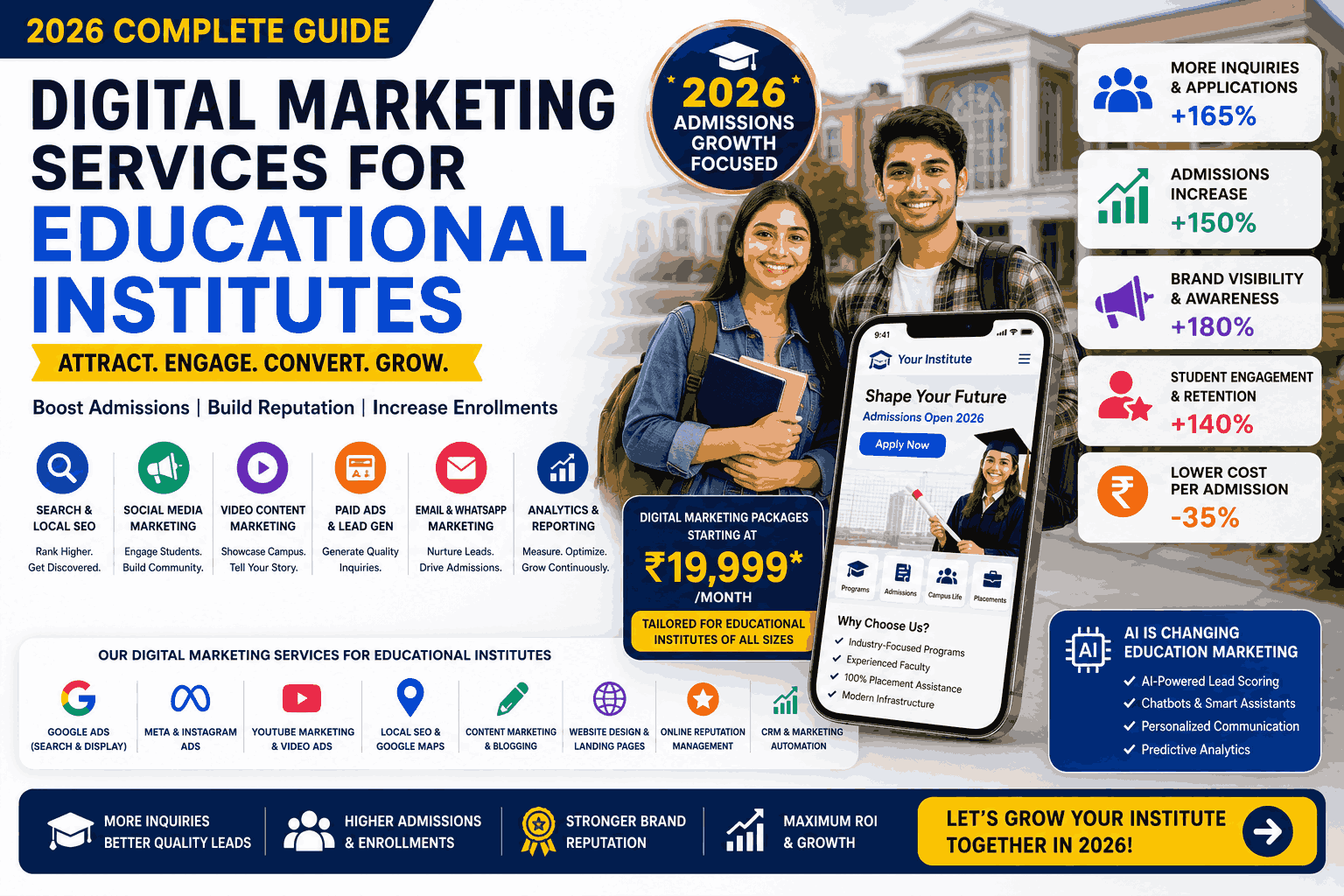
This is the definitive 2026 guide to digital marketing services for educational institutes — covering every channel, strategy, cost benchmark, compliance consideration, and emerging trend that matters, whether you run a K-12 school, an engineering college, a coaching institute, a university, or an EdTech platform reaching learners nationally.
Why Educational Institutions Can No Longer Afford to Ignore Digital Marketing
The education sector has historically operated on reputation and reach — institutions with well-established names attracted students through legacy, word-of-mouth, and geographic presence. That model has not disappeared, but it has been dramatically supplemented by digital discovery.
Consider what happens when a parent in Lucknow searches ‘best CBSE school near me’ or a Class 12 student types ‘top engineering colleges in Maharashtra 2026’. The institutions that appear first — in Google Search, in Google Maps, in YouTube results, in Meta ads — capture that student’s attention. The ones that do not appear might as well not exist for that searcher at that moment. This is the fundamental competitive pressure that makes digital marketing services for educational institutes not a nice-to-have but an enrollment-critical investment.
The competitive landscape has also intensified. EdTech platforms — Byju’s, Unacademy, PhysicsWallah, upGrad, Coursera — have poured hundreds of crores into digital marketing, setting student expectations for what educational discovery should look and feel like online. Traditional institutions now compete for digital attention against these well-funded players in addition to each other.
And the stakes extend beyond admissions. Digital presence affects faculty recruitment, research visibility, alumni engagement, corporate partnership development, and an institution’s ability to attract grant funding and media coverage. Every dimension of an educational institution’s external relationship is now shaped, at least in part, by its digital footprint.
The Full Spectrum: Digital Marketing Services for Educational Institutes
1. Search Engine Optimization (SEO) for Education
Educational SEO is about making your institution the first answer when students and parents search for the programs, outcomes, and opportunities your institution provides. Unlike product SEO — where a transaction can happen within minutes — education SEO targets a long consideration journey that may span months from initial awareness to enrollment submission.
Effective educational SEO covers:
- Program-specific landing pages optimized for queries like ‘BBA colleges in Pune with good placement’ or ‘online MBA for working professionals India’
- Hyperlocal SEO for city and area-based searches — particularly important for schools, coaching centers, and community colleges
- Technical SEO ensuring fast load speeds, mobile-first design, and correct structured data including EducationalOrganization, Course, and Event schema types
- Content ecosystems — blog posts, resource guides, and career-outcome articles answering the questions prospective students actually ask
- Google AI Overview optimization: structuring FAQ content and comparison guides to appear in AI-generated search summaries
- YouTube SEO: campus tour videos, faculty interview videos, and student testimonial videos optimized for both YouTube search and Google video results
A frequently underinvested area is outcome-based content — articles specifically about placement records, alumni careers, industry partnerships, and post-program salary data. This content converts high-intent readers because it directly addresses the core evaluation question: ‘Will this institution improve my life?’
2. Pay-Per-Click Advertising (Google Ads) for Admissions
For institutions with time-sensitive enrollment windows — annual admission cycles, batch start dates, scholarship deadlines — PPC advertising fills the gap where SEO cannot deliver immediate traffic. A well-structured Google Ads campaign targeting high-intent keywords like ‘BCA admission 2026’, ‘nursing college application open’, or ‘part-time MBA classes Bangalore’ can deliver qualified enquiries within days.
Key PPC services for educational institutes include:
- Search campaign architecture targeting program-specific and location-specific keywords
- Ad copy testing with clear enrollment CTAs, deadline urgency, and specific differentiators (placement rate, accreditations, scholarship availability)
- Landing page creation and optimization aligned to each campaign’s specific message
- Remarketing campaigns re-engaging website visitors who explored programs but did not submit an enquiry
- YouTube TrueView campaigns for campus tours and event promotions
- Google Display Network campaigns building awareness during pre-admission research phases
The education sector is increasingly competitive in paid search, with CPCs for high-value terms like ‘MBA admission’ or ‘MBBS college India’ reaching ₹200–₹800 per click in premium markets. This makes conversion rate optimization for landing pages as important as campaign management itself — driving expensive traffic to an underperforming page is a budget drain, not a marketing strategy.
3. Social Media Marketing for Schools and Colleges
Social media is the primary digital habitat of students — and increasingly of parents evaluating institutions for their children. The platforms differ in how they serve educational marketing goals:
- Instagram: Visual storytelling through campus life content, student achievement spotlights, Reels showing events and facilities, and paid lead generation ads targeting students by age, location, and educational background
- Facebook: Parent-focused content and community building, admission event promotions, alumni groups, and paid ads targeting parents in the 35–55 age bracket researching institutions for their children
- YouTube: Long-form campus tours, faculty lectures, student success stories, and event recordings that serve both organic discovery and build brand depth
- LinkedIn: Positioning the institution for corporate partnerships, faculty recruitment, alumni engagement, and marketing graduate and executive education programs
- WhatsApp Business: Admission enquiry management, automated program information delivery, counsellor appointment scheduling, and broadcast messaging to opted-in prospective students
In 2026, Instagram Reels and YouTube Shorts have emerged as particularly effective for reaching Class 11–12 students in research mode. Short-form videos showcasing campus life, honest student-led ‘day in my life’ content, and faculty Q&A clips consistently outperform polished corporate productions in organic reach and engagement among this demographic.
4. Content Marketing and Education Blogging
Content marketing serves a dual function for educational institutions: it drives organic search traffic and it builds authentic institutional authority — the sense that this institution genuinely knows its field and invests in sharing that knowledge. A school or college publishing genuinely useful content about career paths, industry trends, exam preparation, or scholarship opportunities earns trust that no amount of paid advertising can manufacture.
High-performing educational content categories include:
- Career pathway guides: ‘What can you do with a degree in Environmental Science?’ or ‘Career options after BCA in 2026’
- Admission process guides: Detailed, accurate walkthroughs of application requirements, exam schedules, and selection criteria
- Scholarship and fee structure information: Transparent, updated, and easily searchable
- Faculty thought leadership: Published articles, research summaries, and expert commentary on industry developments
- Student outcome reports: Placement statistics, alumni profiles, and career progression data
- Comparison content: ‘B.Sc vs BCA — which suits your career goals?’ — capturing students evaluating their options
E-E-A-T (Experience, Expertise, Authoritativeness, Trustworthiness) compliance is especially important for educational content because Google treats institutions publishing guidance about education, careers, and financial decisions as YMYL (Your Money or Your Life) content. Content must be accurate, verifiable, attributed to credible authors, and regularly updated to maintain rankings and reader trust.
5. Website Design and Development for Educational Institutions
An educational institution’s website is its most important digital asset — and in most cases, the single greatest barrier to conversion. Prospective students and parents who arrive from any channel — search, social, or referral — will judge your institution largely by the quality, speed, and clarity of your website.
A high-performing educational website in 2026 needs:
- Mobile-first design: Over 75% of education-related searches in India now happen on mobile devices
- Program finder with intelligent filtering by level, mode, duration, and location
- Virtual campus tour integration: 360-degree walkthroughs, drone footage, and facility highlights
- Live chat and AI chatbot for 24/7 enquiry handling — critical during admission season when counsellors cannot respond to all queries
- Clear conversion architecture: Every page should have a visible, contextually relevant call-to-action (Enquire Now, Download Brochure, Register for Open Day)
- Accessibility compliance: WCAG 2.1 standards, important both for inclusivity and for avoiding regulatory exposure
- Fast load speed: Under 2.5 seconds on mobile — each additional second of load time measurably reduces form submission rates
6. Email Marketing and CRM-Based Lead Nurturing
The admission enquiry-to-enrollment journey in higher education can span 3–12 months. During that time, prospective students are comparing multiple institutions, attending open days, sitting entrance exams, and receiving offers. Email marketing keeps your institution present and persuasive throughout that entire consideration window.
Effective educational email marketing includes:
- Automated welcome sequences delivering program information, campus tour invites, and counsellor introductions within minutes of an enquiry
- Segmented nurture sequences by program of interest, academic background, and stage in the decision journey
- Deadline and event reminder campaigns for open days, scholarship applications, and admission cutoff dates
- Post-admission onboarding sequences reducing dropouts between offer acceptance and registration
- Alumni re-engagement for continuing education and executive programs
CRM integration is essential for educational email marketing. Platforms like Leadsquared (popular in Indian education), HubSpot, or Salesforce Education Cloud allow counsellors to track every touchpoint in a prospective student’s journey — from first website visit to enrollment — enabling data-driven follow-up rather than generic broadcast emails.
7. Online Reputation Management for Educational Institutes
For educational institutions, online reviews are not a secondary concern — they are a primary enrollment factor. A 2025 survey found that over 68% of parents check Google reviews and ratings before shortlisting a school or college. A 3.2-star average rating on Google Business Profile can cost an institution dozens of admission enquiries per month.
Reputation management services for educational institutes include:
- Proactive Google review generation from current students, parents, and alumni
- Monitoring and professional response to all reviews — positive and negative — on Google, MagicBricks Education, Shiksha, CollegeDekho, and Careers360
- Suppression of inaccurate or damaging search results through content strategy and digital PR
- Social listening for brand mentions across platforms, including Reddit, Quora, and Facebook groups where students candidly discuss institutions
8. EdTech-Specific Digital Marketing Services
Educational institutions that operate digital-first — online learning platforms, coaching apps, course marketplaces — require a slightly different marketing stack than brick-and-mortar schools and colleges. EdTech marketing services include app store optimization (ASO) for course discovery apps, programmatic advertising across education-adjacent content, affiliate and influencer partnerships with educators on YouTube and Instagram, and performance marketing with subscription conversion funnels.
The EdTech sector in India has matured significantly post-pandemic. Student acquisition costs have risen, free trial conversion rates have declined, and retention has become as important a metric as acquisition. Digital marketing services for EdTech brands in 2026 must address the full student lifecycle — acquisition, activation, retention, and re-engagement — not just top-of-funnel awareness.
Channel Comparison: Digital Marketing Services for Educational Institutes
Here is how each major channel performs across the key dimensions that matter for educational enrollment marketing:
| Channel | Best For | Speed | Cost Level | Lead Quality | Long-Term ROI |
|---|---|---|---|---|---|
| SEO | Organic admissions, brand authority | Slow (3–6 months) | Medium | Very High | Excellent |
| Google Ads (PPC) | Admission season leads, program launches | Immediate | High | High | Good if managed well |
| Meta Ads (FB + IG) | Student awareness, parent engagement | Fast (days) | Medium | Medium–High | Good |
| YouTube Ads | Campus tours, course promos | Fast | Medium | Medium | Very Good |
| Content Marketing | Long-term trust, SEO foundation | Slow | Low–Medium | Very High | Excellent |
| Email / CRM | Enquiry-to-enrollment conversion | Medium | Low | Very High | Excellent |
| Social Media (Organic) | Community building, student engagement | Medium | Low | Medium | Good |
| ORM / Reviews | Trust and conversion rate lift | Ongoing | Low–Medium | Indirect | Very High |
| WhatsApp Marketing | Lead nurturing, event reminders | Fast | Low | High | Very Good |
Recommended Digital Marketing Strategy by Institution Type
| Institution Type | Priority Channels | Key Message Focus | Approx. Monthly Budget (India) |
|---|---|---|---|
| K-12 School | Local SEO, GBP, Instagram, Facebook (parents), WhatsApp | Safety, academics, holistic development | ₹15,000 – ₹40,000 |
| Engineering / Medical College | SEO, Google Ads, YouTube, Shiksha/CollegeDekho listings | Placement records, faculty, NIRF ranking | ₹50,000 – ₹2 lakh |
| Coaching Institute | Google Ads, Instagram Reels, YouTube, Local SEO | Results, faculty expertise, batch structure | ₹25,000 – ₹75,000 |
| University (multi-program) | Full-funnel SEO + PPC + CRM + Content + ORM | Academic breadth, research, campus life | ₹1.5 lakh – ₹5 lakh+ |
| EdTech Platform | Performance marketing, ASO, YouTube, influencer | Learning outcomes, flexibility, cost vs ROI | ₹2 lakh – ₹10 lakh+ |
| Professional / Executive Ed | LinkedIn, Google Ads, Email, Content | Career advancement, ROI, peer network | ₹40,000 – ₹1.5 lakh |
2026 Updates: What’s Changed in Education Digital Marketing
Google AI Overviews Are Rewriting the Student Research Journey
When a student in 2026 searches ‘best data science courses in India’ or ‘is an MBA worth it after engineering’, they increasingly see a Google AI-generated summary at the top of results — a synthesized answer drawn from multiple authoritative sources. Institutions whose content is clear, structured, factually specific, and E-E-A-T compliant are getting cited in these summaries, earning brand impressions even when the student does not click through to the website.
This has created a new content strategy imperative: educational institutions must produce genuinely informative, question-answering content — not promotional brochure copy — to benefit from AI search visibility. FAQ pages, comparison guides, career outcome articles, and program structure explainers are the content types AI models draw from.
CUET and Centralized Admission Systems Are Changing Search Behavior
The expansion of CUET (Common University Entrance Test) and centralized admission processes across Indian universities has created new search demand around exam preparation, counseling procedures, and cutoff scores. Institutions with content addressing these specific queries are capturing prospective student attention months before formal admission opens — creating a significant first-mover advantage in the consideration phase.
Short-Form Video Has Become the #1 Student Discovery Format
Instagram Reels and YouTube Shorts have surpassed all other content formats in organic reach among students aged 15–22. Campus life content, faculty introductions, student testimonials, and honest ‘pros and cons of this college’ videos — when produced authentically rather than as polished marketing materials — generate dramatically higher engagement and trust signals than traditional promotional videos. Institutions that embrace student-generated content and informal faculty presence on short-form platforms are outperforming those investing exclusively in high-production brand videos.
India’s DPDPA 2023 — Compliance Requirements for Education Marketers
India’s Digital Personal Data Protection Act (DPDPA) 2023, now fully enforced in 2026, has significant implications for educational institutions collecting student and parent data through online enquiry forms, admission portals, WhatsApp opt-ins, and remarketing campaigns. Institutions must obtain explicit, documented consent for data collection, provide clear privacy notices, limit data use to stated purposes, and maintain records of consent. This applies to third-party platforms like LeadSquared, HubSpot, and Meta’s lead generation ads equally.
Educational institutions working with minors (K-12) face additional obligations under DPDPA, as data involving children requires heightened protection and cannot be processed for advertising purposes without appropriate consent mechanisms.
AI-Powered Chatbots Are Now Standard for Admission Enquiry Management
In 2026, AI chatbots integrated with admission websites are no longer an advanced feature — they are an expected baseline for serious institutions. These tools handle initial enquiry classification, program information delivery, appointment scheduling, and FAQ responses 24/7, allowing human counsellors to focus on high-intent conversations. Institutions using AI chatbots report 30–50% improvements in enquiry-to-counsellor-conversation conversion rates.
Pros and Cons of Digital Marketing Services for Educational Institutes
Advantages
- Precision targeting: Ads and SEO content reach students and parents with specific program interests, geographic locations, and academic backgrounds — far more efficiently than mass media
- Measurable enrollment attribution: Track every enquiry, application, and enrollment back to its digital source, giving you data to optimize marketing spend over each admission cycle
- Always-on visibility: Your website, Google Business Profile, and social channels represent your institution 24/7, capturing student interest at any hour across time zones
- Cost-efficiency at scale: Once SEO content ranks and email nurture sequences are built, the cost per enrolled student declines significantly compared to per-enrollment costs of offline marketing
- Geographic reach expansion: Institutions can attract students from cities and regions beyond their physical footprint through targeted digital campaigns — previously only possible for large national brands
- Community building: Social media and content platforms enable ongoing engagement with current students, alumni, and parents that strengthens retention and advocacy
- Competitive intelligence: Digital marketing data reveals what prospective students are searching for, what competitors are advertising, and where gaps in your messaging exist
Disadvantages
- Upfront investment before ROI: SEO and content marketing require 3–6 months of consistent investment before measurable enrollment impact — making budget conversations challenging in institutions with short planning horizons
- Digital skills gap: Many educational institutions lack the internal expertise to effectively manage digital marketing, making quality agency selection critical and quality evaluation difficult
- PPC dependency risk: Paid search and social advertising stops delivering leads immediately when campaigns pause — creating enrollment pipeline gaps during budget freezes
- Reputation amplification cuts both ways: Digital marketing increases visibility, including visibility of negative experiences — an institution with genuine service quality issues will see those amplified online
- Platform algorithm volatility: Google algorithm updates, Meta reach changes, and YouTube policy shifts can disrupt traffic and engagement that has taken months to build
- Content compliance requirements: In the YMYL category, educational content must be accurate, regularly updated, and attributed — creating ongoing editorial obligations that some institutions underestimate
- Data privacy complexity: DPDPA 2023 compliance for student data management requires legal oversight and operational processes that represent genuine administrative overhead
Trust, Regulations, and Ethical Standards in Education Digital Marketing
UGC and AICTE Advertising Guidelines
The University Grants Commission (UGC) and All India Council for Technical Education (AICTE) have issued guidelines governing how approved institutions represent themselves in advertising and online content. Claims about rankings, accreditations, placement rates, and affiliations must be accurate, verifiable, and consistent with current approvals. Misrepresentation in digital marketing — even unintentional — can result in regulatory action and severely damage institutional credibility.
Shiksha, CollegeDekho, and Third-Party Platform Transparency
A significant portion of student decision-making happens on third-party education portals. Institutions should maintain accurate, complete, and regularly updated profiles on platforms where students compare options. Inaccurate fee structures, outdated placement data, or incorrect accreditation information on these platforms creates both regulatory risk and admission counsellor credibility issues when enquiries are followed up.
Student Data Protection and Consent
Educational institutions collect extensive personal data during admission processes — academic records, financial information, parent contact details, and in some cases medical information. Digital marketing activities that involve this data — CRM-based retargeting, email personalization, scholarship targeting — must operate within explicit DPDPA consent frameworks. Minimum data collection principles apply: collect only what is necessary for clearly stated purposes.
Honest Representation Standards
The Advertising Standards Council of India (ASCI) has specific guidelines for educational advertising, including requirements around substantiation of claims about placements, salaries, success rates, and rankings. Phrases like ‘highest placement rates’, ‘100% placement guaranteed’, or ‘India’s #1 engineering college’ require documented substantiation. Digital marketing agencies working with educational clients should conduct compliance reviews of all ad copy and landing page content before publication.
How to Choose the Right Digital Marketing Agency for Your Educational Institute
The education sector has enough unique characteristics — seasonal enrollment windows, DPDPA obligations, YMYL content requirements, multi-stakeholder audiences of students and parents — that choosing a generalist agency without specific education marketing experience carries meaningful risk.
When evaluating agencies, look for:
- Documented education sector experience with case studies showing enrollment impact, not just traffic metrics
- Familiarity with education-specific platforms: Shiksha, CollegeDekho, Careers360, Leadsquared CRM integration
- Understanding of DPDPA compliance for student data handling in digital campaigns
- Knowledge of UGC and AICTE advertising standards and claim substantiation requirements
- CRM and admission funnel integration capability — not just lead generation but full-funnel attribution
- Content team with subject-matter awareness of Indian education landscape, exam systems, and career pathways
- Transparent reporting with real-time dashboard access to campaign and enquiry data
Ask specifically: How do you attribute enrollments back to digital marketing activity? How do you handle admission season traffic spikes? What is your process when lead volume drops month-over-month? The depth and specificity of answers will tell you more than any pitch deck.
Expected ROI and Cost Benchmarks for Education Digital Marketing in India
| Service | Avg. Cost per Enquiry | Conversion Rate (Enquiry→Enrollment) | Approx. Cost per Enrollment | ROI Potential |
|---|---|---|---|---|
| Google Ads (Search) | ₹300 – ₹1,200 | 5–15% | ₹2,000 – ₹24,000 | High (5x–20x on fee revenue) |
| SEO (organic leads at scale) | ₹100 – ₹500 | 8–20% | ₹500 – ₹6,000 | Very High (20x+) |
| Meta Ads | ₹150 – ₹600 | 3–10% | ₹1,500 – ₹20,000 | Good (4x–15x) |
| Content Marketing | ₹80 – ₹400 | 10–25% | ₹320 – ₹4,000 | Excellent (25x+) |
| Email Marketing (warm leads) | ₹30 – ₹150 | 15–35% | ₹86 – ₹1,000 | Exceptional |
| WhatsApp Campaigns | ₹20 – ₹100 | 10–25% | ₹80 – ₹1,000 | Exceptional |
Note: These benchmarks vary significantly by institution type, program fee, market competitiveness, and campaign quality. High-fee programs (MBA, MBBS, engineering) can absorb higher cost-per-enrollment figures while maintaining strong ROI. Low-fee programs require tighter cost-per-enrollment management.
Frequently Asked Questions — Digital Marketing Services for Educational Institutes
For institutions beginning their digital marketing journey, three services deliver the fastest impact with the most manageable investment: Google Business Profile optimization (for local search visibility), a mobile-optimized website with clear enquiry forms, and targeted Meta ads reaching parents and students in the relevant age and geographic segment. These three together can meaningfully increase enquiry volume within 30–60 days while longer-term SEO and content investments build in parallel.
Costs range from approximately ₹15,000–₹40,000 per month for a K-12 school running basic local SEO and social media management, to ₹1.5 lakh–₹5 lakh or more per month for a university running comprehensive SEO, paid search, content marketing, and CRM-based nurturing. EdTech platforms investing in performance marketing typically spend significantly more. Always clarify whether quoted figures include ad spend separately from agency management fees.
Yes, and this impact is measurable. Educational institutions running integrated digital marketing programs — combining search visibility, paid campaigns, lead nurturing, and reputation management — consistently report 20–50% enrollment increases over 12–24 month periods compared to institutions relying solely on offline methods. The key is attribution tracking: linking each enrollment back to the digital touchpoints that influenced the student’s decision.
Social media serves both functions simultaneously — and they are not separable. Instagram and Facebook are where a significant portion of student and parent research happens, making organic presence important for discovery. Paid social ads on these platforms directly generate enquiries and are measurable at the lead level. YouTube content builds brand depth that increases conversion rates from other channels. Social media in education marketing is a lead generation channel, not just a brand exercise.
Every negative review should receive a professional, thoughtful response within 48 hours — acknowledging the feedback without being defensive and outlining any steps being taken. Never ignore negative reviews; non-response is interpreted by prospective students and parents as confirmation that the criticism is valid. Where reviews are factually inaccurate or violate platform policies, follow the formal dispute process. The best long-term strategy is proactively generating a high volume of positive reviews from satisfied students and parents, so individual negative reviews have less proportional impact.
Yes, significantly. DPDPA 2023 requires explicit consent for collecting and processing personal data through admission forms, website enquiry forms, WhatsApp opt-ins, and retargeting campaigns. For K-12 institutions, additional protections apply for children’s data. Institutions must provide clear privacy notices, maintain consent records, and ensure third-party tools like CRMs and ad platforms handle data within DPDPA compliance frameworks. Legal review of data collection practices is advisable before running campaigns at scale.
Educational SEO typically requires 3–4 months before noticeable ranking improvements appear for moderately competitive terms, and 6–12 months for competitive terms like ‘engineering colleges in [major city]’. However, less competitive long-tail terms — specific program queries, less-competitive locations — can begin ranking within 6–8 weeks. The enrollment impact follows ranking improvements, typically with a further 1–2 months of lead accumulation before enrollment conversions appear.
The highest-performing content categories for educational institutions are: (1) outcome-focused content — placement records, alumni careers, salary data; (2) process guides — how to apply, what exams are required, scholarship availability; (3) comparison content — program comparisons, institution comparisons; (4) career pathway content — what you can do with specific degrees; and (5) authentic student and faculty voices — video content, testimonials, and day-in-the-life features. Promotional content about facilities and rankings performs significantly worse than content that answers the questions students and parents are actually asking.
In 2026, yes — AI chatbots have become a practical standard for managing admission enquiry volume, particularly during peak seasons when human counsellors cannot respond to every query quickly. Well-configured chatbots handle initial program information requests, brochure delivery, FAQ responses, and appointment scheduling, ensuring no enquiry is left unaddressed for hours. The key is ensuring chatbot responses are accurate, updated with current program information, and configured to escalate complex enquiries to human counsellors promptly.
Yes. The Advertising Standards Council of India (ASCI) guidelines require that claims about placement rates, salary packages, rankings, success rates, and accreditations be accurate and substantiated. UGC and AICTE have issued specific directions on misleading advertisements in education. Guaranteed placement claims, unsubstantiated ranking claims, and misleading fee representations all carry regulatory risk. All digital ad copy for educational institutions should be reviewed against current ASCI guidelines and regulatory requirements before publication.