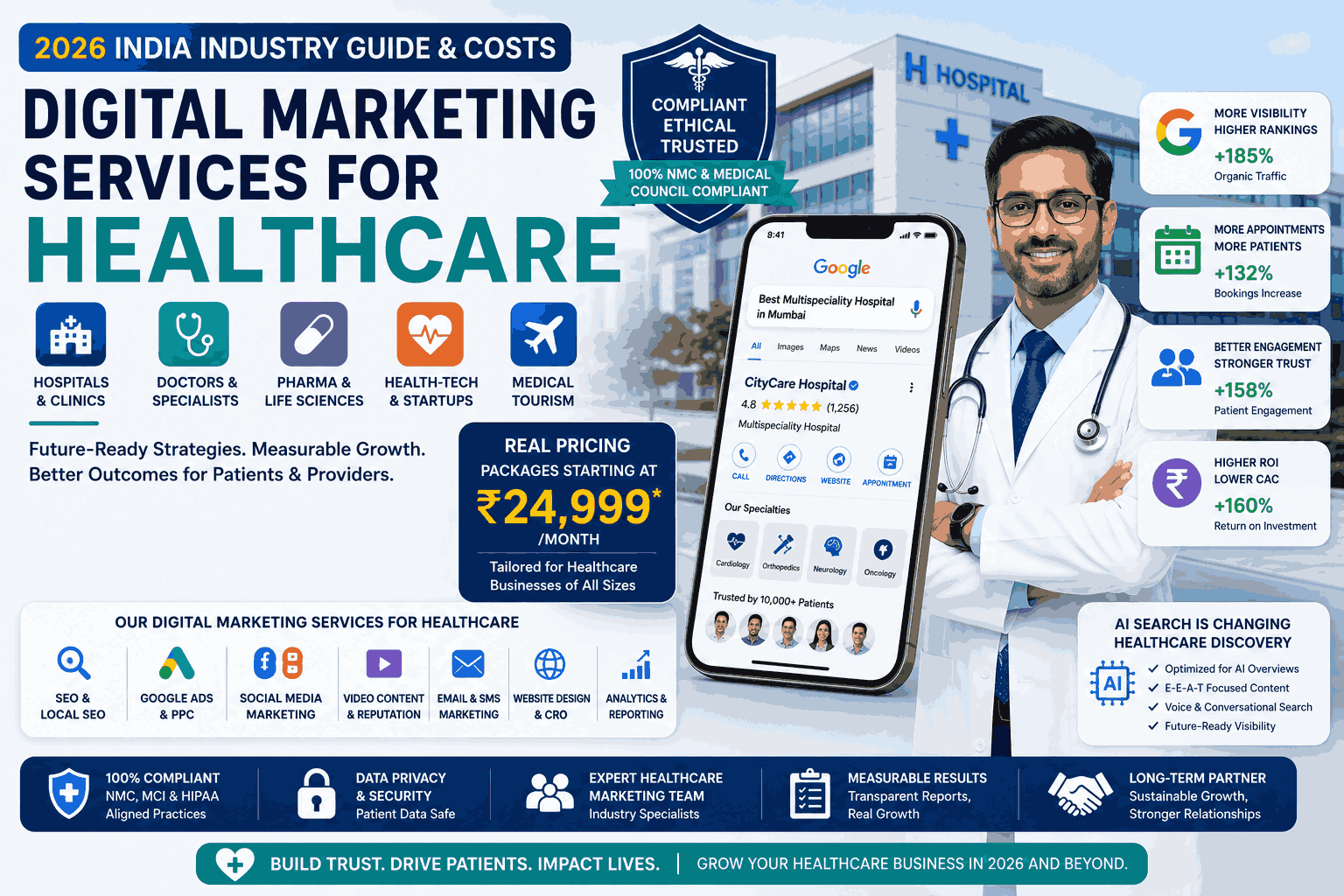
Two very different patients, the same first move. A family in Delhi deciding where to take a parent for a cardiac workup opens Google, reads reviews, and checks a hospital’s website. A father in Oman who needs a knee replacement watches a 45-second reel from a surgeon in Chennai, messages on WhatsApp, and gets a cost estimate and visa guide within minutes. Both journeys start online — and that is exactly why digital marketing services for healthcare have become mission-critical, from a single neighbourhood clinic to a multi-specialty hospital chasing international patients.
Healthcare is also unlike any other industry to market. It sits squarely in what Google calls “Your Money or Your Life” territory, it’s bound by strict medical-ethics and data-protection rules, and the cost of a careless claim can be a damaged reputation or a regulatory notice. Get it wrong and you risk real harm; get it right and you build the kind of trust that fills beds and clinics.
This guide is written for Indian healthcare leaders — hospital administrators, clinic owners, diagnostics and health-tech founders, and the marketers who serve them. We’ll cover what works in 2026, the medical-tourism opportunity, honest pricing, the compliance backbone, and how to choose a partner who understands healthcare rather than just clicks. Reassuringly, as you’ll see, ethical healthcare marketing and effective healthcare marketing now point in the same direction.
What Are Digital Marketing Services for Healthcare?
Digital marketing services for healthcare are the strategy and execution that help healthcare organisations be found, trusted, and chosen by patients online — within the bounds of medical and data regulation. The emphasis is on informing and guiding patients, not pressuring them. Done well, it makes a genuinely capable provider easy to discover and easy to trust, which increasingly decides who fills their appointment book and who doesn’t.
Who it’s for: the healthcare segments
“Healthcare” is a broad industry, and each segment markets differently. Here’s how the major players line up.
| Segment | Primary Goal | Lead Channels |
|---|---|---|
| Hospitals & multi-specialty | Patient acquisition across specialties; medical tourism | Local + national SEO, GBP, paid ads, content, AEO |
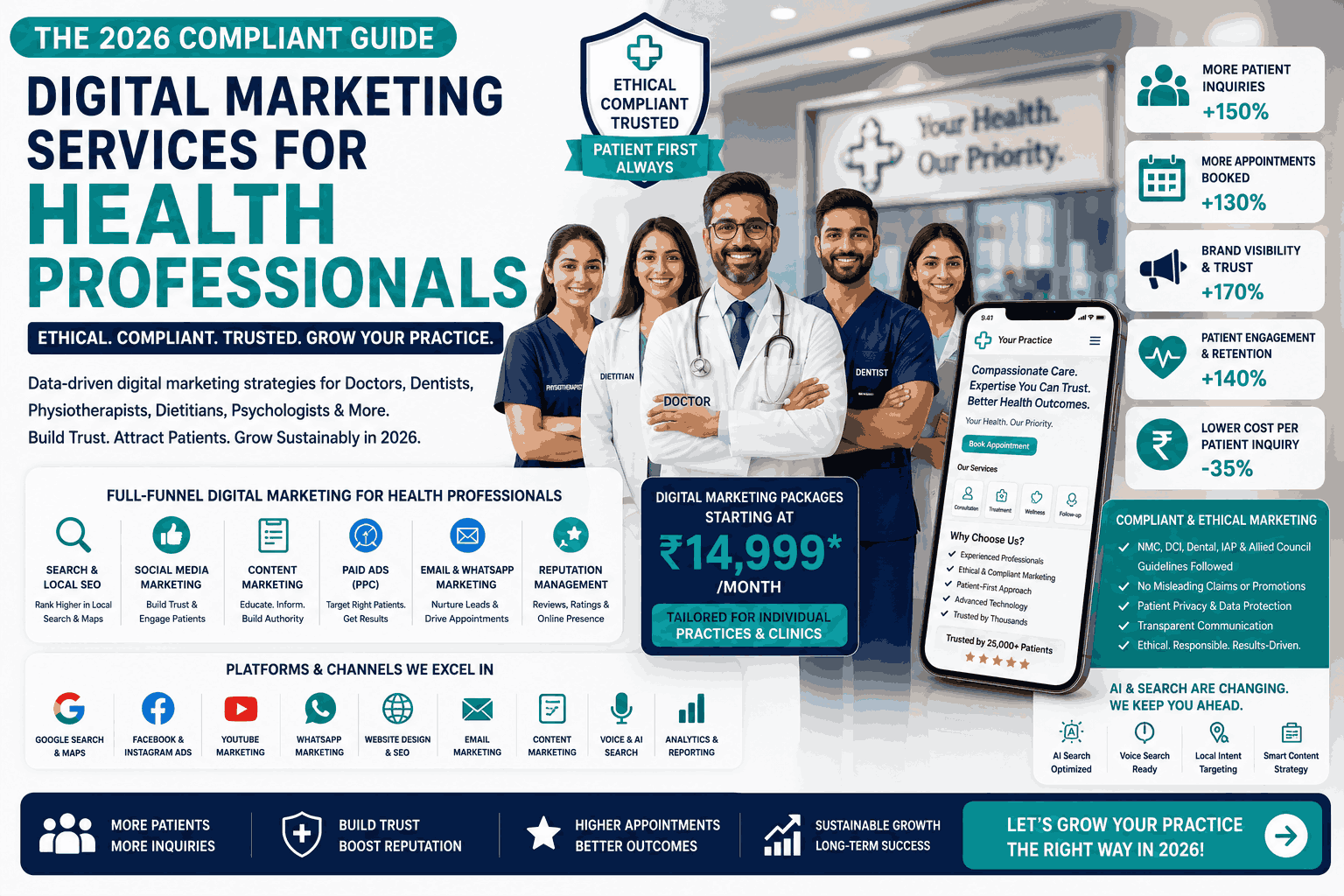
| Clinics & individual practices | Local patient discovery and bookings | Google Business Profile, local SEO, reviews |
| Diagnostics & labs | Test bookings, B2B doctor referrals | Local SEO, paid ads, WhatsApp, partnerships |
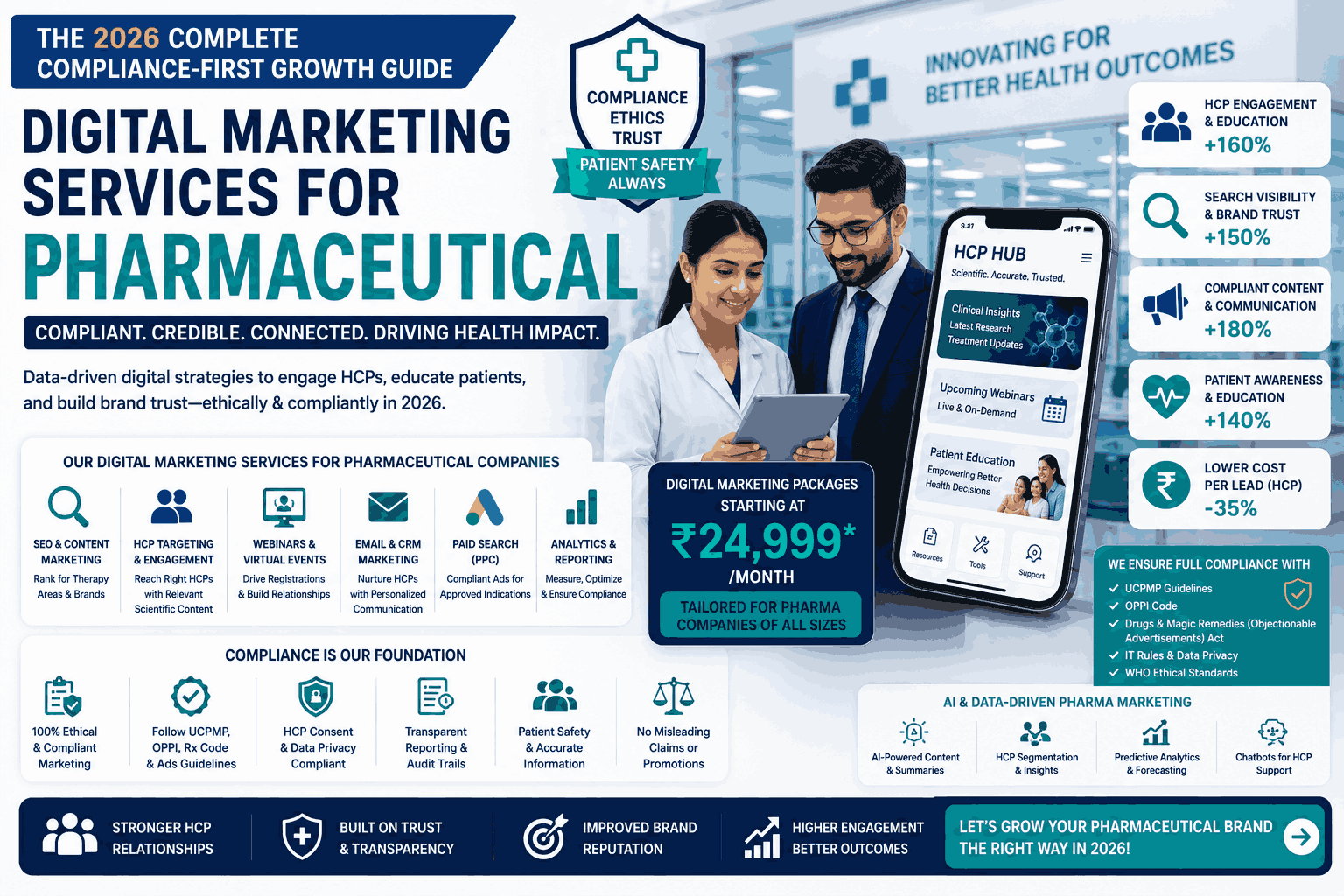
| Pharma & medical devices | Awareness and education (within limits) | Content, SEO, professional channels |
| Health-tech & telehealth | App installs, consultations, retention | Performance ads, SEO, content, CRM |
| Wellness & D2C health | Direct sales and community | Social, influencers, paid ads, email |
The core components
Across segments, a serious healthcare programme usually combines: a fast, mobile-friendly website with online booking; local SEO and a fully optimised Google Business Profile for every location; patient-education content with named medical authorship; online reputation and review management; compliant social media and short video; clinic-level paid advertising; answer engine optimisation so AI assistants describe you accurately; and rigorous analytics tied to patient enquiries and acquisition cost.
Why Healthcare Marketing Is Different (and Higher-Stakes)
Patient behaviour has shifted permanently. Globally, 70–82% of patients research providers online before booking, and in India around 77% do the same. “Doctor near me” and “hospital in [city]” searches have grown roughly 185% since 2020. Patients under 45 are several times more likely to choose a provider based on online presence than on a personal referral, most read reviews first, and a large majority expect to book online — yet far fewer providers actually offer it.
The market reflects this: healthcare digital marketing worldwide is worth several billion dollars and growing at roughly 18% a year. But healthcare carries responsibilities other industries don’t. Health content is held to a higher standard of trust, regulators watch claims closely, and patient data is sensitive and legally protected. That’s why a healthcare-specific approach — compliant, evidence-based, and trust-first — matters far more than generic marketing tactics.
The Rules: Compliance Comes First in Healthcare Marketing
Before tactics, understand the rules, because they govern everything. Most marketing pages aimed at healthcare skip this. We’re putting it up front, because it’s the one area where mistakes genuinely hurt.
The advertising framework
India’s medical ethics — the Indian Medical Council (Professional Conduct, Etiquette and Ethics) Regulations, 2002, still the operative code after the NMC’s 2023 regulations were kept in abeyance — restrict doctors from soliciting patients and from self-promotion. In practice, this means healthcare marketing should promote the institution, its accreditations, and its specialties rather than glorifying a named practitioner. The Drugs and Magic Remedies (Objectionable Advertisements) Act, 1954 separately bars advertisements claiming to cure certain listed conditions, and advertising-standards and consumer-protection rules prohibit misleading health claims and require clear disclosure of any paid influencer content.
The do / don’t of healthcare marketing
| Do (compliant & effective) | Don’t (risky / prohibited) |
|---|---|
| Promote the hospital/brand, specialties, and accreditations | Solicit patients or glorify an individual doctor |
| Publish factual, evidence-based patient education | Claim guaranteed cures or exaggerated outcomes |
| Show facilities, technology, and credentials accurately | Use patient testimonials/images without explicit consent |
| Encourage genuine reviews and respond professionally | Buy reviews, followers, ratings, or paid leads |
| Disclose paid influencer or sponsored content | Run misleading or fear-based health claims |
| Keep clinical advice off public social media | Diagnose or prescribe in comments or DMs |
Here’s the encouraging part: these constraints push you toward exactly what modern search rewards — accurate, helpful, trustworthy content. In healthcare, compliance and good SEO have become the same project.
What’s Included in Professional Healthcare Digital Marketing Services
Here’s a clear breakdown of what a healthcare-savvy provider should deliver, framed for compliance, so you can read any proposal with confidence.
| Service | What It Covers | Why It Matters |
|---|---|---|
| Website & online booking | Mobile-fast site, services, credentials, scheduling | Your digital front door and conversion point |
| Local SEO & Google Profile | Per-location profiles, accurate NAP, photos, posts | Wins “near me” discovery — highest ROI |
| Patient-education content | Condition guides and FAQs with named medical authorship | Builds trust and ranks in search and AI |
| Reputation management | Genuine review generation and professional responses | Drives patient confidence and local ranking |
| Compliant social & video | Factual, educational posts and short videos | Authority without self-promotion |
| Paid advertising | Service and specialty campaigns within policy | Faster, high-intent patient enquiries |
| AEO / structured data | Schema and direct answers for AI assistants | Accurate visibility in AI-generated answers |
| Medical-tourism funnel | Multilingual landing pages, WhatsApp, visa guidance | Unlocks high-value international patients |
The Big 2026 Shifts in Healthcare Marketing
Healthcare marketing is changing fast this year. Here’s what matters most for providers and brands.
1. AI search and answer engines
Patients increasingly begin with AI — asking ChatGPT, Google’s AI Overviews, Gemini, or Perplexity about symptoms, treatments, and which provider to choose. Many searches now end without a click, with the answer delivered directly. This makes Answer Engine Optimisation essential: structured, accurate, machine-readable content about your services, specialties, and locations so AI systems can describe and recommend you correctly. For a hospital, being cited by an AI assistant for a key specialty is among the highest-leverage marketing outcomes of 2026.
2. E-E-A-T and named medical authorship
Health content sits in Google’s YMYL category, where trust is decisive. Content that clearly identifies a qualified medical author or reviewer consistently outperforms anonymous content in both rankings and engagement. Institutional trust signals — NABH and JCI accreditation, real doctor credentials, published outcomes, and cited sources — now double as ranking and AI-citation advantages. This is a rare case where the ethical path and the high-performance path are identical.
3. Google Business Profile and reviews
For local and multi-location discovery, Google Business Profile is the battleground. It powers the map pack that appears for nearly every “near me” search, and review signals strongly influence both ranking and patient choice. Complete, accurate profiles for every location — with correct details, specialty tags, and quality photos — plus a steady stream of genuine, unsolicited reviews and professional responses, form the single highest-ROI asset most providers have.
4. Video and short-form patient education
YouTube is effectively the world’s second-largest search engine, and patients routinely search it for condition overviews, procedure walkthroughs, and to get a feel for a hospital. Short, authentic educational videos now outperform glossy productions — patients trust clarity and honesty over studio polish. Video also lifts time-on-page and gives AI systems richer material to draw on.
5. Privacy-first marketing, DPDPA and ABDM
As personalisation grows, so does scrutiny of patient data. Anything you collect — enquiry forms, bookings, communication preferences — falls under India’s Digital Personal Data Protection Act, 2023, while the Ayushman Bharat Digital Mission is expanding the use of digital health records nationwide. Building consent, purpose limitation, and secure storage into every campaign isn’t just compliance; it’s a genuine trust differentiator that both patients and search engines reward.
Medical Tourism: India’s Billion-Dollar Healthcare Marketing Opportunity
If you run or market a hospital in India, this is the section to study. Medical value travel has become one of the country’s biggest healthcare growth stories — and it is now won or lost almost entirely online.
The numbers are striking. India’s medical tourism market was valued in the range of USD 11–12 billion in 2025–26 and is projected by analysts to roughly double over the next five years, growing around 12–13% a year. Foreign arrivals for treatment climbed from about 1.8 lakh in 2020 to over 6.4 lakh in 2024, with 4.5 lakh-plus recorded in just the first eleven months of 2025. The draw is a powerful mix: treatment costs 60–80% below Western rates, world-class specialists, and a deep network of accredited hospitals — India now has dozens of JCI-accredited institutions and over 4,650 NABH-accredited hospitals.
Government policy has poured fuel on this. The ‘Heal in India’ initiative, a streamlined e-Medical Visa now covering 167 countries with approvals in 48–72 hours, dedicated medical-travel hubs, and the Ayushman Bharat Digital Mission’s Digital Health Passport are making cross-border care faster, more transparent, and more trustworthy. At the same time, source markets are diversifying — as flows from some regions fluctuate, hospitals are actively courting patients across Africa, Central Asia, Southeast Asia, and the Middle East.
The international patient digital funnel
The hospital that wins an international patient is rarely the one with the most famous surgeon — it’s the one that is most reachable, in the right language, on the right platform, at the right moment. Here’s the funnel that captures these high-value patients.
| Stage | International Patient Action | What the Hospital Needs |
|---|---|---|
| Discover | Searches a treatment; watches reels; asks AI | Multilingual SEO, AEO, authentic video |
| Evaluate | Checks reviews, accreditations, doctor profiles | Strong reviews, NABH/JCI proof, credentials |
| Enquire | Messages on WhatsApp; uploads reports | Fast multilingual response, AI “digital front door” |
| Decide | Wants cost estimate, visa and travel clarity | Treatment-specific pages, transparent packages, visa guidance |
| Advocate | Reviews, refers others post-treatment | Tele follow-up, review prompts, referral programmes |
Practically, that means treatment-specific landing pages built per country and language, AI-powered chatbots handling enquiries in Arabic, French, Russian, or Swahili, response times measured in minutes rather than days, and post-treatment tele-follow-up that turns patients into advocates. For Indian hospitals, this digital funnel is the difference between watching the medical-tourism boom and capturing it.
How Much Do Digital Marketing Services for Healthcare Cost in India in 2026?
Let’s be direct. Pricing depends on your segment, your city, how competitive your specialties are, and whether you’re targeting local, national, or international patients. Here are realistic 2026 ranges for the Indian market.
| Tier | Monthly Fee | What You Get | Best For |
|---|---|---|---|
| Clinic starter | ₹10,000–25,000 | Google Profile, local SEO, light content | Single clinics, small practices |
| Growth | ₹25,000–60,000 | Local SEO, content, reviews, paid ads, social | Established clinics, diagnostics |
| Hospital / multi-specialty | ₹2,00,000–5,00,000+ | Multi-location SEO, paid media, content, AEO | Hospitals and large groups |
| Medical tourism / health-tech | ₹1,00,000–5,00,000+ | Multilingual funnels, performance ads, CRM | International patients, telehealth |
Management fee vs ad spend — and GST
Your management fee and your ad spend are two different things. The fee pays the team that plans, builds, and reports; the ad spend goes directly to Google or Meta to run campaigns. A quote that bundles both into one “all-inclusive” number is hiding something. Remember too that 18% GST applies to Indian agency fees, so a ₹1,00,000 retainer really costs ₹1,18,000.
SEO vs paid ads — and the economics of a single patient
Paid ads bring enquiries within days but stop the moment you stop paying. Local SEO and content take three to six months to build, then deliver patients at a far lower long-term cost — organic leads can cost dramatically less than paid ones, and some providers have cut patient-acquisition costs sharply by shifting from ads to local SEO. The clincher is lifetime value: a single high-value case — a cardiac surgery, a transplant, an oncology pathway, or an international patient — can be worth several lakhs, meaning even a substantial monthly marketing budget is often recovered from one or two patients.
A simple budgeting rule
Don’t guess. A practical guideline used across Indian healthcare is to allocate roughly 5–15% of revenue to marketing, scaled to growth ambition and competition. Then work backwards: estimate your target patient volume, realistic cost per patient, and the channel mix to get there. Spending too little to sustain consistent content and managed profiles usually produces little — at the bottom end, doing the basics well beats paying for half-hearted execution.
SEO vs Paid Ads vs Reputation for Healthcare
These channels are complementary, not competing. Here’s how they compare for a healthcare provider.
| Factor | SEO + Local | Paid Ads | Reputation / Reviews |
|---|---|---|---|
| Speed to results | 3–6 months | Days to 2 weeks | Builds gradually |
| Cost model | Monthly retainer | Ad spend + management | Mostly time and process |
| Longevity | Compounds; durable | Stops when budget stops | Compounds with each review |
| Compliance fit | Excellent (educational) | Good (promote institution) | Sensitive — never solicit/fabricate |
| Best for | Steady “near me” discovery | High-intent procedures, fast enquiries | Trust and local ranking |
The verdict: build the foundation first — complete Google Business Profiles and local SEO for every location, because that’s where most patients discover you and it’s fully compliant. Add patient-education content with named authorship to build authority and AI visibility, use paid ads to accelerate high-intent specialties, and nurture genuine reviews steadily. For hospitals, layer the international-patient funnel on top. No single channel wins alone; the mix sustains growth.
Advantages and Disadvantages of Digital Marketing Services for Healthcare
Every agency lists the upsides. Here’s an honest look at both sides.
Advantages
- Visibility where patients search — you show up for “near me” queries and in AI answers.
- Trust before the first visit — credible content, accreditations, and reviews build confidence in advance.
- Strong, measurable ROI — a single high-value or international case can repay months of marketing.
- Access to global patients — a strong funnel unlocks the medical-tourism opportunity.
- Compounding, lower-cost growth — SEO and content keep working long after publication.
- Compliance-friendly when done right — educational marketing aligns with both ethics and SEO.
Disadvantages
- Strict regulation — you can’t advertise like a consumer brand, which rules out many “easy” tactics.
- It rewards patience — SEO, reputation, and international funnels take months, not days.
- Compliance risk if mishandled — misleading claims or misused patient data can cause real harm.
- Quality varies enormously — generalist agencies often don’t understand healthcare rules.
- Ad spend and content are extra — the management fee is rarely the whole bill.
- No legitimate guarantees — credible partners never promise a fixed number of patients.
Security, Trust, and Data Protection (The Non-Negotiables)
Beyond advertising rules, healthcare marketing must protect patient data and earn trust the right way. A healthcare-aware partner builds these in from the start.
Patient data, DPDPA and ABDM
Any patient data you collect — enquiry forms, bookings, chat, communication preferences — falls under India’s Digital Personal Data Protection Act, 2023, requiring clear consent, purpose limitation, secure storage, and easy opt-out. Layered on top is your duty of medical confidentiality. As the Ayushman Bharat Digital Mission expands digital health records and identifiers, responsible data handling becomes even more important. Patient information and images must never become marketing material without explicit, documented permission.
Accreditation and trust signals
In healthcare, trust signals are marketing assets. NABH and JCI accreditation, transparent outcomes, qualified-author content, and clear credentials reassure patients and are increasingly what AI engines and Google’s quality systems look for when deciding whom to surface and cite. Make these signals visible and verifiable across your website, listings, and content.
Ad-platform and claims compliance
On the platforms, Google’s healthcare advertising policies require special certification (such as LegitScript) for sensitive categories like addiction treatment and online pharmacies, and every health claim must be accurate and non-misleading. Keep messaging factual and evidence-based, and avoid “miracle cure” or fear-based language entirely.
Own your assets
Ownership is a form of security. Your website, domain, Google Business Profiles, social accounts, and patient database should belong to your organisation — with any agency given access, never the other way around. If you ever change partners, you keep your data, reviews history, and visibility intact.
| A reminder: India’s healthcare-marketing and data rules are detailed and evolving, and enforcement varies. Nothing here is legal advice. Before launching campaigns, confirm current NMC, ASCI, and DPDPA/ABDM positions and consult a medico-legal or compliance expert. When in doubt, choose the more conservative, patient-first option. |
How to Choose a Healthcare Marketing Agency
Use this as a filter — and weight healthcare experience heavily.
Green flags
- They clearly understand NMC ethics, ASCI, and DPDPA, and lead with compliance.
- They have real healthcare experience and case studies in your segment.
- They separate management fees from ad spend transparently.
- They report on patient enquiries, bookings, and acquisition cost — not just impressions.
- For hospitals, they can build multilingual, international-patient funnels.
Red flags
- They promise a guaranteed number of patients or “#1” rankings.
- They suggest fake reviews, bought followers, or misleading claims.
- “All-inclusive” pricing that hides ad spend.
- They want to own your website, Google Profiles, or patient data.
- No healthcare experience and no awareness of medical-marketing rules.
Questions worth asking before you sign
- How do you keep our marketing compliant with NMC ethics, ASCI, and the DPDP Act?
- How will you promote the institution and specialties rather than individuals?
- Is ad spend separate, and what do you recommend for our specialties and city?
- Who owns our website, Google Profiles, and patient data?
- How do you generate reviews ethically and handle negative ones?
- If relevant, how do you build and measure a medical-tourism funnel?
Measuring ROI — Metrics That Matter in Healthcare
Followers and impressions feel good but don’t fill beds. Track what ties to patients, and judge each channel on its own timeline.
- New patient enquiries — calls, form fills, WhatsApp messages, and booking requests.
- Cost per patient (acquisition cost) — what it takes to win one new patient.
- Patient lifetime value — total value over time, not just the first visit.
- Google Business Profile actions — calls, directions, and website clicks from your listings.
- Review rating and volume — your most public, trust-moving metric.
- International funnel metrics — enquiry-to-arrival rate and revenue per international patient.
| Timeframe | What to Expect |
|---|---|
| Week 1–2 | Paid ads and optimised Google Profiles can start producing enquiries; foundations cleaned up. |
| Month 2–3 | Local SEO and reviews lift discovery; content begins ranking and feeding AI answers. |
| Month 4–6+ | Organic patient flow and reputation compound; cost per patient falls and international funnels mature. |
Expert Insights — What Works in Healthcare Marketing in 2026
A few hard-won principles from healthcare brands growing the right way:
- Educate, don’t advertise. Answer real patient questions clearly; helpful content builds trust, ranks, and stays compliant.
- Make trust signals visible. Surface accreditations, credentials, and named medical authorship — they win patients and AI citations.
- Win local discovery first. Complete, active Google Business Profiles for every location are the highest-ROI move.
- Respond fast, especially on WhatsApp. For high-value and international patients, minutes matter more than polish.
- Structure content for AI. Direct answers and schema help AI assistants describe your services accurately.
- Earn reviews, don’t buy them. Encourage genuine feedback and respond professionally within privacy limits.
- Promote the institution, not the persona. Market the hospital, brand, and specialties to stay on the right side of the rules.
Frequently Asked Questions
Digital marketing services for healthcare are the strategy and execution that help healthcare organisations — hospitals, clinics, diagnostic labs, pharma, health-tech, and wellness brands — be found, trusted, and chosen by patients online. They span local SEO and Google Business Profile, patient-education content, online reputation management, compliant social media and video, paid advertising, answer engine optimisation for AI search, online booking, and, for many Indian hospitals, international patient and medical-tourism marketing — all within strict medical and data-protection rules.
In 2026, a single clinic in India can start around ₹10,000–25,000 per month, while healthcare SEO typically runs ₹20,000–80,000. Full-service marketing for multi-doctor clinics ranges from ₹50,000 to ₹1,00,000+, and multi-specialty hospitals usually invest ₹2,00,000–5,00,000+ per month across SEO, paid media, content, and AI-search optimisation. Medical-tourism and health-tech programmes can run higher. Ad spend is separate, and 18% GST applies to agency fees.
Yes, with important limits. Hospitals and healthcare organisations can market their services, facilities, and patient education, but Indian medical ethics restrict soliciting patients and promoting individual practitioners, and the Drugs and Magic Remedies Act bars claims of guaranteed cures for certain conditions. The safest approach promotes the institution, its accreditations, and its specialties through factual, educational content. Because rules are evolving, verify current NMC guidance and seek medico-legal advice before campaigns.
Start with the highest-ROI foundation: a complete Google Business Profile and local SEO for every location, since most patients search ‘[specialty] near me.’ Add a fast, mobile website with online booking, patient-education content carrying named medical authorship, and a steady flow of genuine reviews. Layer on answer engine optimisation so AI assistants describe your services accurately, and use clinic-level paid ads to accelerate. For hospitals, a dedicated international-patient funnel unlocks medical tourism.
The international patient journey now begins online, often months before travel. Digital marketing helps Indian hospitals capture it through multilingual, treatment-specific landing pages, fast WhatsApp response with cost estimates and visa guidance, strong Google reviews, and authentic video. With the Heal in India push, an e-Medical Visa covering 167 countries, and NABH/JCI accreditation as trust signals, a well-built digital funnel lets a hospital attract patients from Africa, Central Asia, the Middle East, and Southeast Asia.
Patient data collected through forms, bookings, or chat falls under the Digital Personal Data Protection Act, 2023, which requires clear consent, purpose limitation, and secure storage, alongside the professional duty of medical confidentiality. With the Ayushman Bharat Digital Mission expanding digital health records, responsible handling matters more than ever. Never use patient information or images for marketing without explicit, documented permission, and build privacy into every campaign from the start.
It varies by channel. A well-optimised Google Business Profile and paid ads can generate patient enquiries within the first week or two. Local SEO and content marketing usually take three to six months to show meaningful organic growth, then compound. Reputation builds steadily as genuine reviews accumulate, and medical-tourism funnels often need a few months to mature across markets. Anyone promising instant, guaranteed patient volumes is overselling.
For most Indian healthcare providers, the priority order is Google Business Profile and local SEO first, then a conversion-focused website with online booking, followed by patient-education content and reviews. Google Search Ads work well for high-intent procedures, WhatsApp is powerful for enquiries and international patients, and YouTube and short video build trust. AI search visibility (AEO) is the fastest-rising channel as patients increasingly research through ChatGPT, Gemini, and Perplexity.
Yes, within each platform’s policies. Google requires special certification such as LegitScript for sensitive categories like addiction treatment and online pharmacies, and all health claims must be accurate and non-misleading. Because Indian medical ethics restrict individual-practitioner solicitation, campaigns should promote the hospital or brand, its accreditations, and its services rather than glorifying a named doctor or guaranteeing outcomes. Done right, paid ads are effective for high-intent patient acquisition.
Final Verdict
Digital marketing services for healthcare in 2026 are less about promotion and more about presence and trust: showing up accurately where patients search, proving credibility through accreditations and genuinely helpful information, and making it effortless to find, contact, and book you — all within the strict rules that govern the industry. For Indian hospitals especially, a strong digital funnel now also unlocks one of the country’s biggest growth stories: medical tourism under the Heal in India banner.
If you’re investing here, go in with clear eyes. Lead with education over advertising, build strong local SEO and trust signals, protect patient data rigorously, insist on healthcare-aware partners who understand NMC ethics and the DPDP Act, judge results by real patient enquiries rather than vanity metrics, and verify the current rules before you launch. Do that, and digital marketing becomes what it should be for healthcare — an ethical, dependable way to connect capable providers with the patients who need them, at home and around the world.